Step into the 'Cradle of Liberty' with this self-guided audio walk through the cobblestone streets of Philadelphia’s Old City. This neighborhood stroll captures the essence of 18th-century America, leading you through what is often called the most historic square mile in the United States. As you explore independently, you will encounter the very sites where the Declaration of Independence was debated and the U.S. Constitution was drafted. The route begins at the iconic Liberty Bell, a global symbol of freedom, before moving into the lush grounds of Independence National Historical Park. Here, the red-brick architecture serves as a backdrop to the stories of the Founding Fathers who once gathered in these halls to shape a new nation. Beyond the grand government buildings, this walking route dives into the personal lives of the city's famous residents. You will visit the site of Benjamin Franklin’s former home at Franklin Court, where his legacy as an inventor and statesman is immortalized in a unique 'ghost structure.' The path continues toward the towering steeple of Christ Church, a masterpiece of colonial architecture where George Washington and other early leaders once worshiped. This walking tour Philadelphia experience is designed for those who want to absorb history at their own pace, allowing time to stop for a photo or a coffee in the heart of the historic district. As you reach the final stops, you will explore the Betsy Ross House, the reputed birthplace of the American flag, and finish at Elfreth’s Alley. This narrow, picturesque street is the oldest continuously inhabited residential street in the country, offering a rare glimpse into the daily lives of 18th-century artisans and laborers. This self-guided adventure provides a deep dive into the revolutionary history that defined a country, all while enjoying the vibrant atmosphere of modern Philadelphia. Whether you are a first-time visitor or a local history buff, this walking route offers a flexible and immersive way to experience the landmarks that earned Philadelphia its place on the world stage.
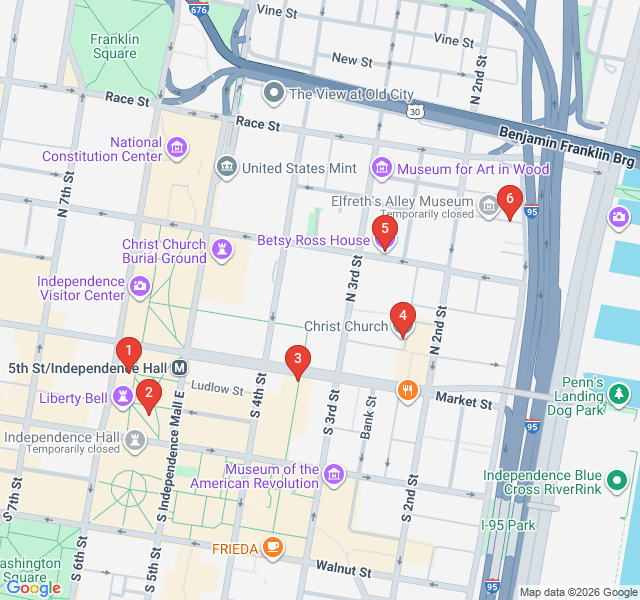
Numbers indicate the order of stops on the tour
Start exploring with Zigway at the Liberty Bell Center. This 2,000-pound bell is more than just a piece of metal; it is a global symbol of freedom. Originally cast in London in 1752, it famously cracked during its first test ring in Philadelphia. While the inscription from Leviticus, 'Proclaim Liberty throughout all the land,' was meant to mark the 50th anniversary of William Penn’s Charter of Privileges, the bell became a powerful icon for abolitionists and suffragettes in the centuries that followed. Today, it sits in a glass pavilion, perfectly aligned with Independence Hall in the background. Take a moment to notice the fine details of the crack and the names of the founders etched into the rim.
Step into the heart of the American Revolution. This park is the site where the United States was born. Independence Hall, the centerpiece of the park, saw the signing of both the Declaration of Independence in 1776 and the U.S. Constitution in 1787. As you walk across the grassy mall, imagine the intense debates that occurred behind those red-brick walls. The park also includes Congress Hall, where the first two presidential inaugurations outside of New York took place. The architecture here reflects the Georgian style popular in the 18th century, emphasizing symmetry and order—values the Founding Fathers hoped to instill in their new government. It is a peaceful space today, but it was once the most radical spot on earth.
This stop honors Philadelphia’s most famous polymath: Benjamin Franklin. Rather than a traditional house museum, you will find a striking steel 'ghost structure' designed by architect Robert Venturi. This frame outlines the original footprint of Franklin’s mansion, which was demolished in the 1810s. Below the courtyard lies an underground museum, and nearby is the B. Free Franklin Post Office, the only colonial-themed post office operated by the U.S. Postal Service. Franklin lived here during the Continental Congress and the Constitutional Convention. As you explore the court, look for the 'viewing ports' that allow you to see the original foundation fragments of the home where Franklin tinkered with his many inventions.
Known as 'The Nation’s Church,' this stunning example of Georgian architecture was the tallest building in North America until 1810. Founded in 1695, the current building dates back to 1744. Its pews have held historical giants including George Washington, Benjamin Franklin, and Betsy Ross. The interior is remarkably preserved, featuring an original wine-glass pulpit and a baptismal font used since the 1300s, brought over from England. The church’s spire was funded in part by a lottery organized by Benjamin Franklin. This site represents the intersection of religious freedom and political revolution, as many of the church’s vestrymen were also signers of the Declaration of Independence.
Welcome to the home of the woman credited with sewing the first American flag. While historians debate the exact details of the story, the legend of Betsy Ross remains a cornerstone of American folklore. The house itself is a quintessential 18th-century Philadelphia 'trinity' house—small, narrow, and bustling with activity. Ross was a professional upholsterer who supposedly took George Washington’s rough sketch of a flag and suggested changing the stars from six points to five because they were easier to cut. Even if the legend is partly myth, the house offers a fascinating look at the working-class life of women during the Revolutionary era, showing how domestic skills contributed to the war effort.
Finish your walking route on Elfreth's Alley, the oldest continuously inhabited residential street in America. These 32 houses, built between 1720 and 1830, were home to the tradespeople who built Philadelphia—blacksmiths, silversmiths, and glassblowers. The narrow cobblestone path and colorful shutters transport you back three centuries. Unlike the grand mansions of the wealthy, these homes were modest, multi-use spaces where families lived and worked. Pay attention to the 'busybody' mirrors on the upper windows, designed to let residents see who was at the door without being seen. It is a living neighborhood, so while the street is public, the houses remain private residences, preserving the intimate spirit of old Philadelphia.
Download Zigway to experience "Birthplace of a Nation: Revolutionary Philadelphia" with AI-powered audio narration. Walk at your own pace while stories unfold around you.
 Easy
EasyPhiladelphia, United States
Discover the flavors of South Philly on this self-guided walk through the historic Italian Market and the iconic Cheesesteak Vegas.
 Easy
EasyPhiladelphia, United States
Discover colonial elegance on this self-guided walk through Philadelphia's most historic residential neighborhood, from grand manors to secret alleys.
 Easy
EasyPhiladelphia, United States
Explore Philadelphia's Gilded Age masterpieces, from the world's largest masonry building to historic opera houses, on this architectural stroll.
 Moderate
Philadelphia, United States
Explore Philadelphia’s rich literary heritage on this self-guided walk from Franklin’s library to the dark world of Edgar Allan Poe.
 Easy
EasyKrakow, Poland
Uncover Krakow's legendary past on this self-guided walk from literary monuments to the fire-breathing Wawel Dragon.
 Easy
EasyInnsbruck, Austria
Uncover the myths and legends of Innsbruck on this self-guided walk through the historic Altstadt and beyond.
 Easy
EasySalzburg, Austria
Discover the 'Rome of the North' on this self-guided walk through the Baroque squares and monumental legacy of Salzburg’s Prince-Archbishops.
 Easy
EasyNairobi, Kenya
Explore Nairobi's architectural evolution from colonial-era landmarks to iconic Brutalist skyscrapers on this historic self-guided walking route.
 Easy
EasyNew York City, United States
Explore the golden age of Manhattan architecture on this self-guided walk through Midtown's iconic Art Deco skyscrapers and historic landmarks.
 Easy
EasyNew York City, United States
Discover the literary legends, jazz haunts, and revolutionary history of Greenwich Village on this immersive self-guided walking route.
 Easy
EasyNew York City, United States
Explore Manhattan's transformation on this self-guided walk from the High Line to Hudson Yards.
 Easy
EasyNew York City, United States
Discover the world's finest cast-iron architecture and the evolution of fashion on this self-guided walking route through NYC's iconic SoHo district.
