Cape Town’s V&A Waterfront is more than a world-class shopping destination; it is the beating heart of the city’s maritime history. This self-guided walk invites you to peel back the layers of a working harbor that has evolved over centuries, from a Dutch colonial outpost to a modern cultural hub. As you begin your neighborhood stroll in the Silo District, you will encounter the monumental Zeitz MOCAA, a structure that once stored the region's grain and now houses the world's largest collection of contemporary African art. This transition from industrial utility to creative expression sets the tone for the entire walking route. Following the waterfront’s edge, you’ll discover the remains of the Chavonnes Battery, an 18th-century fortification once hidden beneath the modern city. The route then leads to the iconic Victorian Gothic Clock Tower, a bright red beacon of the harbor's 19th-century peak. This neighborhood stroll captures the essence of Cape Town's identity, blending the salty grit of a functional port with the polished elegance of a premier tourist destination. You will see active vessels alongside historic landmarks, illustrating how the city’s past and present coexist. As you explore independently, you’ll pass through Nobel Square, where the legacies of South Africa’s peacemakers are immortalized in bronze. The path concludes at the Robinson Dry Dock, an engineering marvel from 1882 that remains one of the oldest operating dry docks in the world. This walking tour Cape Town provides an intimate look at the engineering feats and social history that shaped the Table Bay harbor. Whether you are an architecture enthusiast or a history buff, this walking route offers a fascinating perspective on how a colonial harbor transformed into a global icon.
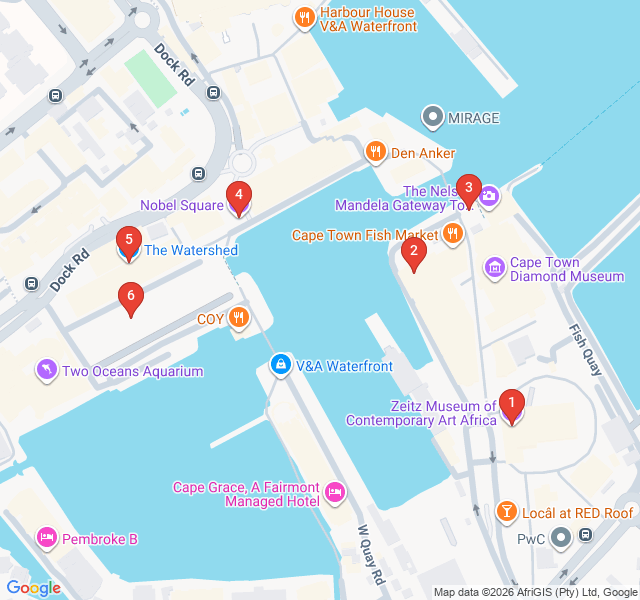
Numbers indicate the order of stops on the tour
Your self-guided walk begins at the Silo District, dominated by the Zeitz MOCAA. This building was once the tallest in Sub-Saharan Africa, serving as a grain silo complex from 1924 until 2001. Architect Thomas Heatherwick transformed the industrial structure by carving out a massive atrium shaped like a grain of corn. The 42 concrete tubes that once held grain now house galleries and a luxury hotel. Notice the unique 'pillow' windows that reflect the Cape Town sky. This site represents the perfect marriage of Cape Town's industrial past and its creative future.
Buried for over 140 years, the Chavonnes Battery was rediscovered during the redevelopment of the Waterfront. Built by the Dutch East India Company in 1724, this was once one of the most powerful coastal fortifications in the Cape. As you walk through the museum area, you can see the original stone masonry that stood against the sea for centuries. It served as a defense point, a prison, and even a hospital. The battery is a stark reminder of the Cape's strategic importance on the maritime route to the East.
The bright red Clock Tower is perhaps the most recognizable landmark in the harbor. Completed in 1882, this Victorian Gothic structure originally served as the Port Captain’s Office. Inside, it featured a tide gauge and a mechanism to inform ships of the water level. The second floor was a reading room for ship captains. Its striking color and ornate design were intended to demonstrate the prosperity of the Cape Colony during the height of the British Empire's influence on global trade.
Step into Nobel Square, a space dedicated to South Africa's four Nobel Peace Prize laureates: Albert Luthuli, Desmond Tutu, F.W. de Klerk, and Nelson Mandela. The larger-than-life bronze statues are arranged in a semicircle, symbolizing their collective contribution to democracy and peace. Behind them, the 'Peace and Democracy' sculpture by Noria Mabasa represents the people of South Africa. This square is a central gathering point where the gravity of the nation's history meets the vibrant energy of the modern waterfront.
The Watershed is a prime example of adaptive reuse. What was once a cavernous harbor warehouse is now a light-filled market for African design and craft. As you walk through, look up at the industrial steel beams and high ceilings that hint at its previous life as a storage facility for cargo. Today, it serves as an incubator for local entrepreneurs. It connects the maritime heritage of the harbor with the contemporary economy of the city, focusing on sustainability and local craftsmanship.
Concluding your walking route is the Robinson Dry Dock. Opened in 1882, it is the oldest operating dry dock of its kind in the world. Named after Sir Hercules Robinson, the Governor of the Cape Colony, this facility was a feat of 19th-century engineering, constructed from local stone. If you are lucky, you might see a vessel currently under repair, supported by massive wooden blocks. The dock has been in continuous use for over 140 years, proving that while the Waterfront has become a tourist destination, it remains a vital, working port.
Download Zigway to experience "Working Harbor: The V&A Waterfront’s Maritime Past" with AI-powered audio narration. Walk at your own pace while stories unfold around you.
 Moderate
Cape Town, South Africa
Explore the vibrant murals and creative hubs of Woodstock on this self-guided neighborhood stroll through Cape Town's artistic heart.
 Easy
EasyCape Town, South Africa
Discover the heritage of Cape Town on this self-guided audio walk through the historic Company’s Garden and its surrounding landmarks.
 Easy
EasyCape Town, South Africa
Explore Cape Town's bohemian heart and scientific heritage on this self-guided walk through the eclectic and historic Observatory neighborhood.
 Easy
EasyCape Town, South Africa
Explore the resilient spirit of District Six on this self-guided walk through Cape Town’s most moving historical landscape.
 Easy
EasyWarsaw, Poland
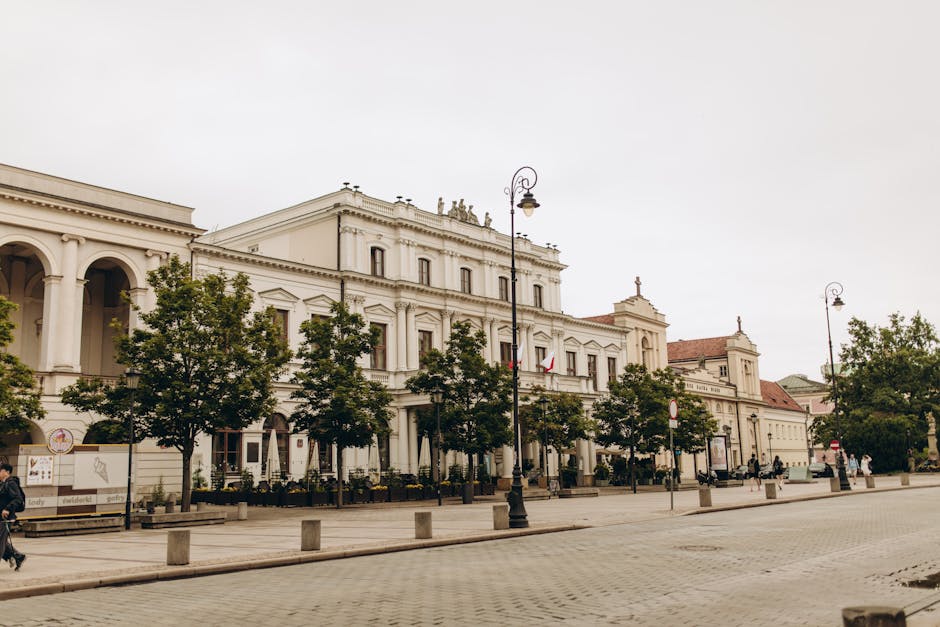
Explore the 'Polish Versailles' at your own pace. Discover Baroque architecture, royal history, and stunning gardens on this self-guided walk.
 Moderate
Helsinki, Finland
Explore the 'Gibraltar of the North' on this independent walking route through the historic bastions and hidden gardens of Suomenlinna Sea Fortress.
 Moderate
Gothenburg, Sweden
Discover Gothenburg’s maritime soul on this self-guided walk from the historic Central Station to the scenic riverfront at Stenpiren.
 Easy
EasyGothenburg, Sweden
Explore Gothenburg's maritime soul on this self-guided walk from historic shipyards to sleek modern piers and iconic industrial landmarks.
 Easy
EasyJohannesburg, South Africa
Explore Johannesburg's cultural soul on this self-guided walk through Newtown’s historic theaters, jazz venues, and powerful migrant labor museums.
 Easy
EasyJohannesburg, South Africa
Discover the 'City of Gold' on this self-guided walk through Johannesburg’s historic mining district, from Gandhi Square to Mandela’s law office.
 Moderate
Johannesburg, South Africa
Explore the creative soul of Johannesburg on this self-guided walk through Melville’s iconic bookstores, cafes, and ancient ridges.
 Easy
EasyJohannesburg, South Africa
A sensory self-guided walk through Johannesburg's Indian district, featuring aromatic spices, legendary street food, and rich anti-apartheid history.
