San Francisco’s skyline is a living museum, a vertical timeline that tells the story of a city constantly reinventing itself. This self-guided walk invites you to explore the heart of the Financial District, where the grand elegance of the early 20th century meets the glass-and-steel ambition of the tech era. Starting at the legendary Palace Hotel, you will witness the resilience of a city that rose from the ashes of the 1906 earthquake to become a global hub of innovation. This neighborhood stroll isn't just about height; it’s about the intricate details of terracotta facades, the pioneering use of glass, and the bold geometric shapes that define the West Coast's most famous profile. On this walking route, you’ll encounter the Hallidie Building, a structure that predicted the future of architecture with the world’s first glass curtain wall, and the Shell Building, an Art Deco masterpiece that glows with 1920s optimism. As you move toward the modern era, the Salesforce Tower and the Transamerica Pyramid provide a striking contrast, showcasing how San Francisco continues to reach for the clouds while honoring its historic roots. Whether you are an architecture enthusiast or a curious traveler, this self-guided adventure offers the flexibility to stop for a coffee in a hidden POPOS (Privately Owned Public Open Space) or linger under the gilded ceilings of a historic lobby. This walking tour San Francisco experience allows you to look up and discover the stories etched into the stone and glass of the city’s most iconic landmarks at your own pace.
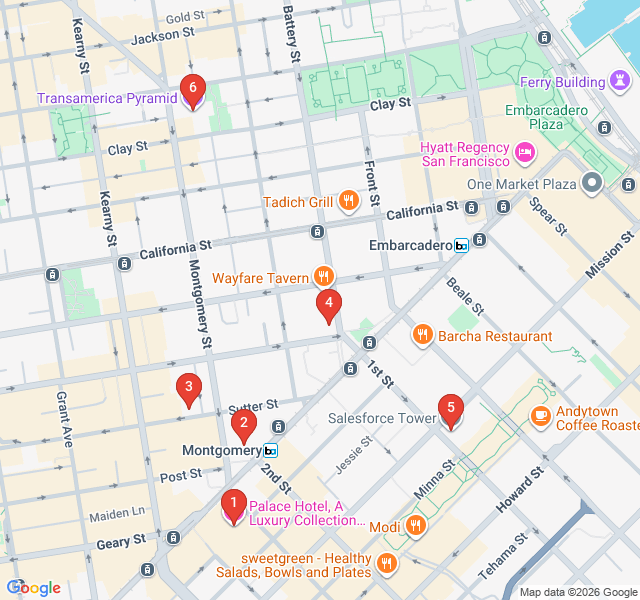
Numbers indicate the order of stops on the tour
Begin your self-guided walk at the Palace Hotel, a symbol of San Francisco’s enduring spirit. Originally opened in 1875 and rebuilt after the 1906 earthquake, this hotel was once the largest and most luxurious in the world. Step inside to see the Garden Court, a breathtaking space featuring a massive leaded-glass ceiling and Austrian crystal chandeliers. It was here that President Woodrow Wilson gave speeches in support of the League of Nations. Look for the 'Maxfield Parrish' painting, 'The Pied Piper of Hamelin,' in the hotel’s famous bar. This building represents the Beaux-Arts style that defined the city’s reconstruction, blending classical elegance with the modern needs of a growing metropolis.
As you walk down Market Street, look up at the Hobart Building. Completed in 1914, it was designed by Willis Polk, a man known for his architectural versatility. For a brief period, this was the second-tallest building in San Francisco. Its slender, sculpted form is unique, featuring a mix of Italian Renaissance and neoclassical elements. Notice the exquisite terracotta ornamentation and the way the building seems to lean into its narrow lot. It is said that Polk was given just 11 months to complete the design and construction, a frantic pace that reflected the city’s post-earthquake boom. It remains one of the most beloved 'old-school' skyscrapers in the Financial District.
The Hallidie Building is a true hidden gem for architecture lovers. Designed by Willis Polk and completed in 1918, this building is credited with having the world’s first glass curtain wall. This means the glass exterior is suspended in front of the structural frame, a technique that is now standard for skyscrapers globally but was revolutionary at the time. Named after Andrew Smith Hallidie, the inventor of the cable car, the building features intricate Gothic-style ironwork that contrasts beautifully with the modern transparency of the glass. It serves as a bridge between the heavy masonry of the past and the light-filled structures of the future.
The Shell Building is San Francisco’s Art Deco crown jewel. Completed in 1929, just before the Great Depression, it captures the jazz-age optimism of the era. Architect George Kelham designed the building with a 'set-back' style, which was required by zoning laws to allow sunlight to reach the streets below. If you look closely at the upper floors, you’ll see stylized shells and oceanic motifs cast in terracotta, a nod to the Shell Oil Company which commissioned the tower. The lobby is equally stunning, featuring bronze elevators and geometric patterns that make it one of the most photographed interiors in the city.
Standing at 1,070 feet, the Salesforce Tower is the tallest building in San Francisco and a defining feature of the modern skyline. Designed by Pelli Clarke Pelli and completed in 2018, its soft, tapering silhouette is meant to be non-intrusive despite its massive scale. The tower is a marvel of sustainable engineering, featuring an advanced water recycling system and innovative ventilation. At night, the top nine floors transform into a massive light sculpture by artist Jim Campbell, displaying low-resolution videos of city life. This tower represents the shift of the city’s 'center of gravity' toward the South of Market tech corridor.
No walking route of San Francisco architecture is complete without the Transamerica Pyramid. When it was proposed in the late 1960s, it was met with fierce public opposition; critics called it a 'dunce cap.' However, since its completion in 1972, it has become an inseparable part of the city’s identity. Architect William Pereira chose the pyramid shape to allow more light to reach the streets below—a modern take on the older set-back laws. The building is incredibly resilient, having swayed significantly but remained undamaged during the 1989 Loma Prieta earthquake. Its quartz-covered concrete facade gives it a distinct white glow that stands out against the blue Bay fog.
Download Zigway to experience "Art Deco to Skyscrapers: Downtown's Architectural Evolution" with AI-powered audio narration. Walk at your own pace while stories unfold around you.
 Easy
EasySan Francisco, United States
Explore the epicenter of LGBTQ+ history on this self-guided walk through San Francisco's Castro district, from Harvey Milk's legacy to iconic cinema.
 Easy
EasySan Francisco, United States
Explore the historic Barbary Coast waterfront, from the iconic Ferry Building to the vintage arcades and sea lions of the Embarcadero.
 Moderate
San Francisco, United States
Discover hidden art, cinematic history, and historic forts on this self-guided walk through the Presidio’s lush forests and coastal trails.
 Easy
EasySan Francisco, United States
Explore SoMa’s transformation from industrial warehouses to a global tech and art hub on this self-guided San Francisco neighborhood stroll.
 Easy
EasyNairobi, Kenya
Discover Nairobi's iconic skyline on this self-guided architecture walk through the CBD’s most famous modernist and Brutalist landmarks.
 Easy
EasyNairobi, Kenya
Explore Nairobi's architectural evolution from colonial-era landmarks to iconic Brutalist skyscrapers on this historic self-guided walking route.
 Easy
EasyGdansk, Poland
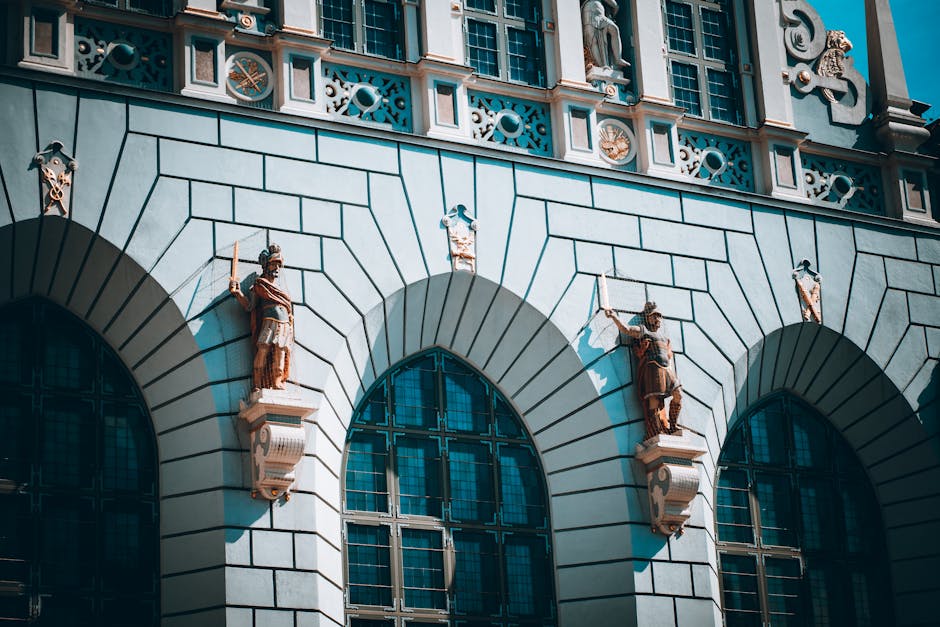
Discover the opulent Royal Way of Gdansk at your own pace. Explore Hanseatic history, gilded architecture, and the iconic Neptune's Fountain.
 Easy
EasyGothenburg, Sweden
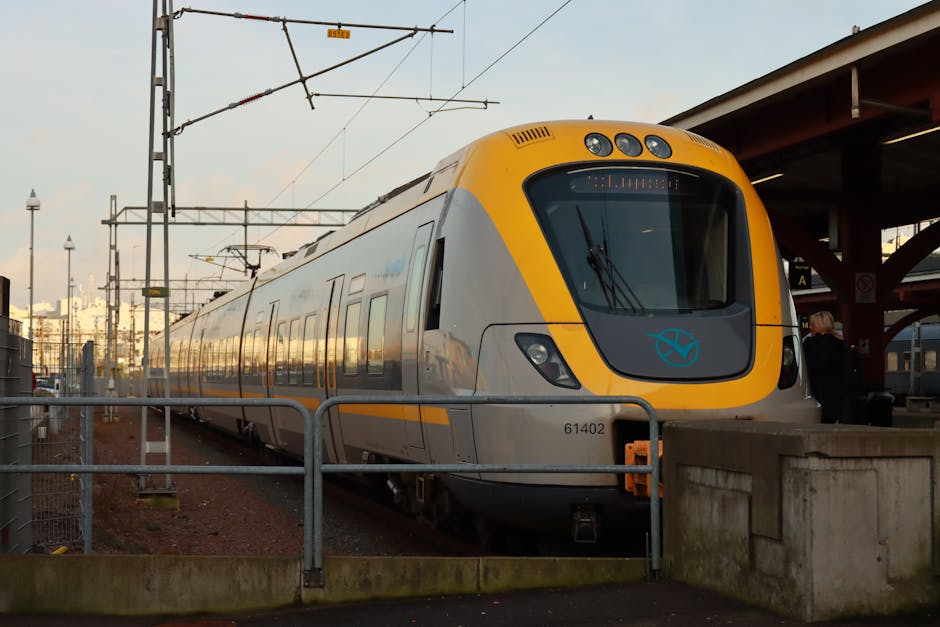
Discover Gothenburg’s 17th-century Dutch foundations, historic canals, and military fortifications on this self-guided architectural walk.
 Easy
EasyNew York City, United States
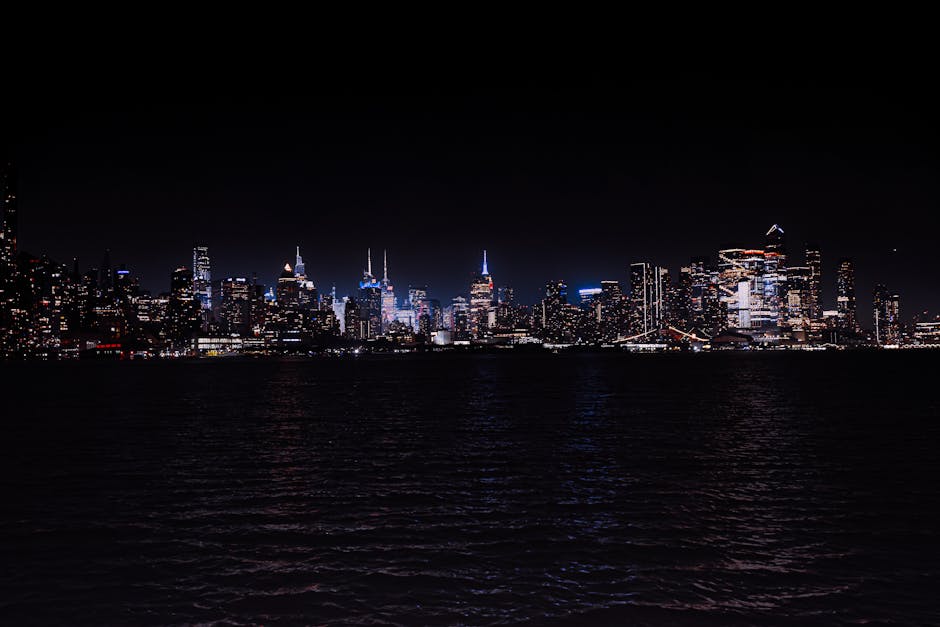
Explore the golden age of Manhattan architecture on this self-guided walk through Midtown's iconic Art Deco skyscrapers and historic landmarks.
 Easy
EasyNew York City, United States
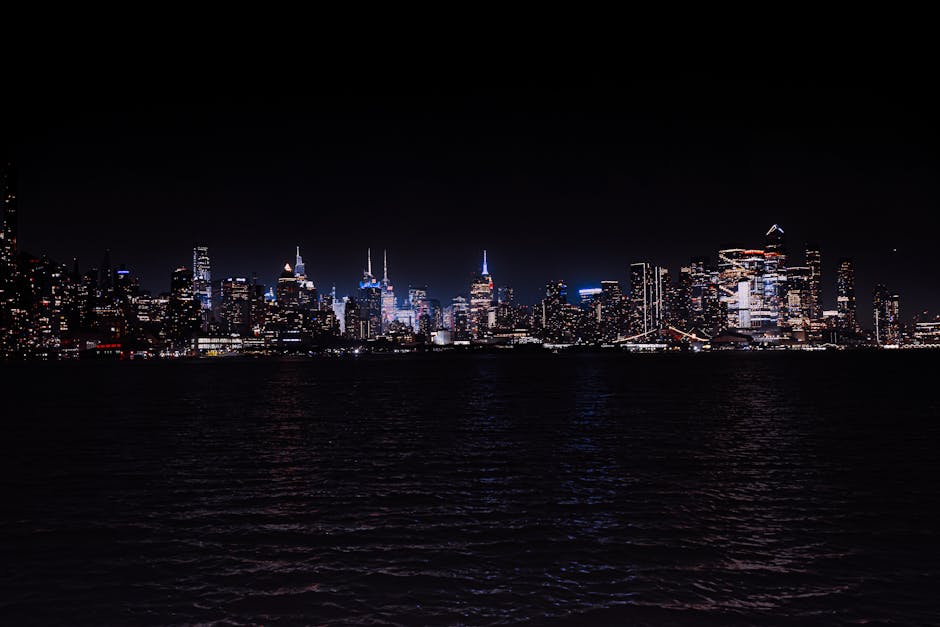
Discover the literary legends, jazz haunts, and revolutionary history of Greenwich Village on this immersive self-guided walking route.
 Easy
EasyNew York City, United States
Explore Manhattan's transformation on this self-guided walk from the High Line to Hudson Yards.
 Easy
EasyNew York City, United States
Discover the world's finest cast-iron architecture and the evolution of fashion on this self-guided walking route through NYC's iconic SoHo district.
