Step away from the bustling carriage routes and discover the intimate side of the Holy City on this self-guided walk through Charleston’s most enchanting secret gardens and narrow cobblestone passages. The South of Broad neighborhood is famous for its grand mansions, but its true soul lies in the whisper-thin alleys and hidden pedestrian paths that most travelers overlook. This neighborhood stroll invites you to slow down and notice the intricate details: the scent of jasmine trailing over high brick walls, the uneven texture of 18th-century ballast stones beneath your feet, and the quiet seclusion of gardens tucked away from modern traffic. On this walking route, you will experience the legendary charm of spots like Stolls Alley and Bedons Alley, where the city feels more like a European village than a modern American town. You will explore the historic Gateway Walk, a curated path through churchyards and cemetery gardens that offers a peaceful retreat in the heart of the historic district. This photography-focused journey is perfect for those who want to capture the play of light on pastel stucco and wrought iron. While many visitors opt for a traditional walking tour Charleston offers, this independent exploration allows you to linger as long as you like at each iron gate or flowering trellis. Highlights of this travel experience include the rugged stones of Longitude Lane and the overgrown, romantic beauty of the Unitarian Church graveyard—a place where nature and history have formed a hauntingly beautiful partnership. Whether you are a first-time visitor or a long-time resident, these hidden gems offer a fresh perspective on the city's architectural heritage. This self-guided walking tour Charleston journey provides the historical context you need to understand how these paths evolved from colonial trade routes to the tranquil residential escapes they are today. Prepare to discover the quiet, green heart of the South's most historic city at your own pace.
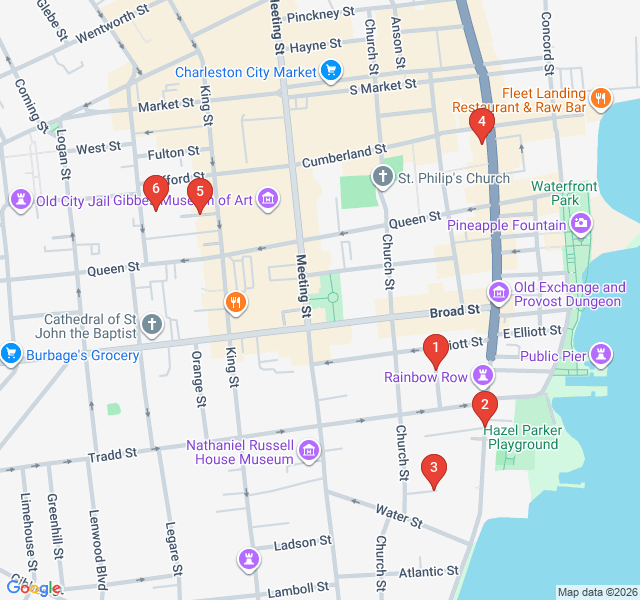
Numbers indicate the order of stops on the tour
Begin your neighborhood stroll at Bedons Alley, one of the most picturesque narrow passages in the city. Connecting Elliott Street to Tradd Street, this alley represents the intimate scale of early Charleston. Originally a bustling commercial lane lined with warehouses and tenements, it has since been transformed into a quiet residential sanctuary. As you walk, notice the variety of building materials, from traditional Charleston brick to smooth stucco. The alley is named for the Bedon family, who were early French Huguenot settlers. This is a perfect spot to observe how the city has preserved its colonial footprint while adapting to modern residential life.
Next, find yourself on Longitude Lane, perhaps the most famous 'hidden' street in Charleston. What makes this lane special is its pavement—it is one of the few remaining streets surfaced with Belgian blocks and river stones, originally used as ballast in trading ships. The name 'Longitude' is a nod to the city's maritime history, though some local legends suggest it was simply a play on words regarding its length. Look for the pomegranate trees and lush greenery spilling over the garden walls. This lane provides a sense of the rugged, unpolished beauty of the 18th-century city before modern paving took over.
Step into Stolls Alley, a path so narrow you can almost touch the walls on both sides. Named for Justinus Stoll, who built a house here in the mid-1700s, this alley connects the high-society East Bay Street to the more secluded residential interior. As you walk toward the harbor side, the alley narrows significantly. Pay attention to the iron gates; many hide private courtyards that exemplify the Charleston 'outdoor room' philosophy. The transition from the red brick of the alley to the bright light of the street ends is a favorite moment for photographers exploring the city.
As you move north, you encounter Lodge Alley. This area was once the heart of the French Quarter's commercial district. The 'Lodge' in the name refers to the Masonic Lodge that was located here in the 1700s. The inn itself is housed in a series of restored 19th-century warehouses. This stop highlights the city's successful efforts in adaptive reuse—taking old industrial and commercial spaces and turning them into beautiful accommodations while keeping the original brickwork and timber beams intact. It serves as a reminder that Charleston’s beauty is a result of centuries of layers, rather than a single era.
Now, enter the Gateway Walk, a true hidden gem created by the Garden Club of Charleston in 1930. This informal trail meanders through the graveyards and gardens of some of the city's oldest churches. It was designed by Mrs. C.P. Huntington to celebrate the city’s 250th anniversary. As you pass through the wrought-iron gates, you are walking through the history of Charleston's religious diversity. The path is intended to be a 'walk of peace,' and even on a busy afternoon, the high walls and thick canopy of live oaks provide a sound barrier against the city noise. It is one of the most serene experiences in the historic district.
Your final stop is the Unitarian Church graveyard. Unlike the manicured lawns of many historic cemeteries, this garden is intentionally left 'wild' to honor the cycle of life and nature. The church itself is a masterpiece of Fan Vaulted Gothic architecture, but the grounds are the main attraction for nature lovers. Follow the winding dirt paths through overgrown ferns, tangled vines, and ancient tombstones. It feels like a secret world where time has stood still. This site perfectly encapsulates the theme of our walk: the intersection of man-made history and the persistent, beautiful encroachment of the natural world.
Download Zigway to experience "Secret Gardens and Cobblestone Alleys" with AI-powered audio narration. Walk at your own pace while stories unfold around you.
 Easy
EasyCharleston, United States
Explore the elegant streets of Harleston Village on this self-guided stroll through Charleston's most historic residential enclave.
 Easy
EasyCharleston, United States
Explore the neon lights and culinary gems of Upper King. Discover Charleston's modern nightlife and cultural evolution on this self-guided stroll.
 Easy
EasyCharleston, United States
Discover Charleston’s rich literary history on this self-guided walk past historic libraries, authors' homes, and iconic bookstores.
 Moderate
Charleston, United States
Discover the profound Gullah-Geechee influence and African American history of Charleston on this moving and educational self-guided walking route.
 Easy
EasyWarsaw, Poland
Discover the hidden courtyards and grand pre-war architecture of Warsaw's most atmospheric neighborhood on this self-guided stroll.
 Easy
EasySalzburg, Austria
Discover Salzburg's oldest medieval alley, the birthplace of the 'Silent Night' author, and breathtaking views on this quiet self-guided walk.
 Easy
EasyNairobi, Kenya
Discover Nairobi's iconic skyline on this self-guided architecture walk through the CBD’s most famous modernist and Brutalist landmarks.
 Easy
EasyKrakow, Poland
Explore the prestigious Jagiellonian University district, featuring Neo-Gothic architecture, Baroque churches, and Krakow's hidden scholarly gems.
 Easy
EasyNew York City, United States
Explore the golden age of Manhattan architecture on this self-guided walk through Midtown's iconic Art Deco skyscrapers and historic landmarks.
 Easy
EasyNew York City, United States
Discover the literary legends, jazz haunts, and revolutionary history of Greenwich Village on this immersive self-guided walking route.
 Easy
EasyNew York City, United States
Explore Manhattan's transformation on this self-guided walk from the High Line to Hudson Yards.
 Easy
EasyNew York City, United States
Discover the world's finest cast-iron architecture and the evolution of fashion on this self-guided walking route through NYC's iconic SoHo district.
