Step into a world where historic red-brick warehouses meet the whimsical curves of Finnish Art Nouveau. This self-guided walk through the Katajanokka neighborhood reveals a side of Helsinki that feels distinct from the rest of the city, largely because it is separated by a narrow canal. As you explore independently, you will encounter the peninsula's unique blend of maritime grit and architectural elegance. The route begins near the bustling Market Square and leads you toward the towering Uspenski Cathedral, the largest Orthodox church in Western Europe, before diving into the heart of the 'Jugendstil' district. Katajanokka boasts one of the highest concentrations of Art Nouveau architecture in the world, with facades adorned with mythical creatures, nature motifs, and stone carvings that tell the story of a nation searching for its identity at the turn of the 20th century. This neighborhood stroll also uncovers the area's darker history at a former prison turned into a stylish hotel, and its industrial roots along the waterfront warehouses. Whether you are interested in the evolution of Finnish design or simply want to enjoy a peaceful walk with views of the Baltic Sea and the city's fleet of icebreakers, this walking tour Helsinki provides the perfect pace to soak in the atmosphere. The journey concludes at the tip of the peninsula, where the maritime heritage of the Finnish Navy and the harbor come to life. Discovering Katajanokka at your own leisure allows you to pause for coffee in a converted warehouse or linger by the sea, making it an essential experience for those who appreciate history and design away from the main tourist crowds.
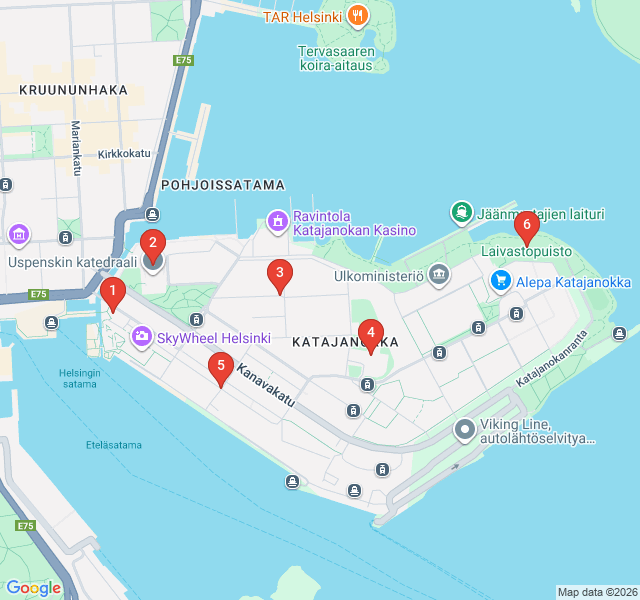
Numbers indicate the order of stops on the tour
Begin your exploration at the gateway to Katajanokka. While this location offers a virtual flight over the city's landmarks, it serves as a perfect starting point to understand the scale of Helsinki before you set off on foot. From here, you can see the bridge connecting the city center to the peninsula. Notice the contrast between the modern amenities and the historic skyline ahead. This area was once a humble fishing village and later a military zone, but today it represents the sophisticated maritime character of the Finnish capital. Take a moment to look toward the harbor before heading toward the red-brick heights of the cathedral.
Perched on a rocky outcrop, the Uspenski Cathedral is an unmistakable landmark of Helsinki’s skyline. Completed in 1868, it serves as a powerful reminder of Finland's period as an autonomous Grand Duchy of the Russian Empire. The red bricks used in its construction were actually recycled from the Bomarsund fortress in Åland, which was destroyed during the Crimean War. Look up at the thirteen golden cupolas, representing Christ and the twelve apostles. The interior, though often quiet, is filled with intricate icons and incense-heavy air, reflecting the rich traditions of Eastern Orthodox Christianity. It stands in stark contrast to the white Lutheran Cathedral visible across the water.
Welcome to what many consider the most beautiful street in Helsinki. Luotsikatu is a living gallery of Finnish Art Nouveau, or 'Jugendstil.' As you walk, look closely at the doorways and window frames. You will see carvings of owls, squirrels, pinecones, and floral patterns—motifs drawn from Finnish folklore and nature. This style emerged around 1900 as Finnish architects sought to create a national identity separate from Swedish or Russian influences. The building at number 4, known as Tallberg, is a masterpiece designed by the famous firm Gesellius, Lindgren, and Saarinen. The pastel colors and asymmetrical shapes make this street a favorite for photographers.
This impressive red-brick building has a surprising past. From 1837 until 2002, it served as the Helsinki County Prison and the main remand prison for the city. It once housed high-profile inmates, including a former Prime Minister. After a massive renovation, it reopened as a hotel, but much of the original structure remains. The central corridor still retains the look of a 19th-century prison block, and the thick perimeter walls are a reminder of its former life. It is a fascinating example of adaptive reuse, turning a place of confinement into a space of hospitality while preserving the somber architectural heritage of the district.
Walk along the quay to experience Katajanokka’s maritime soul. The long rows of red-brick warehouses, known as Wanha Satama (The Old Harbour), were once the center of Helsinki's trade and shipping. Today, they have been converted into restaurants, offices, and event spaces, but they still retain their industrial charm. From this vantage point, you can watch the massive ferries depart for Estonia and Sweden, or look across the water at the Allas Sea Pool and the Market Square. The breeze here is fresh, and the sound of rigging clinking against masts provides a constant soundtrack to this part of the neighborhood.
Your walk ends at the quiet, northern tip of the peninsula in Fleet Park. This area is steeped in naval history; the Finnish Navy headquarters are located nearby. If you look toward the water, you may see the massive, powerful hulls of the Finnish icebreaker fleet. These ships are essential for keeping the Baltic shipping lanes open during the frozen winter months. The park itself is a peaceful spot where locals come to walk their dogs and enjoy the sea views. It’s a perfect place to reflect on the blend of architectural beauty and maritime utility that defines Katajanokka before heading back to the city center.
Download Zigway to experience "Katajanokka Art Nouveau and Maritime Heritage" with AI-powered audio narration. Walk at your own pace while stories unfold around you.
 Moderate
Helsinki, Finland
Explore Helsinki's bohemian heart. Discover historic saunas, granite churches, and the vibrant local life of the Kallio neighborhood at your own pace.
 Easy
EasyHelsinki, Finland
Discover Helsinki's oldest neighborhood on this self-guided audio walk through Kruununhaka’s historic streets, hidden courtyards, and scenic shores.
 Moderate
Helsinki, Finland
Explore the 'Gibraltar of the North' on this independent walking route through the historic bastions and hidden gardens of Suomenlinna Sea Fortress.
 Easy
EasyHelsinki, Finland
Explore Helsinki's imperial past on this self-guided stroll through the grand Neoclassical landmarks of the Kruununhaka district.
 Easy
EasyGothenburg, Sweden
Discover Gothenburg’s 17th-century Dutch foundations, historic canals, and military fortifications on this self-guided architectural walk.
 Easy
EasyNairobi, Kenya
Discover Nairobi's iconic skyline on this self-guided architecture walk through the CBD’s most famous modernist and Brutalist landmarks.
 Easy
EasyKrakow, Poland
Explore the historic heart of Kazimierz on this self-guided walk through synagogues, ancient cemeteries, and vibrant squares.
 Easy
EasyGdansk, Poland
Discover the 'Baltic Gold' on this self-guided walk through Gdansk's historic mills, massive cathedrals, and the magical Mariacka Street.
