Thessaloniki is a city where history is not confined to museums but lives in the very fabric of the streets. This self-guided walk through the city center allows you to witness the grandeur of two of the world’s greatest empires: the Roman and the Byzantine. Your journey begins at the Roman Forum, the ancient civic heart where the sounds of markets and political debate once filled the air. This neighborhood stroll then transitions into the spiritual realm at the Church of Saint Demetrius, a site of pilgrimage for over a millennium. As you navigate the route, you will see the architectural evolution of the city, from the sturdy brickwork of the Roman era to the elegant domes of Byzantine churches. The path is easy and flat, making it an ideal way to explore independently at your own pace. You will encounter the Church of Panagia Chalkeon, a hidden gem surrounded by greenery, before reaching the monumental Arch of Galerius. This victory arch, with its intricate stone reliefs, tells the story of imperial triumph in the late Roman period. Just a short distance away stands the Rotonda, a massive domed structure that has served as a temple, a church, and a mosque throughout its long life. This walking tour Thessaloniki offers is perfect for those who want to see the big hitters of the city's history without the constraints of a group. While some travelers might look for a guided tour Thessaloniki provides, this self-guided adventure gives you the freedom to stop for a coffee or spend extra time admiring the ancient mosaics. By tracing these imperial footsteps, you gain a deeper understanding of how Thessaloniki became a crossroads of cultures and a bridge between the classical and medieval worlds. The route is packed with highlights, including the underground crypt of Saint Demetrius and the towering heights of the Rotonda’s dome. It is a simple yet profound way to experience the layers of time that define this vibrant Greek city. This walking tour Thessaloniki route is designed for explorers who love history and architecture.
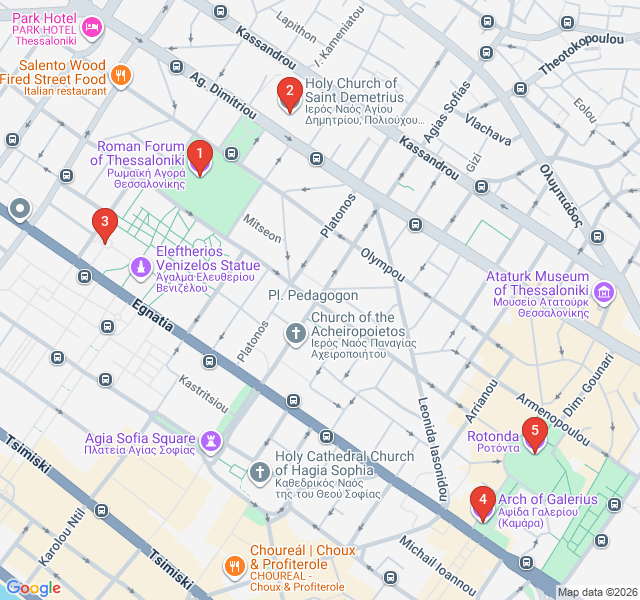
Numbers indicate the order of stops on the tour
The Roman Forum, or Ancient Agora, was the heart of Thessaloniki for nearly four centuries, beginning in the 2nd century AD. As you look over the site, you can see the remains of the two-tiered stoas that once housed the city's administrative offices and commercial shops. The most striking feature is the restored odeon, a small theater used for musical performances and civic meetings. Below the surface level lies the cryptoporticus, a series of underground corridors that provided structural support and storage space. This site was actually hidden for centuries until it was accidentally unearthed in the 1960s during excavations for a new courthouse. Today, it serves as a powerful reminder of Thessaloniki’s importance as a regional capital within the Roman Empire, where the bustle of trade and the debates of the senate defined daily life.
The Church of Saint Demetrius is not just a building; it is the spiritual heart of Thessaloniki. Dedicated to the city's patron saint, who was martyred here in 303 AD, the current structure is a beautiful example of a five-aisled basilica. Although much of the church was tragically destroyed in the Great Fire of 1917, it was meticulously restored using original materials where possible. Inside, you can find rare 5th and 7th-century mosaics that survived the flames. A highlight of this stop is the crypt, located beneath the altar, which marks the exact spot where the saint was imprisoned and killed. The atmosphere here is one of deep reverence, reflecting over fifteen centuries of continuous worship and the enduring connection between the people of Thessaloniki and their protector.
Nestled in a lush garden near the bustling Aristotelous Square, the Church of Panagia Chalkeon is a masterpiece of Middle Byzantine architecture. Completed in 1028 AD, its name translates to the Virgin of the Copper-smiths, a nod to the metalworking district that has surrounded this site for a millennium. The church is built entirely of brick, earning it the nickname The Red Church. It follows the classic cross-in-square plan, featuring four columns supporting a central dome. As you observe the exterior, notice the elegant proportions and the decorative brickwork that characterizes the Macedonian school of architecture. It stands as a serene island of history in the middle of the modern city, showcasing the transition of Thessaloniki from a late antique hub to a flourishing Byzantine center of art and faith.
The Arch of Galerius, known locally as Kamara, is perhaps the most iconic meeting point in Thessaloniki. Built in 303 AD, it was part of a massive imperial complex that included a palace and a hippodrome. The arch was commissioned to celebrate Emperor Galerius's victory over the Sassanid Persians. If you look closely at the surviving marble slabs on the pillars, you will see incredibly detailed relief carvings depicting scenes of battle, imperial ceremonies, and the Emperor himself. These carvings were intended as propaganda, projecting the power and divine favor of the Roman tetrarchy to all who passed through the gateway. Originally, the arch had eight pillars and three openings, but today only three pillars remain. It serves as a bridge between the city's Roman past and its vibrant, student-filled present.
The Rotonda is one of the most enigmatic and impressive buildings in the Mediterranean. Built around 306 AD, possibly as a mausoleum for Emperor Galerius or a temple to Zeus, its massive dome spans nearly 25 meters, making it one of the largest brick domes in the world. Its history reflects the city's own transformation: it was converted into a Christian church in the late 4th century, then into a mosque during Ottoman rule—evidenced by the surviving minaret—and finally into a museum. Inside, the 4th-century mosaics are breathtaking, featuring intricate depictions of martyrs and architectural landscapes against a shimmering gold background. The thickness of the walls, over six meters in some places, has allowed it to withstand centuries of earthquakes, standing as a testament to the architectural ingenuity of the late Roman world.
Download Zigway to experience "The Imperial Footsteps: Roman and Byzantine Landmarks" with AI-powered audio narration. Walk at your own pace while stories unfold around you.
 Moderate
Thessaloniki, Greece
Discover Thessaloniki’s creative soul on this self-guided walk through hidden alleys, vibrant murals, and iconic modern art installations.
 Easy
EasyThessaloniki, Greece
Uncover the hidden Ottoman soul of Thessaloniki. Explore ancient bathhouses, vibrant markets, and historic mosques on this self-guided audio walk.
 Easy
EasyThessaloniki, Greece
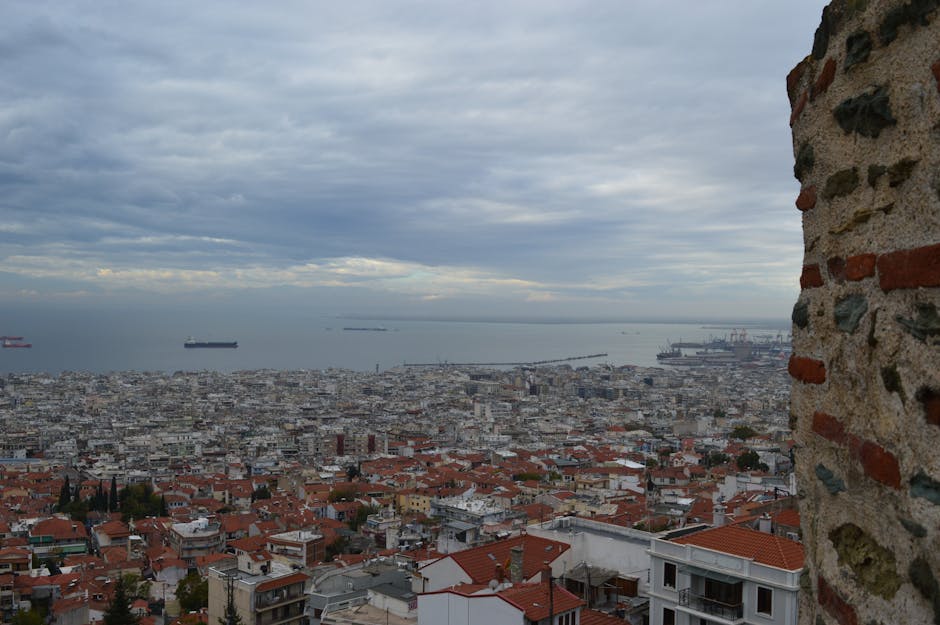
Discover how the 1917 Great Fire transformed Thessaloniki into a modern European masterpiece on this self-guided architectural walking route.
 Easy
EasyThessaloniki, Greece
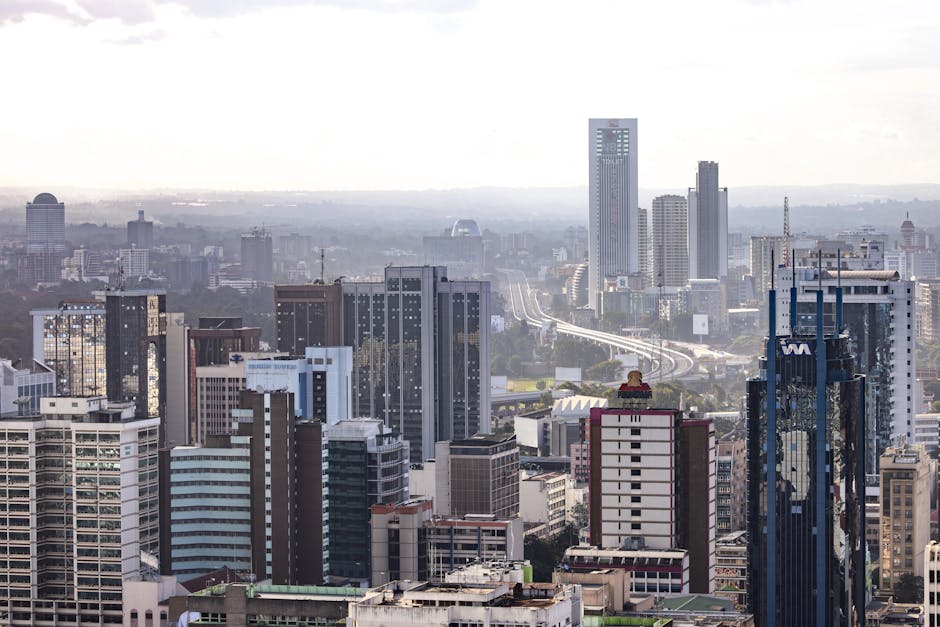
Discover the literary soul of Thessaloniki on this self-guided walk through iconic libraries, historic theaters, and the scenic waterfront.
 Easy
EasyNairobi, Kenya
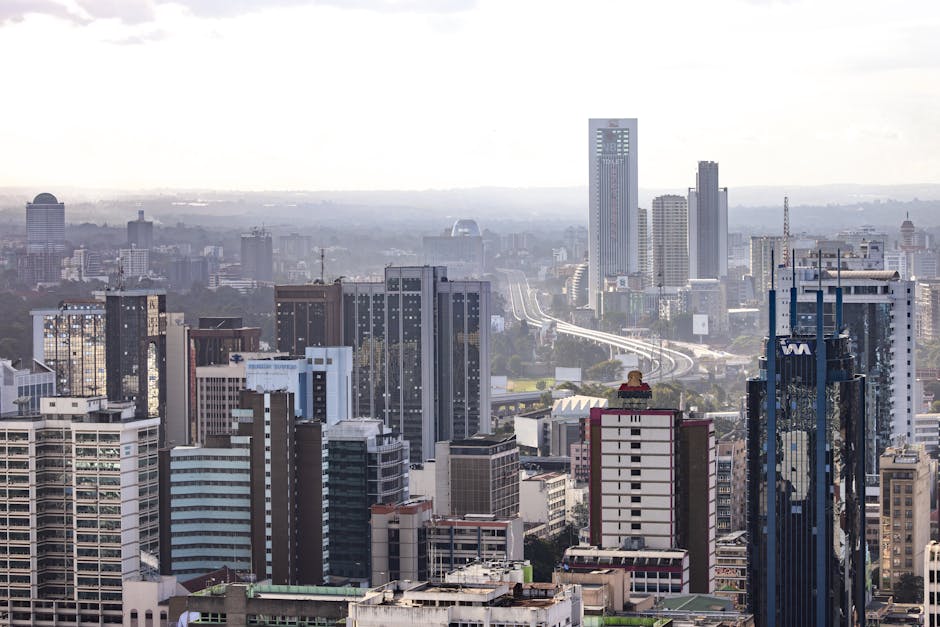
Explore Nairobi's architectural evolution from colonial-era landmarks to iconic Brutalist skyscrapers on this historic self-guided walking route.
 Easy
EasyNairobi, Kenya
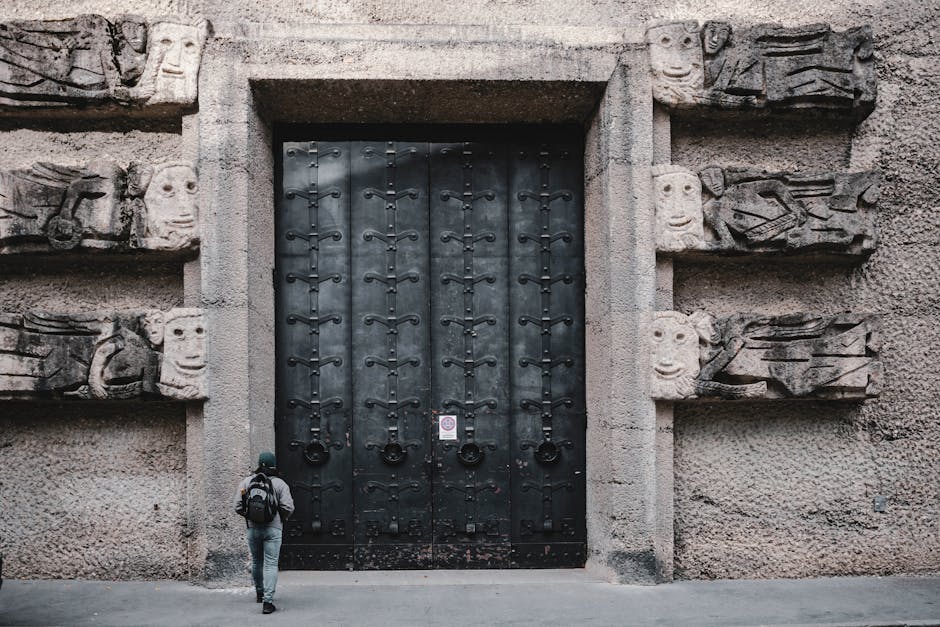
Discover Nairobi's iconic skyline on this self-guided architecture walk through the CBD’s most famous modernist and Brutalist landmarks.
 Easy
EasySalzburg, Austria
Discover the 'Rome of the North' on this self-guided walk through the Baroque squares and monumental legacy of Salzburg’s Prince-Archbishops.
 Easy
EasyGothenburg, Sweden
Discover Gothenburg’s 17th-century Dutch foundations, historic canals, and military fortifications on this self-guided architectural walk.
 Easy
EasyAthens, Greece
Explore the intersection of ancient history and industrial art on this self-guided walk through Kerameikos and the vibrant Gazi district.
 Moderate
Athens, Greece
Ascend the Hill of the Muses for breathtaking Acropolis views and ancient democratic sites on this scenic self-guided walking route in Athens.
 Moderate
Athens, Greece
Discover a hidden Cycladic village and ancient monuments on this self-guided walking route through the enchanting alleys of Plaka and Anafiotika.
 Challenging
Athens, Greece
Conquer the highest peak in Athens on this self-guided walking route through chic Kolonaki to the stunning 360-degree summit of Mount Lycabettus.
