Perched atop Jabal al-Qal'a, the highest hill in Amman, the history of Jordan’s capital unfolds in a dramatic display of stone and shadow. This self-guided walk invites you to explore the Citadel, a site inhabited since the Bronze Age, where Roman columns stand alongside Byzantine churches and Umayyad palaces. As you navigate this open-air museum, you will witness the layers of civilization that have shaped the Levant. The route begins at the very peak, offering a panoramic view of the rolling hills of Amman, before descending into the bustling heart of the old city to discover the grand architectural feats of the Roman Empire. This neighborhood stroll is a journey through time, focusing on the architectural evolution and the strategic importance of this ancient crossroads. At the Citadel, the Temple of Hercules serves as a towering reminder of Roman religious devotion, while the Umayyad Palace showcases the early Islamic era's sophisticated design. The photography opportunities here are unparalleled, especially as the golden light hits the weathered limestone of the ruins. The experience is not just about the grand structures but also the smaller details found within the Jordan Archaeological Museum, which houses some of the oldest human-made statues in existence. After exploring the heights, the walking route takes you down the steep hillsides toward the downtown basin. Here, the Roman Theater awaits, a massive 6,000-seat arena carved directly into the northern side of the hill. It remains a vibrant part of the city's cultural life today. Nearby, the smaller, more intimate Odeon Theater highlights the Roman penchant for musical and oratorical performance. This walking tour Amman experience allows you to move at your own pace, skipping the crowds of a traditional guided tour Amman and instead soaking in the atmosphere of the 'White City' independently. From the echoes of ancient cheers in the theater to the silent majesty of the ruins above, this route captures the enduring spirit of Philadelphia—the ancient name for this historic desert metropolis.
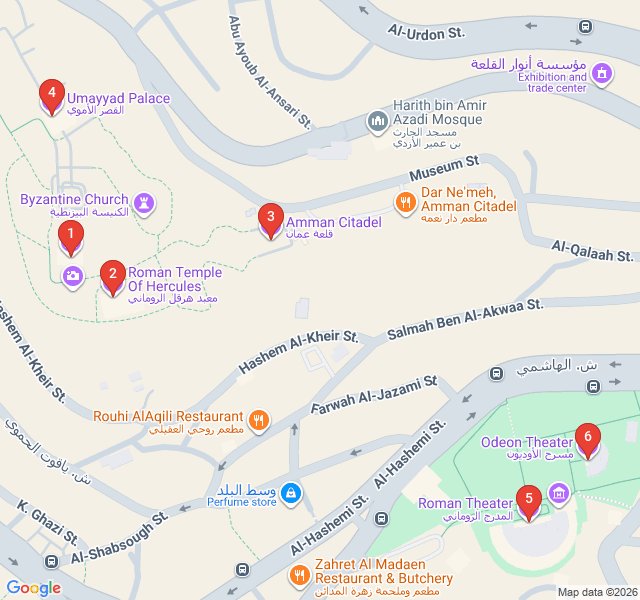
Numbers indicate the order of stops on the tour
Begin your exploration at the Jordan Archaeological Museum, located within the Citadel complex. This museum is a treasure trove of Jordanian history, spanning from the prehistoric era to the 15th century. Its most famous residents are the 'Ain Ghazal statues, which are among the oldest human forms ever created by our ancestors, dating back over 9,000 years. As you walk through the galleries, look for the unique Dead Sea Scrolls and the intricate pottery that tells the story of the many civilizations—including the Moabites and Nabataeans—who once called this land home. It provides a perfect chronological context before you step outside to see the ruins themselves.
Standing as the most iconic landmark on the Citadel hill, the Temple of Hercules was built between 161 and 166 AD during the reign of Roman Emperor Marcus Aurelius. Only a few of its massive columns have been re-erected, but they are enough to convey the sheer scale of the original structure, which was intended to be larger than any temple in Rome itself. Nearby, keep an eye out for three giant marble fingers and an elbow. These fragments belonged to a colossal statue of Hercules that likely stood over 12 meters tall. This site represents the peak of Roman architectural ambition in the ancient city of Philadelphia.
The Citadel, known locally as Jabal al-Qal'a, has been a strategic site for millennia. Evidence of occupation dates back to the Neolithic period, making it one of the world's oldest continuously inhabited places. As you wander between the Roman ruins and the Byzantine church ruins, notice how the stones of one era were often repurposed by the next. The site offers a 360-degree view of Amman, showing the dramatic contrast between the ancient ruins and the modern urban sprawl. It is the perfect place to appreciate how the city has grown across its seven original hills, with the call to prayer echoing from the mosques below.
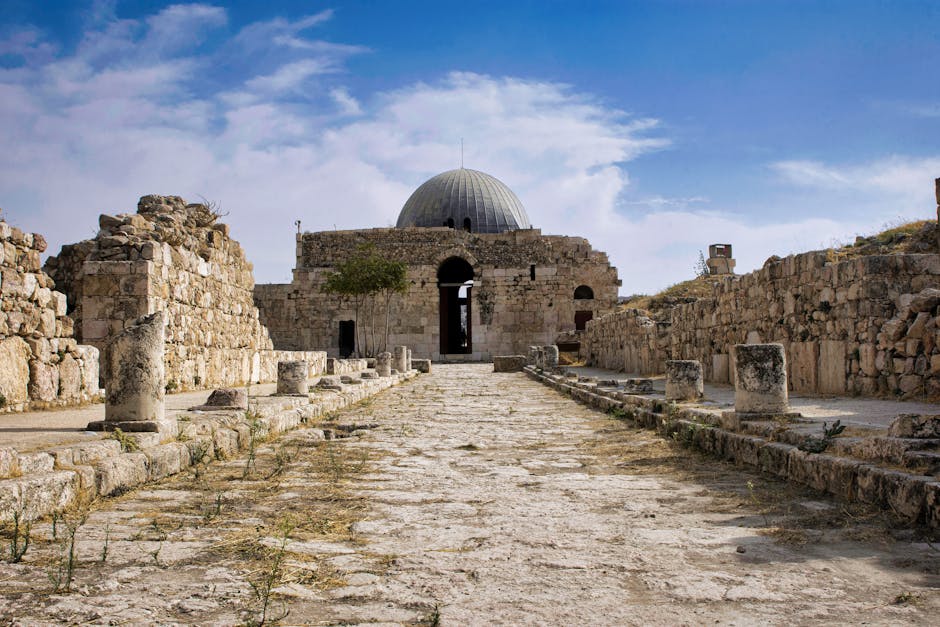
At the northern end of the Citadel lies the Umayyad Palace complex, dating from the 8th century. Unlike the Roman structures you just saw, this complex represents the early Islamic period. The most striking feature is the domed audience hall, which has been meticulously restored with a modern wooden dome. This hall served as a gateway to the governor's residence and was designed to impress visitors with its intricate carved stonework and geometric patterns. Beyond the hall, you can explore the ruins of the residential quarters and the cistern that once provided water to the hilltop community, showcasing the engineering prowess of the Umayyad Dynasty.
After descending from the Citadel, you arrive at the Roman Theater, the centerpiece of downtown Amman. Built during the 2nd century AD, this theater is carved directly into the hillside to provide stability and natural acoustics. It could once hold 6,000 spectators, divided into three tiers: the lowest for the elite, the middle for the military, and the highest for the general public. Even today, the theater is used for cultural festivals and concerts. Climb to the top tier for a breathtaking view of the Hashemite Plaza and the Citadel you just visited. The sheer verticality of the seating is a testament to Roman engineering and social organization.
Adjacent to the grand Roman Theater stands the smaller, more intimate Odeon. Built around the same time, this 500-seat venue was likely used for musical performances, poetry readings, or city council meetings. Unlike the open-air grand theater, the Odeon was originally covered by a wooden roof to enhance the sound quality for vocalists and musicians. Its proximity to the main theater and the Nymphaeum suggests that this area was the cultural and social heart of Roman Philadelphia. It is a quieter, more reflective spot to conclude your walk, offering a closer look at the fine masonry that has survived nearly two thousand years.
Download Zigway to experience "Antiquities of the Citadel and Roman Theater" with AI-powered audio narration. Walk at your own pace while stories unfold around you.
 Challenging
Amman, Jordan
Discover the hidden soul of Amman through its historic staircases, vibrant street art, and ancient Roman landmarks on this challenging hillside walk.
 Easy
EasyAmman, Jordan
Explore the soul of Amman on a self-guided walk through Al-Balad's historic souqs, Roman ruins, and hidden 20th-century archives.
 Easy
EasyAmman, Jordan
Explore the 'New Downtown' of Amman on this self-guided walk through the sleek architecture and vibrant pedestrian zones of the Abdali district.
 Easy
EasyAmman, Jordan
Explore Amman's artistic heartbeat. Discover hidden galleries, historic villas, and bohemian cafés on this self-guided walk through Lweibdeh.
 Easy
EasyNairobi, Kenya
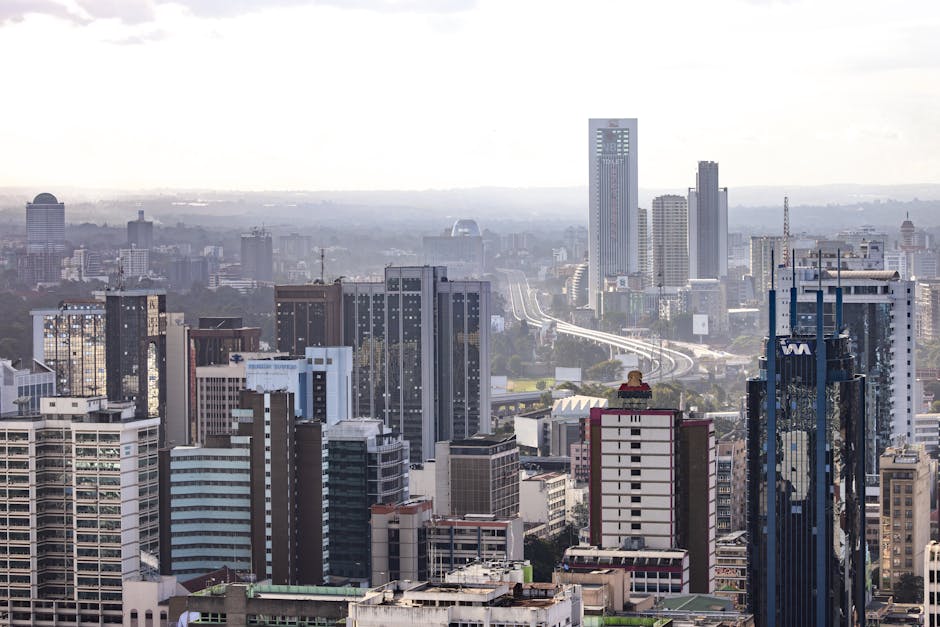
Discover Nairobi's iconic skyline on this self-guided architecture walk through the CBD’s most famous modernist and Brutalist landmarks.
 Moderate
Gothenburg, Sweden
Discover Gothenburg’s maritime soul on this self-guided walk from the historic Central Station to the scenic riverfront at Stenpiren.
 Easy
EasyNairobi, Kenya
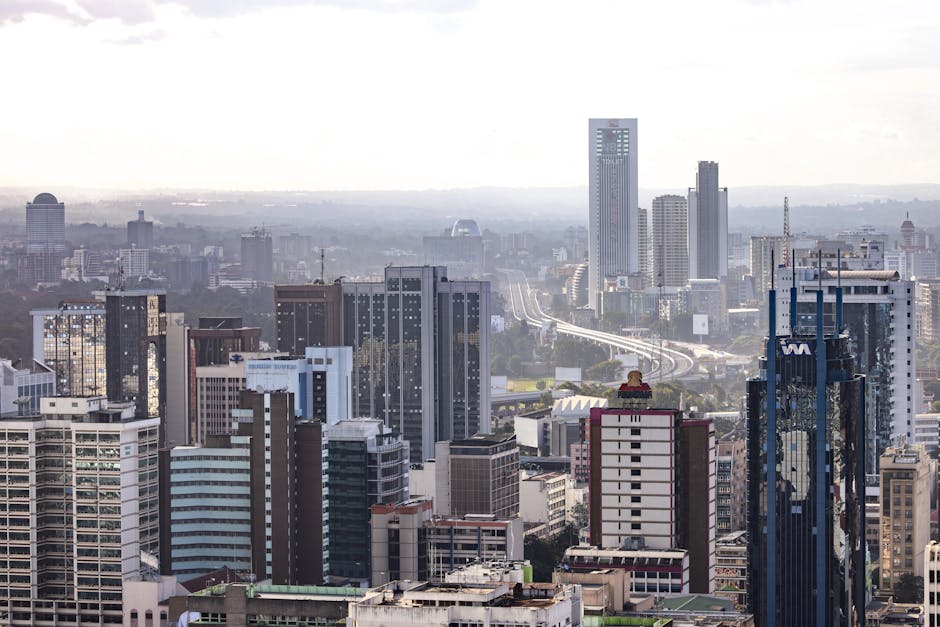
Explore Nairobi's architectural evolution from colonial-era landmarks to iconic Brutalist skyscrapers on this historic self-guided walking route.
 Moderate
Vienna, Austria
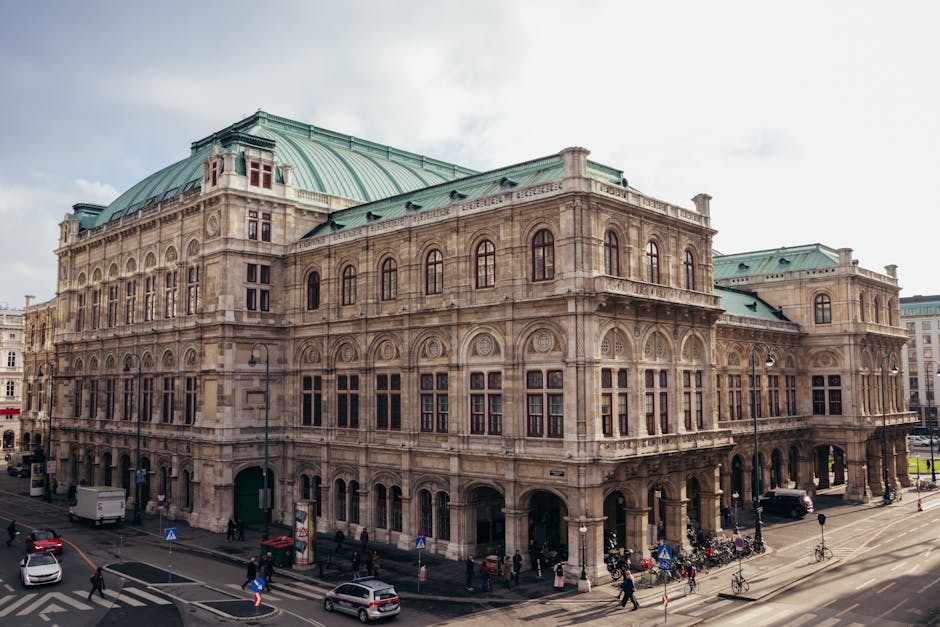
Follow the footsteps of Mozart and Strauss through Vienna’s historic center on this self-guided walk through the city's rich musical history.
