Step away from the bustling Graslei and discover the serene, spiritual heart of Ghent. This self-guided walk invites you to explore the city's 'secret' side, focusing on the unique Beguinages—communities once inhabited by lay religious women—and the hidden green pockets that offer a quiet respite from the medieval center. This neighborhood stroll takes you through centuries of history, from the romantic ruins of a 7th-century abbey to the tranquil, UNESCO-listed courtyards that feel like a city within a city. Your walking route begins at the Appelbrugparkje, a tiny oasis offering one of the most picturesque views of the Lys river and the back of the Great Butchers' Hall. As you move toward the House of the Rear Sickle, you will discover the architectural grandeur of Ghent’s wealthy medieval families, hidden in plain sight behind the cathedral. The journey then stretches toward the eastern edge of the city to the evocative ruins of Saint Bavo’s Abbey, where nature has reclaimed the stones of a once-powerful monastery. The heart of this experience lies in the Beguinages. You will visit both the 'Small' Beguinage (Our Lady Ter Hoyen), known for its well-preserved 17th-century atmosphere, and the 'Great' Beguinage of Saint Elizabeth, which has evolved into a unique, open residential district. These spaces are essential for understanding the social history of Flanders. Unlike a standard walking tour Ghent offers elsewhere, this route prioritizes the quiet, reflective atmosphere of these sacred spaces. Whether you are a history buff or a photography enthusiast, this self-guided adventure provides the flexibility to linger in sun-dappled courtyards or explore the intricate brickwork of Ghent's religious architecture at your own pace. By the time you reach the final stop, a unique mineral shop that bridges the gap between natural history and urban exploration, you will have seen a side of Ghent that most visitors completely overlook.
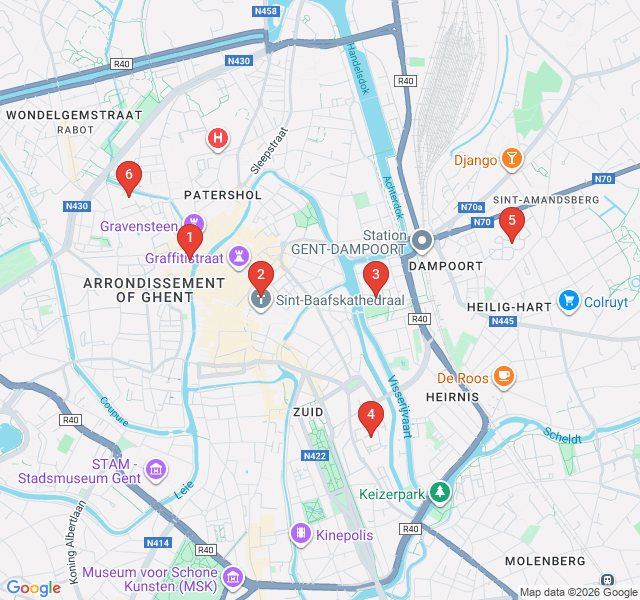
Numbers indicate the order of stops on the tour
Start your journey at Appelbrugparkje, a small but significant green space tucked away near the Fish Market. This park offers a unique perspective of the city, looking across the water toward the back of the Great Butchers' Hall. The name 'Appelbrug' refers to the 'Apple Bridge' that once stood here, a hub for fruit trade. Today, it is a quiet spot where locals come to sit by the water. Notice the contrast between the industrial feel of the old masonry and the soft greenery. It is the perfect place to pause and appreciate the scale of Ghent's medieval trade history before heading deeper into the city's spiritual quarters.
Tucked behind the Saint Bavo Cathedral, the 'Achter Sikkel' (Rear Sickle) is one of Ghent’s most stunning architectural secrets. This was the private estate of the wealthy Van der Sickele family in the 14th and 15th centuries. Look up to see the beautiful Renaissance towers and the brickwork that reflects the family's immense power. Today, the building houses the Royal Conservatory of Ghent. If you are lucky, the sound of violins or pianos may drift through the windows of the courtyard, adding a musical layer to the medieval atmosphere. It is a rare example of a private fortress-residence that has survived the centuries.
The ruins of Saint Bavo’s Abbey are a hauntingly beautiful reminder of Ghent’s earliest days. Founded in the 7th century to convert the locals to Christianity, the abbey flourished for nearly a thousand years. However, in 1540, Emperor Charles V ordered its partial destruction to punish the city for a rebellion, building a fortress on top of it. Today, what remains are the Gothic arches of the cloister and the refectory, now overgrown with ivy and trees. The site feels like a secret garden where history and nature have fused. Please note that the interior ruins often have limited opening hours, but the exterior view remains evocative year-round.
Enter the Small Beguinage of Our Lady Ter Hoyen, a UNESCO World Heritage site. Founded in 1235 by the Countess of Flanders, this was a community for Beguines—women who lived religious lives without taking formal vows. As you walk through the gate, the city noise vanishes. The long rows of white-washed houses and the central green square create a sense of profound peace. Each house has a small garden and a name dedicated to a saint. This is one of the best-preserved Beguinages in Belgium, offering a glimpse into a unique social structure that allowed medieval women a rare degree of independence.
Unlike the Small Beguinage, the Great Beguinage of Saint Elisabeth is no longer walled off. This area is known as the 'Holy Corner' because it houses churches of several different denominations within a small radius. Originally a walled city-within-a-city, the walls were demolished in the 19th century, integrating the quiet, cobblestone streets into the neighborhood. The architecture here is diverse, ranging from traditional brick cottages to grander houses. It remains a residential area where silence is still respected, maintaining the spiritual legacy of the Beguines who once walked these paths.
Conclude your walk at Tian Tu Minerals, a unique destination that fits perfectly with our theme of hidden treasures. While Ghent is famous for its man-made beauty, this shop celebrates the natural artistry of the earth. Inside, you will find an incredible collection of crystals, fossils, and minerals from around the world. It serves as a modern cabinet of curiosities, echoing the medieval tradition of collecting rare and beautiful objects. It is a peaceful, tactile way to end your journey through Ghent's quietest corners, reflecting on the enduring beauty of both the natural and the historic world.
Download Zigway to experience "Secret Gardens and Sacred Beguinages" with AI-powered audio narration. Walk at your own pace while stories unfold around you.
 Challenging
Ghent, Belgium
Explore Ghent's gritty past and modern rebirth on this self-guided walking route through the historic Northern Docks and industrial heritage sites.
 Easy
EasyGhent, Belgium
Explore Ghent’s bold architectural evolution from medieval markets to modernist icons on this self-guided walking route through the city center.
 Easy
EasyGhent, Belgium
Discover the sugary secrets of Ghent on this self-guided stroll through historic bakeries, candy shops, and artisanal chocolatiers.
 Easy
EasyGhent, Belgium
Explore Ghent's historic Patershol district, a medieval maze of narrow alleys, legendary Jenever bars, and the city's finest culinary hidden gems.
 Moderate
Nairobi, Kenya
Discover Nairobi's lush side on this self-guided walk through botanical gardens, historic memorials, and vibrant local markets.
 Easy
EasyGdansk, Poland
Discover the monastic heritage, world-famous organs, and lush botanical gardens of Oliwa on this peaceful self-guided neighborhood stroll.
 Easy
EasySalzburg, Austria
Discover Salzburg's oldest medieval alley, the birthplace of the 'Silent Night' author, and breathtaking views on this quiet self-guided walk.
 Easy
EasyHelsinki, Finland
Discover Helsinki's oldest neighborhood on this self-guided audio walk through Kruununhaka’s historic streets, hidden courtyards, and scenic shores.
 Easy
EasyBrussels, Belgium
Discover the colorful world of Belgian comics on this independent walking route through the creative streets and murals of central Brussels.
 Moderate
Brussels, Belgium
Explore the majestic Royal Quarter, from Art Nouveau gems to the King's Palace and the iconic views of Mont des Arts on this self-guided walk.
 Moderate
Brussels, Belgium
Explore Brussels' industrial heart and artistic rebirth on this self-guided walk through Molenbeek and the Canal district's iconic landmarks.
 Moderate
Brussels, Belgium
Discover Brussels' Art Nouveau masterpieces at your own pace, from Victor Horta's UNESCO sites to the flamboyant Maison Saint-Cyr.
