Downtown Los Angeles is a city of layers, where 1920s opulence sits right next to gritty urban history. This self-guided walking route invites you to peel back those layers, moving from the bustling food stalls of a century-old market to the silent, light-filled atriums of cinematic landmarks. Unlike the sprawling suburbs typically associated with LA, the historic core is remarkably walkable, offering a dense concentration of architectural styles ranging from Spanish Colonial Revival to the geometric precision of Art Deco. On this neighborhood stroll, you will encounter the 'shortest railway in the world' and step inside buildings that have played starring roles in noir classics like Blade Runner. The journey begins at the heart of the city’s culinary scene before transitioning into the 'Broadway Theater District,' once the highest concentration of cinemas in the world. You’ll explore the evolution of the city from its early 20th-century boom to its mid-century decline and modern revitalization. This is not just a look at old buildings; it is an exploration of the dreams that built Los Angeles, visible in the intricate terracotta facades and the golden ceilings of grand hotel lobbies. Whether you are a photography enthusiast looking for the perfect play of light or a history buff interested in the origins of Hollywood glitz, this walking route Los Angeles offers a comprehensive look at the city’s soul. As you navigate the streets independently, you’ll notice how the historic grit of the former financial district has transformed into a vibrant cultural hub. The route is designed to be flexible, allowing you to linger over a coffee or spend extra time capturing the perfect shot of a sun-drenched stairwell. By the time you reach the final stop at the monumental Central Library, you will have a deeper understanding of why DTLA remains one of the most filmed and fascinating urban centers in America.
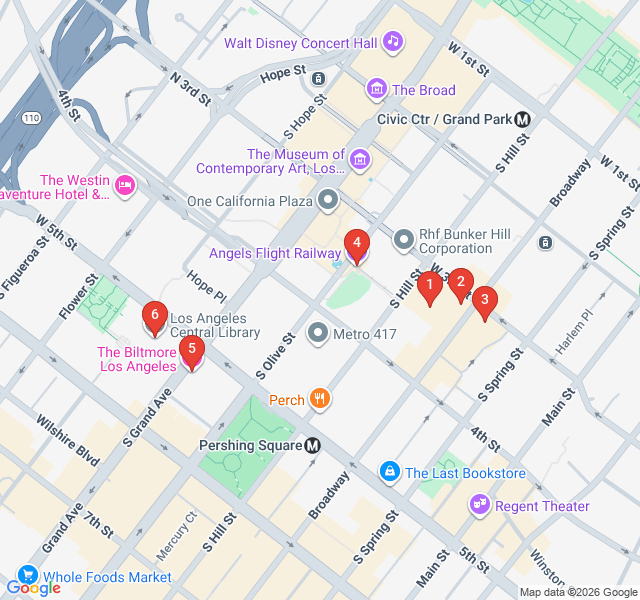
Numbers indicate the order of stops on the tour
Start your self-guided adventure at Grand Central Market, a DTLA institution since 1917. Originally a place for locals to buy groceries, it has evolved into a massive food hall reflecting the city's incredible diversity. Look up to see the vintage neon signs and notice the original tiled columns. This market has survived the neighborhood's many transformations, remaining a constant anchor for the community. It’s the perfect place to soak in the local atmosphere before you begin your architectural exploration. The scents of roasting coffee, street tacos, and fresh bread provide a sensory introduction to the 'historic grit' of the city.
Just across from the market stands the Million Dollar Theater, opened in 1918. It was the first movie palace built by legendary showman Sid Grauman, who later created the Chinese Theatre in Hollywood. The exterior is a masterpiece of Churrigueresque style—a Spanish Baroque revival known for its incredibly ornate, almost dripping, sculptural details. If you look closely at the facade, you can spot figures representing the arts and even some whimsical touches. This building marked the beginning of Broadway’s reign as the entertainment capital of the West, long before the film industry fully migrated to Hollywood.
Step inside the Bradbury Building, Los Angeles' oldest commercial building in the central core, dating back to 1893. While the exterior is modest brick, the interior is a breathtaking world of light and iron. The central atrium is flooded with natural light from a massive skylight, illuminating open-cage elevators, marble stairs, and intricate wrought-iron railings. This space is so otherworldly it has been used in countless films, most notably as the apartment of J.F. Sebastian in the 1982 sci-fi classic 'Blade Runner.' It stands as a testament to Victorian-era imagination and remains one of the most photographed interiors in the United States.
Known as the 'shortest railway in the world,' Angels Flight is a historic funicular that has carried passengers up and down the steep incline of Bunker Hill since 1901. Though the two orange and black cars, Olivet and Sinai, have been moved slightly from their original location, they represent a bygone era of LA transit. The funicular was originally built to connect the fashionable residential district on top of the hill with the shopping district below. Today, it offers a charming, brief journey that provides a unique perspective on the surrounding skyscrapers. It is a beloved survivor of the city’s early infrastructure.
Walk through the doors of The Biltmore and you are transported to the Golden Age of Hollywood. Opened in 1923, this hotel was once the largest west of Chicago. Its lobby and 'Gallery' are masterpieces of Spanish-Italian Renaissance style, featuring hand-painted ceilings and ornate carvings. The Biltmore has hosted presidents, royalty, and was the early home of the Academy Awards; legend has it the Oscar statuette was first sketched on a Biltmore napkin. As you explore the public hallways, you can feel the 'glitz' that defines the upper crust of historic Los Angeles, a stark and beautiful contrast to the bustling streets outside.
The final stop is the Los Angeles Central Library, a 1926 architectural marvel designed by Bertram Goodhue. It is a unique blend of Ancient Egyptian, Mediterranean, and Art Deco influences. The building is topped with a colorful tiled pyramid and a torch representing the 'Light of Learning.' Inside, don't miss the Rotunda, which features massive murals depicting the history of California and a stunning bronze chandelier representing the solar system. The library is not just a repository for books; it is a monument to the city's intellectual and cultural aspirations, offering a quiet, majestic conclusion to your walk through DTLA.
Download Zigway to experience "Art Deco Glitz and Historic Grit in DTLA" with AI-powered audio narration. Walk at your own pace while stories unfold around you.
 Easy
EasyLos Angeles, United States
Explore Tinseltown's glitziest era on this self-guided walk through Hollywood's historic landmarks, haunted hotels, and iconic film locations.
 Easy
EasyLos Angeles, United States
Explore the cinematic neon and hidden art galleries of LA’s Chinatown on this atmospheric self-guided evening walk.
 Moderate
Los Angeles, United States
Explore Victorian mansions, a historic lake, and quirky local landmarks on this self-guided walk through the heart of historic Echo Park.
 Easy
EasyLos Angeles, United States
Explore the retro charm of LA's Highland Park. Discover historic Victorian homes, neon signs, and quirky landmarks on this self-guided walk.
 Easy
EasyNairobi, Kenya
Discover Nairobi's iconic skyline on this self-guided architecture walk through the CBD’s most famous modernist and Brutalist landmarks.
 Easy
EasyGdansk, Poland
Discover the opulent Royal Way of Gdansk at your own pace. Explore Hanseatic history, gilded architecture, and the iconic Neptune's Fountain.
 Easy
EasyNairobi, Kenya
Explore Nairobi's architectural evolution from colonial-era landmarks to iconic Brutalist skyscrapers on this historic self-guided walking route.
 Easy
EasyInnsbruck, Austria
Uncover the myths and legends of Innsbruck on this self-guided walk through the historic Altstadt and beyond.
 Easy
EasyNew York City, United States
Explore the golden age of Manhattan architecture on this self-guided walk through Midtown's iconic Art Deco skyscrapers and historic landmarks.
 Easy
EasyNew York City, United States
Discover the literary legends, jazz haunts, and revolutionary history of Greenwich Village on this immersive self-guided walking route.
 Easy
EasyNew York City, United States
Explore Manhattan's transformation on this self-guided walk from the High Line to Hudson Yards.
 Easy
EasyNew York City, United States
Discover the world's finest cast-iron architecture and the evolution of fashion on this self-guided walking route through NYC's iconic SoHo district.
