Rothschild Boulevard is more than just a street; it is the physical timeline of Tel Aviv's transformation from a dream in the sand to a global hub of technology and culture. This self-guided walk invites you to explore the 'White City,' a UNESCO World Heritage site known for its unparalleled collection of International Style and Bauhaus architecture. As you stroll down the tree-lined central promenade, you will discover how a small group of families held a lottery on a desolate dune in 1909, laying the foundation for what would become Israel's most vibrant metropolis. This neighborhood stroll captures the essence of the city's dual identity: its deep historical roots and its forward-looking spirit of innovation. Along this walking route, you will encounter the eclectic Pagoda House, a testament to the architectural fantasies of the 1920s, and the Great Synagogue, which stands as a landmark of communal life. The journey takes a profound turn at the Founders Monument, where the names of Tel Aviv's pioneers are etched in stone, and culminates at Independence Hall. It was here, in 1948, that David Ben-Gurion declared the establishment of the State of Israel, changing the course of history forever. Beyond the history, this walking tour Tel Aviv allows you to experience the modern pulse of the city. You will see how historic preservation meets cutting-edge design at the Rothschild 1 Tower, symbolizing the 'Startup Nation' phenomenon. Whether you are an architecture enthusiast or a history buff, this walking tour Tel Aviv offers an independent way to see the city's evolution. Enjoy the shade of the ficus trees, stop for a coffee at a historic kiosk, and immerse yourself in the stories of the visionaries who built this Mediterranean gem from the ground up.
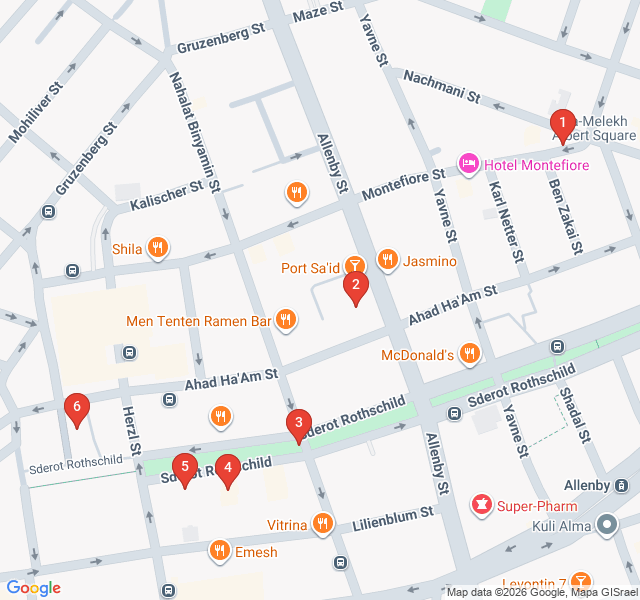
Numbers indicate the order of stops on the tour
Begin your self-guided adventure at the corner of Rothschild and Nahmani Street. Standing before you is the Pagoda House, one of Tel Aviv's most iconic examples of 'Eclectic' architecture. Built in 1924 for an American businessman, this residence was designed by Alexander Levy during a period when the city's elite wanted to blend styles from around the world. Look closely and you will see elements of Islamic, Greek, and even Far Eastern design—hence the name. It was also the first private home in Tel Aviv to feature an elevator. This building represents the 'Roaring Twenties' of Tel Aviv, a time when the city was rapidly expanding beyond its original borders and expressing its new wealth through bold, imaginative design.
As you move toward Allenby Street, you will find the Great Synagogue. While it may look modern today, the original building was completed in 1926. It served as the spiritual heart of the growing city for decades. In the late 1960s, the building underwent a massive architectural 'facelift' led by Aryeh Elhanani, who added the series of concrete arches and pillars you see surrounding the original structure. This change was meant to modernize the space and help it stand out amidst the growing commercial district. Though the neighborhood has shifted from residential to business-focused, the synagogue remains a landmark of the city's Jewish heritage and a quiet observer of the bustling Allenby Street intersection.
Continue your walking route to the center of the boulevard to find the Founders Monument. This spot is essential for understanding Tel Aviv's origins. In 1909, sixty-six families gathered on the nearby sand dunes for a lottery. They used seashells—white for the names and grey for the plot numbers—to divide the land fairly. This monument honors those pioneers. On one side, you can see the names of the families; on the other, a bronze relief depicts the three stages of Tel Aviv's development: the initial leveling of the dunes, the building of the first houses and the Herzliya Gymnasium, and finally, the modern city as it appeared in the mid-20th century. It is a tribute to the sheer willpower required to build a city out of nothing.
This modest building at 16 Rothschild Boulevard is perhaps the most significant site in modern Israeli history. Originally the home of Tel Aviv's first mayor, Meir Dizengoff, it later became the city's first art museum. On May 14, 1948, as the British Mandate was ending, Jewish leaders gathered in this hall. In a ceremony kept secret until the last moment to avoid an Egyptian air raid, David Ben-Gurion read the Declaration of Independence. Within these walls, the State of Israel was born. The building stands today as a symbol of national sovereignty and the realization of a two-thousand-year-old dream of return. It perfectly encapsulates the 'Independence' theme of our stroll.
Take a moment to appreciate the building at number 12. This structure is a prime example of the preservation efforts that have defined Rothschild Boulevard in recent years. As you explore independently, notice the clean lines and functional design, hallmarks of the International Style, or Bauhaus. These buildings were designed by Jewish architects who fled Europe in the 1930s, bringing modernist principles to the Middle East. They focused on light, ventilation, and simplicity, adapting the style to the local climate with recessed balconies. Today, many of these historic gems have been meticulously restored, housing high-tech offices and luxury apartments, bridging the gap between the city's architectural past and its economic future.
Your self-guided walk concludes at the southern end of the boulevard, dominated by the Rothschild 1 Tower. This glass skyscraper represents the 'Innovation' side of Tel Aviv. As the city evolved into a global financial and tech hub, the demand for modern office space grew. This tower sits at the gateway to the Neve Tzedek neighborhood and the financial district. It serves as a stark contrast to the low-rise Bauhaus buildings you just passed, illustrating how Tel Aviv manages to grow vertically without losing its historical soul. From here, you are perfectly positioned to explore the nearby trendy restaurants or walk toward the Mediterranean coast, having witnessed the full arc of Tel Aviv's incredible journey.
Download Zigway to experience "Rothschild Blvd: Independence and Innovation" with AI-powered audio narration. Walk at your own pace while stories unfold around you.
 Easy
EasyTel Aviv, Israel
Explore a hidden New England-style village in Tel Aviv. Discover wooden houses and 19th-century history on this peaceful self-guided walk.
 Easy
EasyTel Aviv, Israel
Explore the literary heart and stunning architecture of Tel Aviv's most beautiful historic street on this self-guided neighborhood stroll.
 Easy
EasyTel Aviv, Israel
Experience the sea breeze on this self-guided walk through Tel Aviv's historic port, featuring iconic boardwalks, markets, and sunset views.
 Easy
EasyTel Aviv, Israel
Explore the romantic origins of Tel Aviv on this self-guided walk through Neve Tzedek's historic lanes, artist studios, and restored landmarks.
 Easy
EasySalzburg, Austria
Discover the 'Rome of the North' on this self-guided walk through the Baroque squares and monumental legacy of Salzburg’s Prince-Archbishops.
 Easy
EasyGothenburg, Sweden
Discover Gothenburg’s 17th-century Dutch foundations, historic canals, and military fortifications on this self-guided architectural walk.
 Easy
EasyNairobi, Kenya
Explore Nairobi's architectural evolution from colonial-era landmarks to iconic Brutalist skyscrapers on this historic self-guided walking route.
 Easy
EasyNairobi, Kenya
Discover Nairobi's iconic skyline on this self-guided architecture walk through the CBD’s most famous modernist and Brutalist landmarks.
 Easy
EasyJerusalem, Israel
Taste the heart of Jerusalem on this self-guided walk through the legendary stalls and hidden gems of Mahane Yehuda Market.
 Easy
EasyJerusalem, Israel
Explore the secluded world of Mea Shearim on this self-guided walk through Jerusalem’s historic ultra-Orthodox district and 19th-century courtyards.
 Easy
EasyJerusalem, Israel
Explore Jerusalem's nightlife and street art, from the shutter murals of the Shuk to secret speakeasies and creative hubs in the City Center.
 Easy
EasyJerusalem, Israel
Explore the 'Garden Suburb' of Jerusalem's elite. Discover Bauhaus architecture, historic residences of prime ministers, and intellectual landmarks.
