Tucked away from the bustling traffic of Allenby Street lies a quiet, crescent-shaped enclave that serves as the intellectual and artistic heart of the city. Bialik Street is often described as Tel Aviv's most beautiful street, a living museum where the early 20th-century dream of a modern Hebrew city remains perfectly preserved. This neighborhood stroll invites you to discover the intersection of literature, art, and architecture in a place that once hosted the greatest minds of the Jewish Renaissance. As you begin your self-guided adventure at the top of the hill, you will encounter a stunning array of architectural styles, from the romantic 'Eclectic' buildings of the 1920s with their arches and domes to the clean, functional lines of the International Style that earned Tel Aviv its 'White City' designation. The street is named after Hayim Nahman Bialik, Israel's national poet, whose presence still looms large over the square. This walking route offers a deep dive into the lives of the pioneers who shaped Israeli culture. You will explore the former home of Bialik himself, a masterpiece of design that blends Islamic motifs with European sensibilities, and the Rubin Museum, where the vibrant canvases of painter Reuven Rubin captured the shifting light of the Mediterranean. Unlike a standard walking tour Tel Aviv visitors might find elsewhere, this self-guided walk allows you to linger in the quiet courtyards and admire the intricate tile work and decorative ironmongery at your own pace. Whether you are an architecture enthusiast, a history buff, or simply looking for a peaceful escape from the urban heat, Bialik Street provides a unique window into the soul of Tel Aviv. The route culminates at the historic City Museum, overlooking the picturesque Bialik Square, offering a panoramic view of the city's evolution from a small sand-dune settlement to a global metropolis.
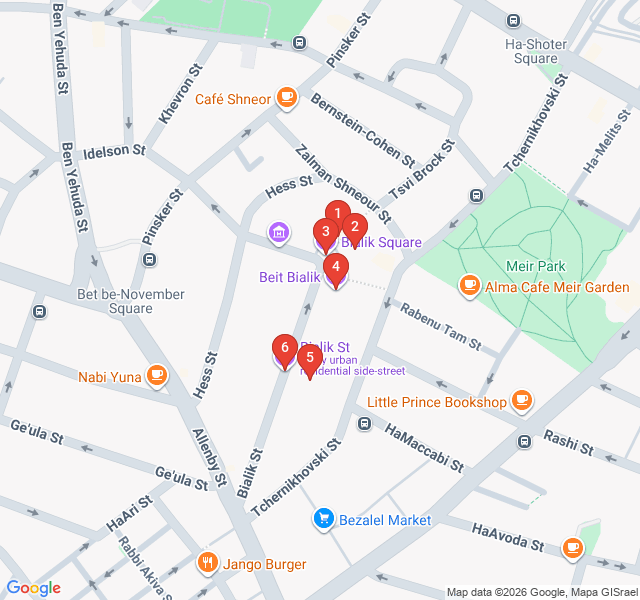
Numbers indicate the order of stops on the tour
Start exploring at the top of the street at the Tel Aviv-Yafo City Museum, housed in the city's original Town Hall. Built in 1925, this building is a prime example of the Eclectic style, featuring a grand entrance and symmetrical wings. It served as the municipal heart of the city until the mid-1960s. Today, it functions as a gateway to the city's history, using innovative digital displays to tell the story of the people who built Tel Aviv. Notice the balance of European architectural traditions with local Middle Eastern elements, a hallmark of early Tel Aviv design.
Just a few steps away, you will see a building that looks remarkably different from its neighbors. The Felicja Blumental Music Center is housed in a structure that showcases the evolution of the street. While much of Bialik Street feels like the 1920s, this center brings a mid-century modernist energy to the area. Named after the renowned Polish-Brazilian pianist, the center is a hub for chamber music and houses an extensive library. Its presence here highlights the street's long-standing connection to the performing arts and the high value the early residents placed on European classical culture.
Pause here at the circular hub of the street. Bialik Square is one of the most tranquil spots in the city. In the center, you will find a fountain once decorated with a famous mosaic by artist Nahum Gutman, depicting the history of Jaffa and Tel Aviv (though the original is often protected or moved for conservation). The square acts as an outdoor living room for the neighborhood. Take a moment to look around the circle; the collection of buildings surrounding you represents the absolute pinnacle of Tel Aviv's early urban planning, where every facade was designed to contribute to a harmonious whole.
Beit Bialik was the home of Hayim Nahman Bialik, the national poet of Israel, who moved here in 1924. The house is an architectural gem, blending pointed arches and Islamic-style pillars with a traditional European library. Bialik was more than a poet; he was a cultural leader, and his home became a pilgrimage site for writers and thinkers. Inside, the house remains exactly as it was during his lifetime, including his massive personal library and the desk where he composed his later works. It is a testament to the Hebrew cultural revival that defined this era.
Continue down the street to the former home and studio of Reuven Rubin, one of Israel’s most celebrated painters. Rubin was a pioneer of the 'Eretz Yisrael' style, characterized by bright colors and a naive, folk-like quality that captured the optimism of the early Zionist movement. The museum houses a permanent collection of his work, as well as his preserved studio on the upper floor. Seeing his paintings of the very streets and shores you are walking today provides a fascinating 'then and now' perspective on the city's rapid transformation.
As you walk the final stretch of the street toward Allenby, take a slow stroll and look up. This segment of the walking route features some of the best-preserved Bauhaus-inspired balconies and 'thermometer' windows in the city. Bialik Street was designated as a UNESCO World Heritage site as part of the White City for a reason. Every doorway, light fixture, and garden fence here tells a story of a community that wanted to build something modern yet rooted in history. The street ends at the intersection with Allenby, where the quiet elegance of the past meets the frantic energy of modern Tel Aviv.
Download Zigway to experience "Bialik Street: The Cultural Soul of Tel Aviv" with AI-powered audio narration. Walk at your own pace while stories unfold around you.
 Easy
EasyTel Aviv, Israel
Explore a hidden New England-style village in Tel Aviv. Discover wooden houses and 19th-century history on this peaceful self-guided walk.
 Easy
EasyTel Aviv, Israel
Experience the sea breeze on this self-guided walk through Tel Aviv's historic port, featuring iconic boardwalks, markets, and sunset views.
 Easy
EasyTel Aviv, Israel
Explore the birthplace of Tel Aviv on a self-guided adventure through Bauhaus architecture and the historic site of Israel's independence.
 Easy
EasyTel Aviv, Israel
Explore the romantic origins of Tel Aviv on this self-guided walk through Neve Tzedek's historic lanes, artist studios, and restored landmarks.
 Easy
EasyNairobi, Kenya
Discover Nairobi’s literary soul on this self-guided walk through historic libraries, iconic bookshops, and cultural centers in the heart of the CBD.
 Easy
EasyKrakow, Poland
Explore the prestigious Jagiellonian University district, featuring Neo-Gothic architecture, Baroque churches, and Krakow's hidden scholarly gems.
 Easy
EasyKrakow, Poland
Explore the historic heart of Kazimierz on this self-guided walk through synagogues, ancient cemeteries, and vibrant squares.
 Easy
EasyWarsaw, Poland
Follow the life of Fryderyk Chopin through Warsaw’s historic center. See where he lived, studied, and where his heart remains today.
 Easy
EasyJerusalem, Israel
Taste the heart of Jerusalem on this self-guided walk through the legendary stalls and hidden gems of Mahane Yehuda Market.
 Easy
EasyJerusalem, Israel
Explore the secluded world of Mea Shearim on this self-guided walk through Jerusalem’s historic ultra-Orthodox district and 19th-century courtyards.
 Easy
EasyJerusalem, Israel
Explore Jerusalem's nightlife and street art, from the shutter murals of the Shuk to secret speakeasies and creative hubs in the City Center.
 Easy
EasyJerusalem, Israel
Explore the 'Garden Suburb' of Jerusalem's elite. Discover Bauhaus architecture, historic residences of prime ministers, and intellectual landmarks.
