Cambridge is world-renowned for its medieval chapels and Tudor courtyards, but there is a parallel history written in concrete, steel, and brick. This self-guided walk invites you to step away from the postcard-perfect Backs and explore the 'Other Cambridge'—the 20th-century vision of a university built for the future. From the industrial majesty of the 1930s to the bold brutalism of the 1960s, this neighborhood stroll reveals how the world's leading architects reinterpreted academic life for the modern age. Your journey begins at the Cambridge University Library, a towering 'Cathedral of Books' designed by Giles Gilbert Scott. Often compared to his other famous work, Battersea Power Station, the Library represents a bridge between tradition and modern scale. From there, the route dives into the radical experimentation of the Sidgwick Site, featuring James Stirling’s Seeley Historical Library. With its cascading glass roof and red brick finish, it remains one of the most debated buildings in the city—a masterpiece of the 'Red Trilogy' that challenged every architectural convention of its time. As you continue west, the landscape shifts. You will encounter Robinson College, a fortress-like structure of handmade bricks that blends medieval enclosure with 1970s geometry. Further along, Harvey Court offers a serene example of high modernism, while the Cripps Building at St John's showcases how 1960s design could elegantly snake through historic grounds. The route culminates at Churchill College, a sprawling campus designed as a deliberate departure from the monastic tradition. Here, the raw concrete and vast open spaces reflect the scientific and forward-looking spirit of the post-war era. This walking route is perfect for those who have already seen King’s College Chapel and want to understand the intellectual and aesthetic evolution of the university. It is a challenging walk due to the distances between the colleges, but it rewards the curious traveler with hidden courtyards and innovative materials. Whether you are an architecture enthusiast or a repeat visitor, this walking tour Cambridge provides a fresh perspective on a city that is constantly reinventing itself.
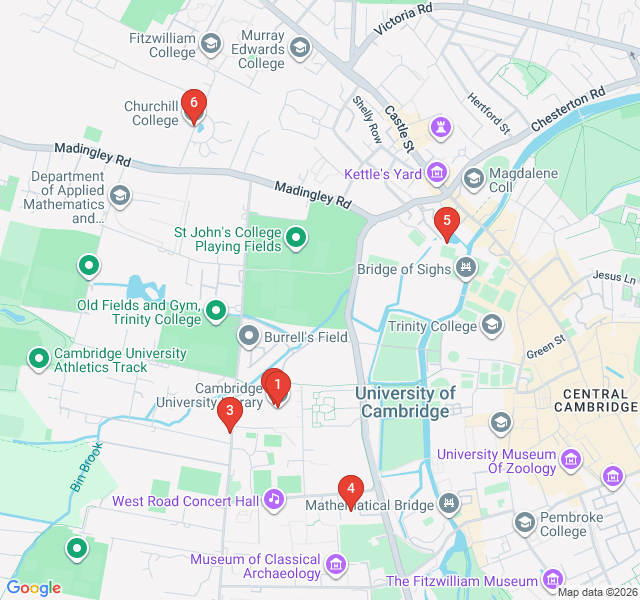
Numbers indicate the order of stops on the tour
Start exploring with Zigway at this massive brick edifice. Designed by Sir Giles Gilbert Scott and completed in 1934, the University Library is a masterpiece of industrial modernism. Scott, who also designed the iconic red telephone box and Battersea Power Station, used a stripped-back classical style that many at the time found shockingly modern. The central tower stands 157 feet tall, a height originally intended to accommodate the library's vast collection, but it also served as a bold statement of the university's expanding intellectual reach beyond the medieval center. Observe the intricate brickwork and the 'cathedral-like' windows that define this landmark of 20th-century Cambridge.
Located on the Sidgwick Site, this building is a cornerstone of British modernism. Designed by James Stirling and completed in 1968, the Seeley Historical Library is famous for its L-shaped plan and cascading glass roof. It was part of Stirling's 'Red Trilogy' and represented a radical departure from traditional library design. While the building has faced criticism for its technical challenges, including temperature control issues, its aesthetic impact is undeniable. The way the glass 'waterfall' meets the red brick skin creates a dynamic tension that makes it a pilgrimage site for architecture students worldwide. Take a moment to view it from the surrounding plaza to appreciate its geometric complexity.
Robinson College, founded in 1977, is the newest of the traditional colleges and a striking example of late modernism. Designed by the Scottish firm Gillespie, Kidd & Coia, the college is constructed almost entirely of over a million handmade dark red bricks. Its design is often described as a 'fortress' or a 'walled city,' featuring a long, elevated walkway that leads students from the busy road into the quiet, landscaped gardens behind. The building's rugged texture and jagged roofline offer a modern interpretation of the traditional Cambridge court, proving that 20th-century materials could still create a sense of scholarly seclusion and intimacy.
Tucked away on West Road, Harvey Court is a residential block for Gonville & Caius College that exemplifies the 'New Brutalism' of the 1960s. Designed by Sir Leslie Martin and Patrick Hodgkinson, it was completed in 1962. The building is raised on concrete pillars, or pilotis, creating a sheltered terrace that overlooks a sunken garden. This design was heavily influenced by the work of Le Corbusier. Its stepped-back terraces and use of pale brick and exposed concrete create a rhythmic, monumental feel that contrasts sharply with the nearby Victorian villas. It remains one of the most significant examples of high-modernist residential architecture in the United Kingdom.
The Cripps Building at St John's College is a masterclass in how to integrate modernism into a historic setting. Completed in 1967 by architects Powell & Moya, this long, zig-zagging structure stretches across the college grounds, creating new courtyards without closing them off. The use of Portland stone and lead cladding allows the building to harmonize with the older Tudor and Gothic structures nearby, while its glass-walled 'cloisters' and slender columns are firmly rooted in the 20th century. It is widely considered one of the most successful post-war buildings in Britain, winning several architectural awards for its elegance and sensitivity to its environment.
Your self-guided adventure concludes at Churchill College, the national memorial to Sir Winston Churchill. Established in 1960 with a focus on science and technology, the college campus was a deliberate break from Cambridge tradition. Designed by Sheppard Robson & Partners, the site features extensive use of 'béton brut' (raw concrete) and large, open greens. The Dining Hall, with its dramatic concrete barrel vaults, is a highlight of British Brutalism. Unlike the enclosed courts of the old city, Churchill’s layout is expansive and airy, reflecting the optimistic, forward-looking spirit of the 1960s 'White Heat of Technology' era. It is a fitting end to a route celebrating the university's modern evolution.
Download Zigway to experience "Modernist Architecture: The 20th Century University" with AI-powered audio narration. Walk at your own pace while stories unfold around you.
 Moderate
Cambridge, United Kingdom
Discover Cambridge's verdant soul on this self-guided walk through the Botanic Garden and secret riverside fens. Perfect for nature lovers.
 Easy
EasyCambridge, United Kingdom
Discover the Saxon and Norman roots of Cambridge on this self-guided walk through the city's oldest churches and medieval landmarks.
 Easy
EasyCambridge, United Kingdom
Discover the architectural wonders and scholarly secrets of Cambridge’s most prestigious colleges on this independent, historic neighborhood stroll.
 Moderate
Cambridge, United Kingdom
Discover the ancient roots of Cambridge and the stunning art of Kettle's Yard on this self-guided stroll through the historic Castle Hill district.
 Easy
EasyHelsinki, Finland
Discover Helsinki's oldest neighborhood on this self-guided audio walk through Kruununhaka’s historic streets, hidden courtyards, and scenic shores.
 Easy
EasyGothenburg, Sweden
Explore Gothenburg's elegant academic district, featuring grand 19th-century stone architecture and the iconic cultural hub of Götaplatsen.
 Easy
EasyKrakow, Poland
Explore the prestigious Jagiellonian University district, featuring Neo-Gothic architecture, Baroque churches, and Krakow's hidden scholarly gems.
 Easy
EasyKrakow, Poland
Discover Krakow’s creative soul in Zabłocie, exploring industrial heritage, contemporary art museums, and avant-garde architecture at your own pace.
 Easy
EasyEdinburgh, United Kingdom
Explore Edinburgh's historic Royal Mile at your own pace, from the heights of the Castle to the royal Palace of Holyroodhouse.
 Easy
EasyEdinburgh, United Kingdom
Capture the magic of Edinburgh on this self-guided stroll through the fairy-tale Dean Village, floral Circus Lane, and the scenic Water of Leith.
 Easy
EasyEdinburgh, United Kingdom
Explore Edinburgh's creative soul on this self-guided walk from historic museums to the stylish galleries and boutiques of the West End.
 Challenging
Edinburgh, United Kingdom
Ascend an ancient volcano and discover royal history on this challenging self-guided walk through Edinburgh's iconic Holyrood Park.
