Ancoats was once known as the world's first industrial suburb, a dense landscape of towering cotton mills and cramped housing that earned it a reputation as one of the toughest neighborhoods in Britain. Today, it has been reborn as Manchester's culinary heart and one of the 'coolest neighborhoods in the world.' This self-guided walk invites you to explore that transformation, moving from the red-brick echoes of the Industrial Revolution to the cutting-edge restaurants that define the city's modern identity. As you navigate the grid-like streets, you will discover how the area's Italian heritage—once home to a thriving 'Little Italy'—laid the foundations for a food scene that now boasts Michelin stars and cult-status bakeries. Unlike a traditional walking tour Manchester visitors might find elsewhere, this neighborhood stroll allows you to linger over a Neapolitan pizza or admire the Victorian masonry at your own pace. You will see how monumental structures like Murrays' Mills have been repurposed for modern living and how public spaces like Cutting Room Square have become the city's outdoor living room. Whether you are interested in the grit of 19th-century history or the innovation of contemporary British cooking, this audio walk provides the perfect context for understanding Manchester’s past and its vibrant future. This independent walking route is ideal for those who want to experience the local favorites of Ancoats without the constraints of a group, making it a highlight for any traveler seeking a deeper connection to the city's urban evolution. **Note:** This area is known for its ever-changing character. Street art, pop-up venues, and temporary exhibitions may differ from what's described. That's part of the adventure - you might discover something entirely new!
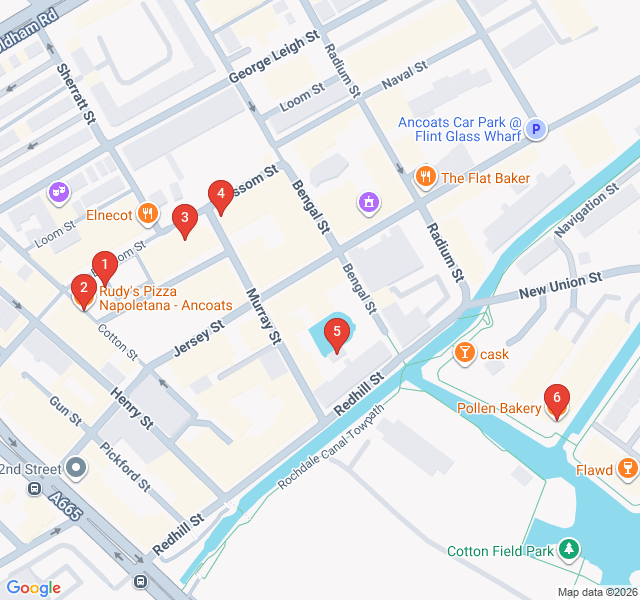
Numbers indicate the order of stops on the tour
Welcome to the heart of modern Ancoats. Cutting Room Square is a perfect example of urban regeneration, where industrial history meets contemporary social life. Look around and you will see several large monoliths; these are public art installations that display photographs found in the local archives, depicting the people who lived and worked here when this was a manufacturing powerhouse. This square was originally where fabric was 'cut'—hence the name—and today it serves as the neighborhood's communal hub. It is surrounded by some of Manchester's most acclaimed independent bars and eateries, marking the transition from a forgotten industrial zone to a thriving residential and culinary hotspot. Take a moment to soak in the atmosphere of one of the city's most successful revitalization projects.
While it may look like a modern restaurant, Rudy's represents a deep historical connection. In the late 19th century, Ancoats was known as 'Little Italy' due to the thousands of Italian immigrants who settled here, bringing with them a rich culture of food and music. Rudy's sparked a pizza revolution in Manchester when it opened, focusing on traditional Neapolitan techniques. The neighborhood's Italian roots are still visible if you look closely at the street names and older building plaques nearby. This specific spot is often credited with kickstarting the modern culinary boom in Ancoats, proving that people would travel from across the city to eat in a district that was once considered a no-go zone.
Standing tall over the square is Hallé St Peter's, a former Anglican church built in 1859. It was the first church built in the expanding industrial suburb of Ancoats to serve the rapidly growing population. After falling into disrepair following the decline of the mills, it was heroically restored and now serves as a rehearsal and recording space for the world-famous Hallé Orchestra. The modern 'Oglesby Centre' extension, which you can see attached, is a stunning example of how contemporary architecture can complement Victorian brickwork. This building symbolizes the neighborhood's shift from heavy industry to the creative and cultural arts, acting as a beacon of high culture in a formerly gritty landscape.
Just a few steps away lies mana, a restaurant that made history in 2019 by earning Manchester’s first Michelin star in over 40 years. Led by chef Simon Martin, mana focuses on British ingredients and fermentation, housed in a sleek, minimalist space that contrasts sharply with the surrounding red-brick warehouses. The presence of such a high-caliber establishment here is a testament to how far Ancoats has come. It marks the neighborhood not just as a place for casual dining, but as a destination for serious gastronomy. Please note that while the exterior is understated, the innovation happening inside has influenced many other local businesses to push the boundaries of Manchester's food scene.
Murrays' Mills is one of the most significant industrial sites in the world. Established in 1798, it is the oldest surviving steam-powered cotton mill complex. At its peak, it was a massive operation, with the 'Old Mill' being the tallest building in Manchester at the time. The mills were built around a central courtyard and canal basin to facilitate the movement of raw cotton and finished goods. Today, the complex has been meticulously converted into luxury apartments, preserving the historic facade and the atmospheric inner courtyard. It serves as a permanent reminder of the 'Cottonopolis' era, where the wealth of the British Empire was forged in these very rooms under grueling conditions.
We conclude our walk at Pollen Bakery, located at the edge of the New Islington Marina. Pollen began as a small operation in a railway arch and grew into a Manchester institution, famous for its sourdough and 'cruffins.' The bakery’s move to this waterfront location highlights the expansion of Ancoats into the New Islington area, where former industrial wasteland has been turned into a scenic marina with eco-friendly housing and green spaces. It is the perfect place to grab a coffee and a pastry, sit by the water, and reflect on the incredible journey of this neighborhood—from the 'slums' of the 1800s to a modern urban oasis. The marina area is often bustling with locals and their dogs, offering a true taste of modern Manchester life.
Download Zigway to experience "Ancoats: From Italian Slums to Culinary Cool" with AI-powered audio narration. Walk at your own pace while stories unfold around you.
 Moderate
Manchester, United Kingdom
Discover Manchester’s secret green spaces and hidden parks on this self-guided audio walk through the city’s most tranquil and photogenic spots.
 Easy
EasyManchester, United Kingdom
Explore Manchester’s creative soul on this self-guided stroll through the Northern Quarter’s iconic street art and quirky subculture.
 Moderate
Manchester, United Kingdom
Trace the sonic legacy of Manchester from the birth of punk to the Oasis era on this self-guided walking route through music history.
 Moderate
Manchester, United Kingdom
Discover Manchester’s radical legacy on this self-guided walk through the history of protest, from Peterloo to the Suffragettes.
 Easy
EasyGothenburg, Sweden
Explore Gothenburg's maritime soul on this self-guided walk from historic shipyards to sleek modern piers and iconic industrial landmarks.
 Easy
EasyGothenburg, Sweden
Explore Gothenburg’s historic wooden houses, legendary giant cinnamon buns, and panoramic fortress views on this self-guided neighborhood stroll.
 Moderate
Nairobi, Kenya
Taste your way through Nairobi's Westlands on this self-guided walk featuring street snacks, cultural landmarks, and hidden foodie gems.
 Easy
EasyNairobi, Kenya
Discover Nairobi’s literary soul on this self-guided walk through historic libraries, iconic bookshops, and cultural centers in the heart of the CBD.
 Easy
EasyEdinburgh, United Kingdom
Explore Edinburgh's historic Royal Mile at your own pace, from the heights of the Castle to the royal Palace of Holyroodhouse.
 Easy
EasyEdinburgh, United Kingdom
Capture the magic of Edinburgh on this self-guided stroll through the fairy-tale Dean Village, floral Circus Lane, and the scenic Water of Leith.
 Easy
EasyEdinburgh, United Kingdom
Explore Edinburgh's creative soul on this self-guided walk from historic museums to the stylish galleries and boutiques of the West End.
 Challenging
Edinburgh, United Kingdom
Ascend an ancient volcano and discover royal history on this challenging self-guided walk through Edinburgh's iconic Holyrood Park.
