Step away from the polished facades of the Long Market and enter Dolne Miasto, or Lower Town—a district that captures the raw, authentic soul of Gdansk. This neighborhood stroll offers a stark contrast to the restored Gothic buildings of the city center, revealing a landscape where 19th-century industrial heritage meets contemporary art and quiet riverside greenery. Once a prestigious suburb for merchants and later an industrial powerhouse under Prussian rule, Lower Town survived the destruction of World War II far better than the Main Town, leaving behind original red-brick architecture and a unique atmosphere of unpolished beauty. On this self-guided walk, you will explore the layers of Gdansk’s history that most travelers miss. You will encounter the formidable Milk Stags towers, which once guarded the entrance to the city’s granaries, and the Royal Rifle Factory, a testament to the area's military-industrial past. The route leads you through the heart of the district’s social transformation at the Łaźnia Centre for Contemporary Art, housed in a former public bathhouse. As you move toward the edges of the neighborhood, the urban grit gives way to the tranquil banks of the Motława River. Here, you will discover the Stone Sluice, a masterpiece of 17th-century Dutch engineering that protected the city from floods and invaders alike. The journey concludes atop the grassy slopes of Bastion Żubr, where you can enjoy a panoramic view of the city’s skyline, from the shipyard cranes to the spire of St. Mary’s Church. This walking route Gdansk is perfect for those who prefer to explore independently, seeking the stories hidden within crumbling brickwork and revitalized industrial spaces. Whether you are a photography enthusiast or a history buff, this neighborhood walk offers a deep dive into the 'real' Gdansk, far from the typical tourist trails. Discover at your own pace how a once-neglected district is reclaiming its identity as a vibrant cultural hub while honoring its complex past.
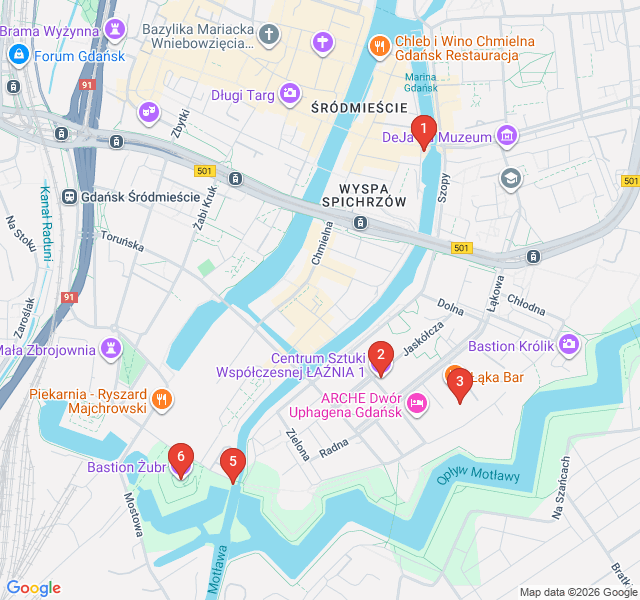
Numbers indicate the order of stops on the tour
Welcome to the gateway of Lower Town. These two massive towers, known as the Milk Stags, were built in the early 16th century as part of the city's defensive fortifications. Standing at the entrance to Granary Island, they served a dual purpose: protecting the city's vital food supplies and acting as a water gate. While much of Gdansk was rebuilt after 1945, these towers retain much of their original character. Take a moment to look at the thick masonry; it was designed to withstand naval sieges. Today, they mark the transition from the bustling, tourist-heavy Long Gardens to the quieter, more residential streets of Dolne Miasto.
This impressive building wasn't always a gallery. Built in 1908, it served as a municipal public bathhouse, providing hygiene facilities for the workers of this industrial district at a time when home plumbing was a luxury. Following a period of neglect after the war, it was reclaimed by artists in the 1990s and transformed into the Łaźnia Centre for Contemporary Art. It stands as a symbol of the neighborhood’s rebirth. The center focuses on social-exchange art and local engagement, bridging the gap between the district's gritty past and its creative future. The architecture remains a classic example of early 20th-century civic utility.
Before you stands a massive complex of red-brick buildings that once fueled the Prussian military machine. Established in the mid-19th century, the Royal Rifle Factory was one of the largest employers in the region. Thousands of workers once streamed through these gates to manufacture precision weaponry. After the weapons production ceased, the site saw various uses, including car manufacturing. Today, it is a prime example of industrial heritage waiting for full revitalization. You can still feel the scale of the Prussian industrial ambition in the sheer size of the workshops and the rhythmic placement of the arched windows.
The wide, boulevard-like Łąkowa Street was once the heart of Gdansk's transportation network. This former tram depot, dating back to the late 1800s, was the hub for the city's horse-drawn and later electric trams. In the early 20th century, this area was quite prestigious, lined with elegant tenements and greenery. The depot itself is a masterpiece of brick functionalism. Even though the tracks no longer carry commuters here, the building has been repurposed for modern office and creative spaces, preserving the aesthetic of a time when the tram was the king of the city's streets.
As you move toward the water, you encounter one of Gdansk's most significant engineering feats. The Stone Sluice was constructed between 1619 and 1623 by Dutch engineers. It wasn't just for navigation; it was a defensive weapon. By manipulating the water levels of the Motława River, the city could flood the surrounding plains, making it impossible for an invading army to stage a siege. The four stone 'maidens' or towers on the sluice are iconic. This site represents the incredible sophistication of 17th-century hydraulic engineering and remains one of the few such structures preserved in Europe.
Climb the path to the top of Bastion Żubr. This is part of the massive 17th-century fortification ring that once completely encircled Gdansk. These earthworks were designed to absorb the impact of cannon fire, a modern alternative to the stone walls of the Middle Ages. Today, the bastion serves as a peaceful park and a perfect lookout point. From here, you can see the contrast between the industrial chimneys of the outskirts and the historic towers of the city center. It’s a place where nature has reclaimed military history, offering a quiet spot to reflect on the resilience of this neighborhood.
Download Zigway to experience "Lower Town: The Unpolished Gem" with AI-powered audio narration. Walk at your own pace while stories unfold around you.
 Moderate
Gdansk, Poland
Discover the bohemian soul of Gdańsk. Explore the literary landmarks of Günter Grass, Prussian villas, and the trendy cafes of historic Wrzeszcz.
 Easy
EasyGdansk, Poland
Discover the opulent Royal Way of Gdansk at your own pace. Explore Hanseatic history, gilded architecture, and the iconic Neptune's Fountain.
 Easy
EasyGdansk, Poland
Discover the monastic heritage, world-famous organs, and lush botanical gardens of Oliwa on this peaceful self-guided neighborhood stroll.
 Easy
EasyGdansk, Poland
Taste the history of the Baltic. Explore Gdansk's culinary heritage from medieval markets to gold-flecked liqueurs on this self-guided walk.
 Easy
EasyKrakow, Poland
Discover Krakow’s creative soul in Zabłocie, exploring industrial heritage, contemporary art museums, and avant-garde architecture at your own pace.
 Moderate
Vienna, Austria
Discover the noir world of The Third Man and Cold War Vienna on this atmospheric self-guided audio walk through the historic Innere Stadt.
 Moderate
Krakow, Poland
Discover Krakow’s stunning skyline and riverside charm on this self-guided audio walk through scenic viewpoints and historic mounds.
 Easy
EasyWarsaw, Poland
Discover the hidden courtyards and grand pre-war architecture of Warsaw's most atmospheric neighborhood on this self-guided stroll.
 Easy
EasyKrakow, Poland
Explore the prestigious Jagiellonian University district, featuring Neo-Gothic architecture, Baroque churches, and Krakow's hidden scholarly gems.
 Easy
EasyKrakow, Poland
Explore Krakow's hidden nightlife with this self-guided walk through medieval cellars, jazz clubs, and bohemian bars in the Old Town and Kazimierz.
EasyKrakow, Poland
Discover Krakow’s creative soul in Zabłocie, exploring industrial heritage, contemporary art museums, and avant-garde architecture at your own pace.
 Easy
EasyKrakow, Poland
Explore the historic heart of Kazimierz on this self-guided walk through synagogues, ancient cemeteries, and vibrant squares.
