Step into the heart of the Hanseatic spirit with a self-guided walk through Hamburg’s Altstadt, where the echoes of medieval merchants still resonate against the backdrop of modern commerce. This neighborhood stroll invites you to peel back the layers of a city that has reinvented itself repeatedly following the Great Fire of 1842 and the devastation of World War II. While Hamburg is often celebrated for its sleek modern harbor, its true soul lies in the narrow alleys and grand squares of the Old Town. This walking route highlights the architectural evolution of the city, from the Neo-Renaissance grandeur of the Rathaus to the somber, blackened spire of the St. Nikolai Memorial. You will explore the historic Trostbrücke, once the center of public life, and wander down Deichstraße, the last remaining vestige of the old harbor-front with its iconic timber-framed houses. This travel experience is designed for those who want to discover the city independently, allowing you to linger over the intricate details of a gothic facade or pause for a coffee by a quiet canal. As you navigate the winding streets, you will learn how the Hanseatic League shaped the city's wealth and why the local architecture reflects a unique blend of northern European traditions. This walking tour Hamburg offers is a journey through time, connecting the legendary foundations of the city to its vibrant present. Whether you are captivated by the stories of early bishops at St. Catherine’s or the resilience of the local merchants, this self-guided adventure provides a comprehensive look at the origins of the Free and Hanseatic City of Hamburg.
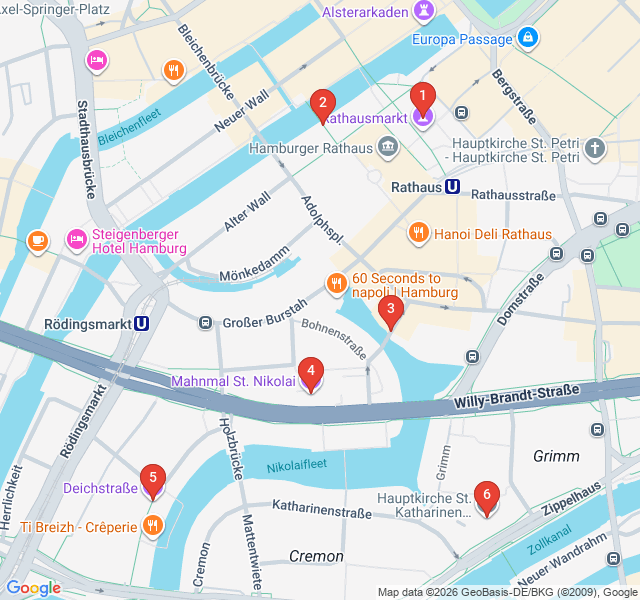
Numbers indicate the order of stops on the tour
Welcome to the heart of Hamburg. The Rathaus, or City Hall, stands as a testament to the city's wealth and independence. Completed in 1897 after the previous city hall was destroyed by fire, this Neo-Renaissance masterpiece is built upon 4,000 oak piles driven into the marshy ground. Look up at the facade to see the statues of twenty German emperors, but notice that the city's crest sits higher than any of them—a subtle nod to Hamburg’s status as a 'Free' city. The market square here has hosted everything from political rallies to Christmas markets for over a century. Take a moment to admire the Hygieia Fountain in the courtyard, built to commemorate the city's recovery from a cholera epidemic in the late 19th century.
As you move toward the Bucerius Kunst Forum, you are standing in a space where history meets modern cultural curation. This building, once the headquarters of the Reichsbank, now serves as a prestigious exhibition space. While the interior hosts rotating world-class art, the exterior architecture remains a significant part of the Altstadt’s urban fabric. It represents the early 20th-century transition in Hamburg's architectural style, moving toward more functional yet imposing stone structures. This site serves as a bridge between the political power of the Rathaus and the commercial history you are about to encounter as we head toward the old canal bridges.
Trostbrücke, or 'Consolation Bridge,' is one of the most historic spots in the city. Historically, this bridge linked the Bishop's town around the cathedral with the Count's town. The statues you see represent Saint Ansgar, the 'Apostle of the North,' and Count Adolf III of Schauenburg, who established the secular settlement. The name 'Trost' supposedly refers to the 'consolation' offered to those being led to the nearby courthouse in medieval times. From here, you can see the Nikolaifleet, one of the oldest parts of the Hamburg harbor. This was the city's central hub for trade before the modern port was developed further down the Elbe.
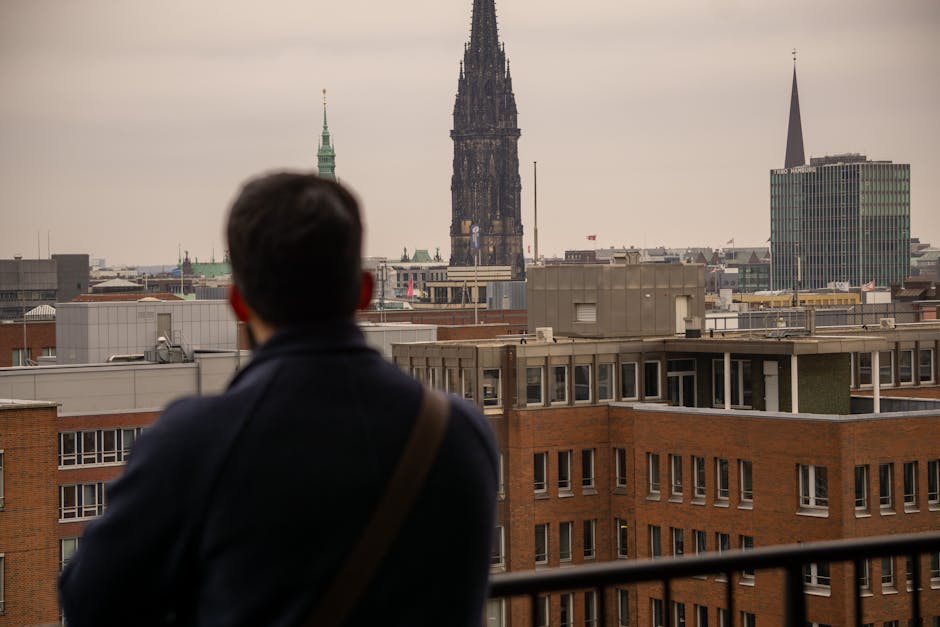
Standing before you is the blackened spire of the St. Nikolai Church. Once the tallest building in the world in the late 19th century, it was largely destroyed during the Operation Gomorrah air raids of 1943. Unlike many other structures, it was never fully rebuilt; instead, it remains as a hollow shell and a somber memorial to the victims of war and tyranny. The spire still stands 147 meters tall, serving as a prominent landmark in the skyline. If you look closely at the remaining walls, you can see the intricate Gothic Revival stonework. It serves as a powerful reminder of the city's resilience and the scars left by the 20th century.
Walking into Deichstraße feels like stepping back into the 17th century. This is the only street in the city center that survived the Great Fire of 1842, which actually started in a house right here at number 42. These timber-framed buildings were traditional merchant houses, where the ground floor served as a shop, the upper floors as living quarters, and the top as a warehouse. If you walk through one of the small alleys between the buildings, you will find yourself overlooking the canal. This allowed merchants to load goods directly from boats into their attics using pulleys—a system that defined Hamburg's economy for centuries.
Our journey concludes at St. Catherine’s (Hauptkirche St. Katharinen), the third oldest of Hamburg's five principal churches. Historically, this was the church of the merchants and shipbuilders. Legend has it that the golden crown on the spire was made from gold captured by the pirate Klaus Störtebeker. Inside, the church is known for its incredible acoustics and its history with Johann Sebastian Bach, who reportedly came here to play the organ. Despite heavy damage during the war, the church has been meticulously restored, preserving its role as a spiritual anchor for the maritime community. It stands as a perfect final stop, embodying the endurance of Hamburg's medieval origins.
Download Zigway to experience "Medieval Echoes: Hamburg’s Old Town Origins" with AI-powered audio narration. Walk at your own pace while stories unfold around you.
 Easy
EasyHamburg, Germany
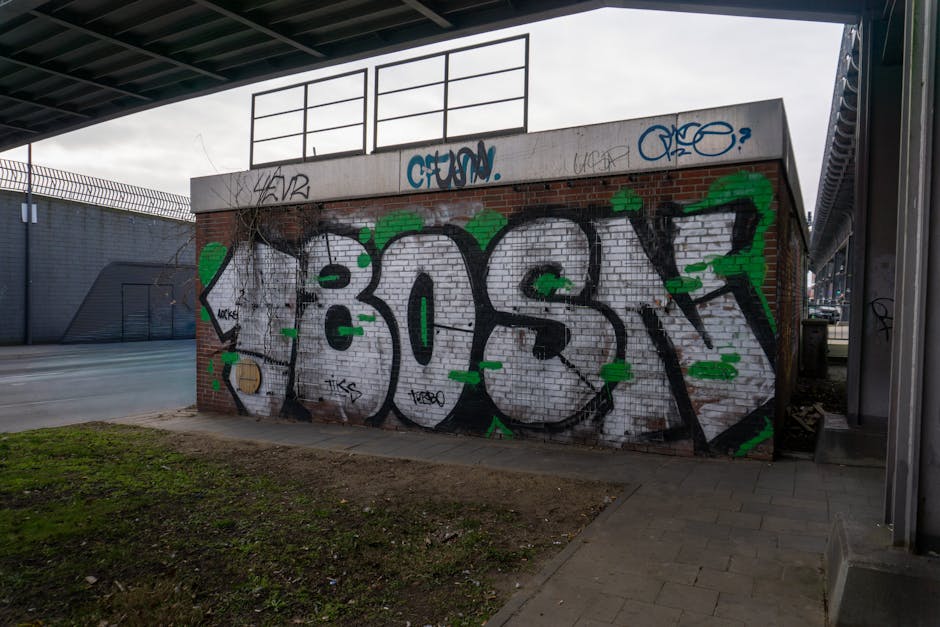
Explore the rebellious heart of Hamburg on a self-guided walk through Sternschanze, featuring iconic murals and radical social history.
 Easy
EasyHamburg, Germany
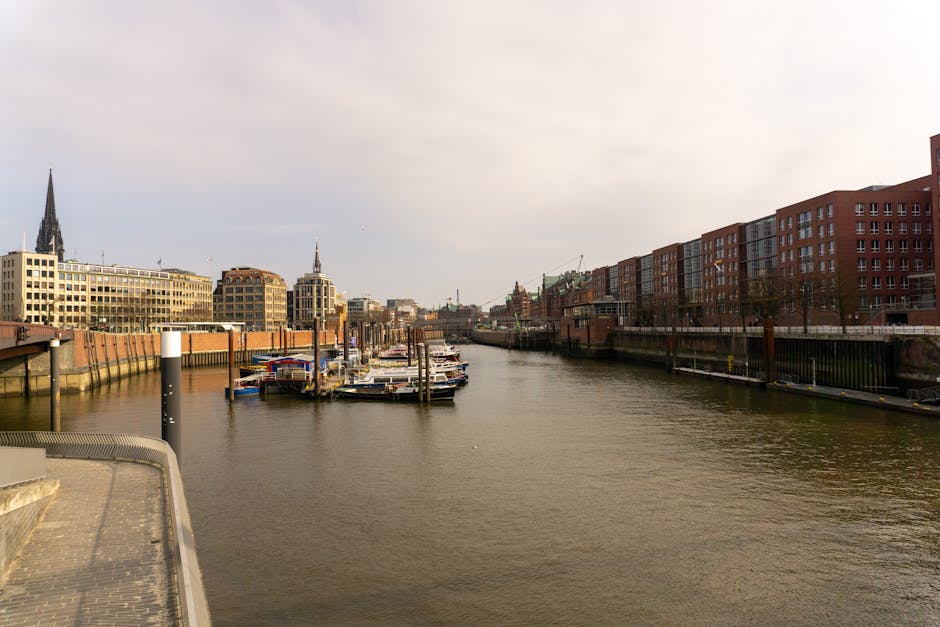
Discover Hamburg's UNESCO-listed warehouse district and stunning Brick Gothic architecture on this self-guided stroll through the Speicherstadt.
 Easy
EasyHamburg, Germany
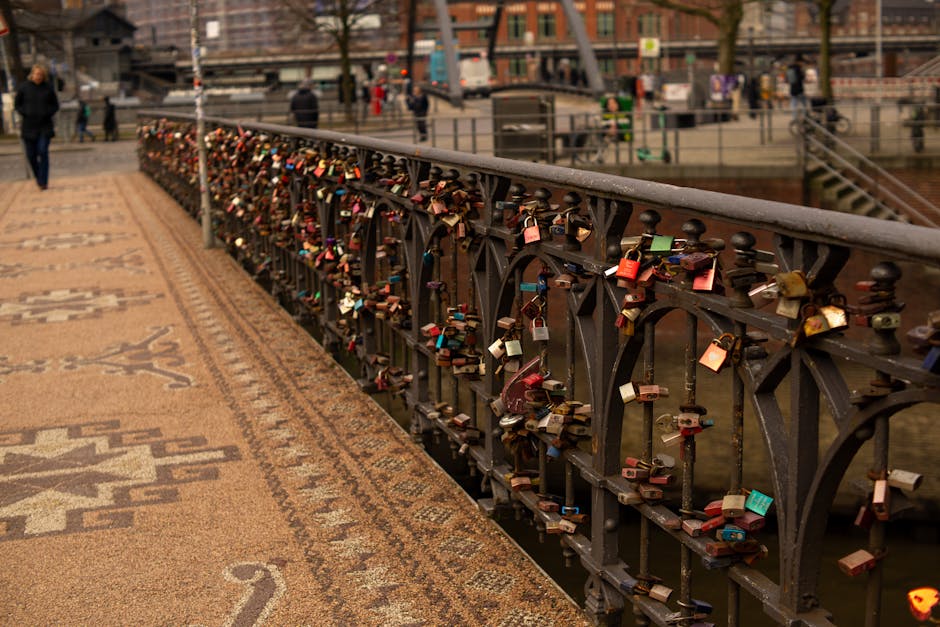
Explore Hamburg's most diverse district, where luxury hotels meet vibrant LGBTQ+ culture and historic art museums on this self-guided audio walk.
 Easy
EasyHamburg, Germany
Explore the neon-lit legends of Hamburg's St. Pauli on this self-guided audio walk through the Reeperbahn’s history, music, and nightlife.
 Moderate
Gothenburg, Sweden
Discover Gothenburg’s maritime soul on this self-guided walk from the historic Central Station to the scenic riverfront at Stenpiren.
 Moderate
Vienna, Austria
Follow the footsteps of Mozart and Strauss through Vienna’s historic center on this self-guided walk through the city's rich musical history.
 Moderate
Warsaw, Poland
Explore the resilient spirit of Warsaw's Muranów district on this self-guided walk through the history and landmarks of the former Jewish Ghetto.
 Moderate
Helsinki, Finland
Explore the 'Gibraltar of the North' on this independent walking route through the historic bastions and hidden gardens of Suomenlinna Sea Fortress.
 Easy
EasyBerlin, Germany
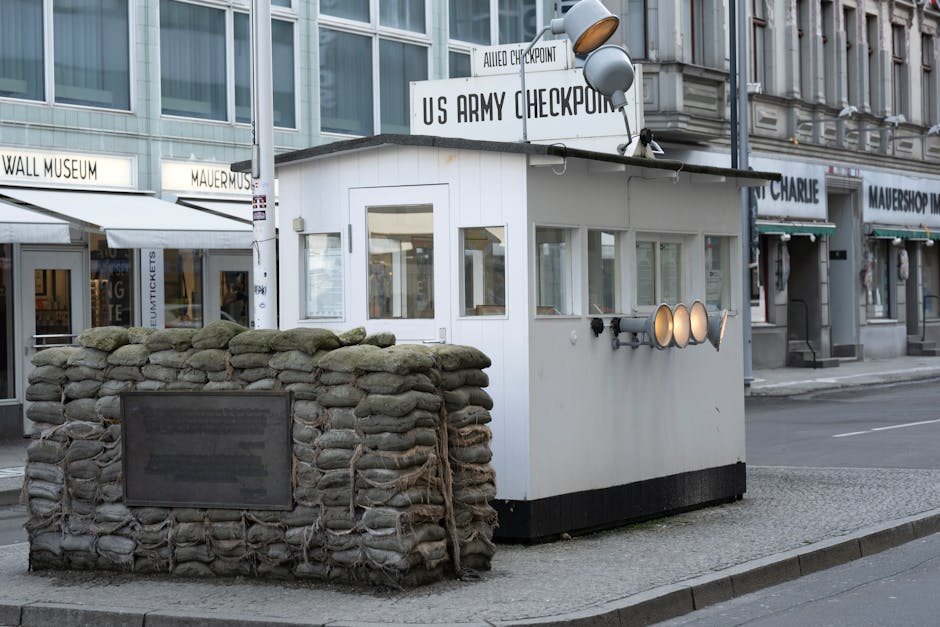
Explore the sites of Nazi power and the memorials that honor its victims on this self-guided walk through Berlin's historic Wilhelmstraße district.
 Moderate
Berlin, Germany
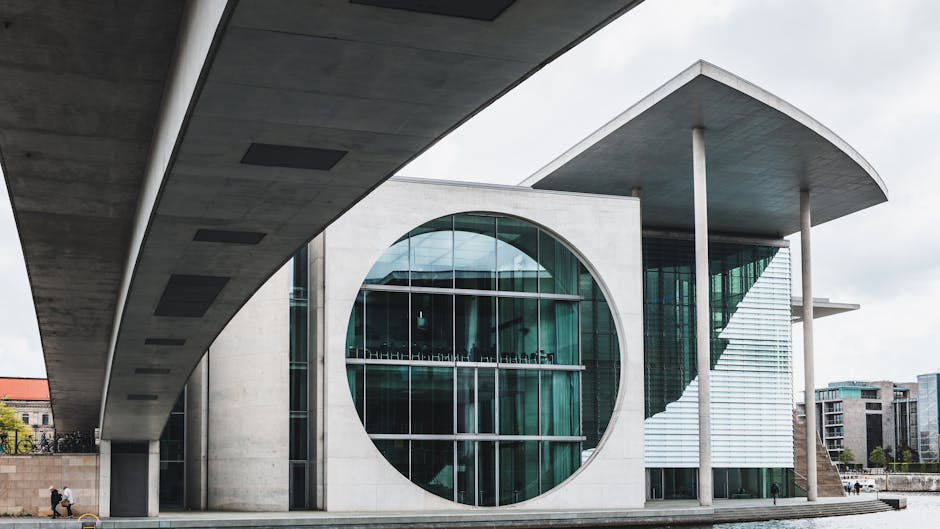
Explore Berlin’s 'Green Heart' on a self-guided walk through royal history, Cold War memorials, and serene lakeside gardens.
 Moderate
Berlin, Germany
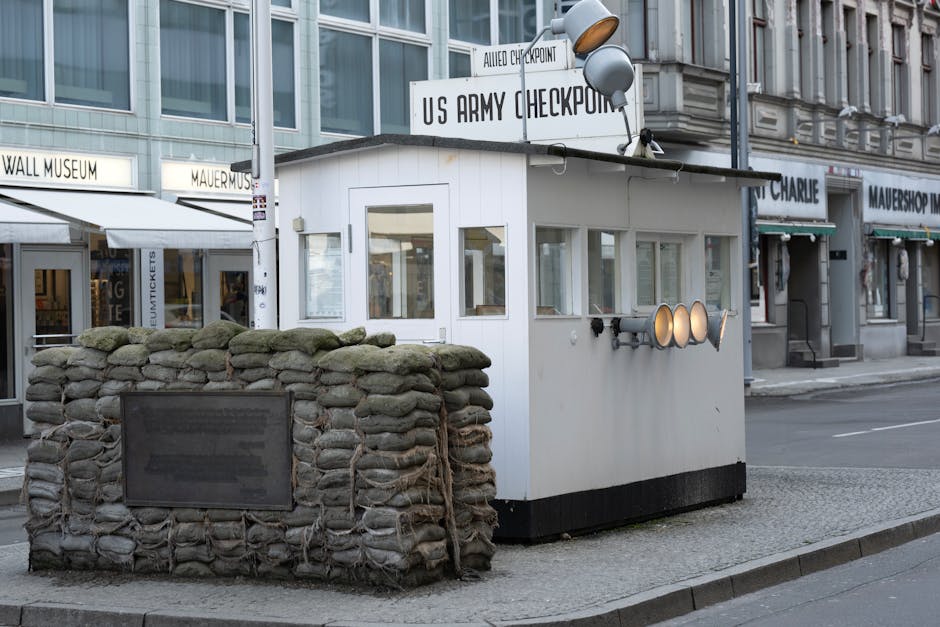
Discover the legacy of the Berlin Wall on this self-guided walk from historic ghost stations to the vibrant street art and cafes of Mauerpark.
 Easy
EasyBerlin, Germany
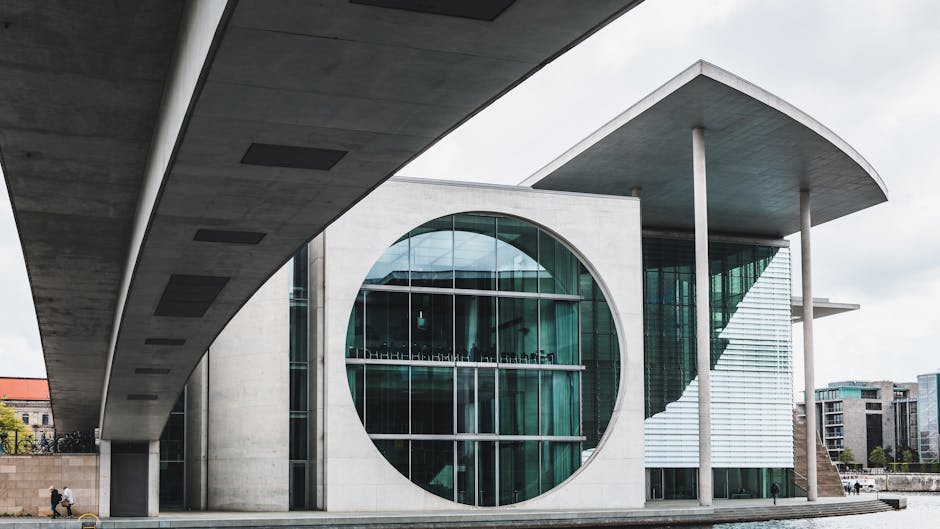
Discover the soul of 1920s Berlin on a self-guided walk through Charlottenburg’s iconic literary cafes, historic theaters, and artistic landmarks.
