Naples is a city built in layers, a literal urban lasagna where the modern street level rests upon centuries of Greek, Roman, and medieval history. This self-guided walk through the UNESCO-listed Centro Storico invites you to peel back these layers. Unlike a traditional walking tour Naples often presents, this route allows you to navigate the narrow, laundry-draped alleys at your own pace, moving from the sunlight of the piazzas into the cool, silent depths of the earth. You will begin at the oldest baptistery in the Western world, hidden within the city's cathedral, and end at the 4th-century BC Greek walls that still stand in the heart of a vibrant social hub. Along the way, this neighborhood stroll reveals the Roman Theatre of Neapolis—a massive structure so integrated into the city's fabric that it is accessed through a trapdoor in a private apartment. You will also encounter the haunting 'cult of the dead' at Santa Maria delle Anime del Purgatorio ad Arco, where the relationship between the living and the 'pezzentelle' souls is palpable. While some visitors look for a guided tour Naples provides, exploring independently gives you the freedom to linger in the Roman macellum (market) or pause for an espresso in Piazza Bellini. This route is a deep dive into the archaeology and spirit of a city that has never stopped reinventing itself on top of its own past. From ancient tufa stone quarries to World War II air-raid shelters, you will see how the underground has shaped the life of Neapolitans for over two millennia.
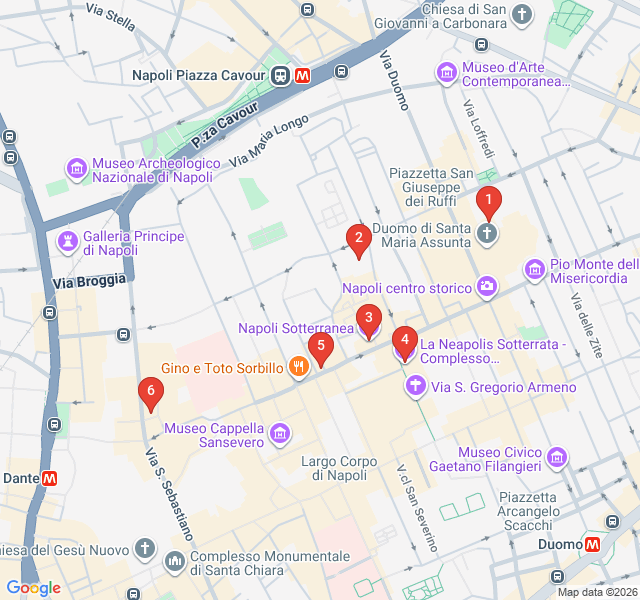
Numbers indicate the order of stops on the tour
Step inside the Cathedral of Naples, but look beyond the Baroque gold. Tucked in a corner is the Baptistery of San Giovanni in Fonte, widely considered the oldest in the Western world, dating back to the 4th century. As you enter, the noise of the city fades, replaced by the shimmer of late-antique mosaics. Look up at the vault to see early Christian symbols—the Phoenix, the Lamb of God, and the Tetramorph—rendered in vibrant blues and golds that have survived for over 1,600 years. This site marks the transition from Roman Neapolis to Christian Naples, built over a former Roman structure, setting the tone for the layers of history you are about to explore.
In Naples, the past isn't just under your feet; it's inside the houses. This Roman Theatre once held 6,000 spectators and hosted the Emperor Nero, who reportedly refused to stop singing even during an earthquake. Today, the theatre is almost entirely swallowed by the modern city. To see it, you often enter through a typical 'basso' (ground-floor apartment) on Via San Paolo. The brickwork of the Roman 'summa cavea' forms the foundations of the current buildings. It is a stunning example of urban recycling, where 1st-century arches now support 21st-century kitchens and bedrooms.
Descend 40 meters below the surface into a vast labyrinth of tufa stone. These caverns began as Greek quarries in the 4th century BC, were expanded into a sophisticated aqueduct system by the Romans, and eventually served as air-raid shelters for thousands of Neapolitans during the bombings of World War II. As you walk through the narrow tunnels, you'll see remains of the ancient water channels and poignant reminders of the war, including abandoned toys and graffiti left by those seeking safety. The sheer scale of this subterranean world explains how Naples was literally built using the stone carved from beneath its own foundations.
Beneath the Gothic church of San Lorenzo Maggiore lies one of the most impressive archaeological sites in the city. Here, you can walk down a real Roman street. This was the Macellum, the bustling central market of Roman Neapolis. You will see the remains of the 'tabernae' or shops, where merchants once sold grain, oil, and cloth. The level of preservation is incredible—you can still see the drainage systems and the stone counters of the shops. It is a rare opportunity to stand in a Roman marketplace while hearing the muffled bells of the medieval church ringing directly above you.
This stop introduces you to the unique Neapolitan relationship with death. The church is famous for the 'cult of the anime pezzentelle' (the lost souls). In the hypogeum (underground crypt), Neapolitans for centuries adopted anonymous skulls, cleaning them, placing them on cushions, and praying for them in exchange for protection or favors. The most famous is the skull of 'Lucia,' adorned with a bridal veil. This practice, though officially banned by the Church in the 1960s, continues in spirit today, representing a deep-seated local belief that the boundary between the living and the dead is easily crossed.
Your journey through the layers of Naples ends in the sunlight of Piazza Bellini. In the center of this bustling square, surrounded by cafes and bookstores, lies a deep pit containing the original Greek walls of Neapolis. These massive blocks of tufa stone date back to the 4th century BC. They were the city's primary defense against invaders. Today, they serve as a casual backdrop for student life and evening aperitivos. It is the perfect place to reflect on the fact that while dynasties and empires have fallen, the foundations of the city remain exactly where the Greeks placed them over two millennia ago.
Download Zigway to experience "Naples Underground: Layers of Ancient History" with AI-powered audio narration. Walk at your own pace while stories unfold around you.
 Moderate
Naples, Italy
Explore the vibrant street art, hidden shrines, and legendary Maradona murals in the heart of Naples' most iconic neighborhood.
 Challenging
Naples, Italy
Follow Elena and Lila’s journey through Naples. Explore the gritty streets and elegant plazas that defined Elena Ferrante’s Neapolitan Novels.
 Easy
EasyNaples, Italy
Explore the Bourbon legacy on this self-guided walk from the ornate Galleria Umberto I to the historic Ovo Castle overlooking the sea.
 Moderate
Naples, Italy
Explore Roman ruins, legendary seaside palaces, and breathtaking Mediterranean vistas on this self-guided stroll through Posillipo's coastal heights.
 Easy
EasyNairobi, Kenya
Explore Nairobi's architectural evolution from colonial-era landmarks to iconic Brutalist skyscrapers on this historic self-guided walking route.
 Easy
EasyNairobi, Kenya
Discover Nairobi's iconic skyline on this self-guided architecture walk through the CBD’s most famous modernist and Brutalist landmarks.
 Easy
EasyKrakow, Poland
Explore the prestigious Jagiellonian University district, featuring Neo-Gothic architecture, Baroque churches, and Krakow's hidden scholarly gems.
 Easy
EasyKrakow, Poland
Explore the historic heart of Kazimierz on this self-guided walk through synagogues, ancient cemeteries, and vibrant squares.
 Easy
EasyRome, Italy
Explore Rome’s industrial heart on this self-guided walk featuring massive murals, the 'Iron Colosseum,' and unique industrial archaeology.
 Easy
EasyRome, Italy
Explore Rome’s whimsical Fairytale District. A self-guided walk through Art Nouveau palaces, mythical fountains, and the magical Coppedè architecture.
 Moderate
Rome, Italy
Uncover Rome's hidden history on this self-guided walk through ancient gladiator pits, subterranean temples, and buried Roman houses.
 Challenging
Rome, Italy
Walk the 'Queen of Roads.' Explore ancient catacombs, imperial villas, and historic basalt stones on this scenic self-guided Roman adventure.
