Step away from the neon lights of Bourbon Street and onto the tranquil, oak-shaded promenade of Esplanade Avenue. Known historically as the 'Creole Millionaires' Row,' this grand thoroughfare served as the aristocratic answer to the American Sector's St. Charles Avenue. On this self-guided walk, you will explore a different side of New Orleans, where the city's French and Spanish roots blossomed into opulent 19th-century estates. This neighborhood stroll takes you through the heart of the Treme and Seventh Ward, areas rich with the stories of free people of color and the European elite who once defined the city's social hierarchy. As you wander beneath a canopy of centuries-old live oaks, the architecture tells a story of prestige and cultural identity. You will encounter landmarks like the Degas House, the only home and studio of the French Impressionist Edgar Degas in the United States, and the Pitot House, a rare surviving example of a late 18th-century West Indies-style plantation cottage. This route is a dream for those interested in photography and history, offering unobstructed views of Italianate, Greek Revival, and Queen Anne mansions. This walking route New Orleans enthusiasts love follows the avenue from the banks of Bayou St. John toward the edge of the French Quarter, or vice versa, culminating in the lush greenery of City Park. You will pass by the ornate marble tombs of St. Louis Cemetery No. 3, where the city's unique above-ground burial traditions are on full display. Unlike a standard walking tour New Orleans visitors might find in the crowded center, this path offers a peaceful, independent way to appreciate the city's layers of history, from its colonial beginnings to its Gilded Age peak. Discover the legacy of the Creole elite at your own pace, stopping to admire the intricate ironwork and sprawling gardens that make Esplanade Avenue one of the most beautiful streets in America.
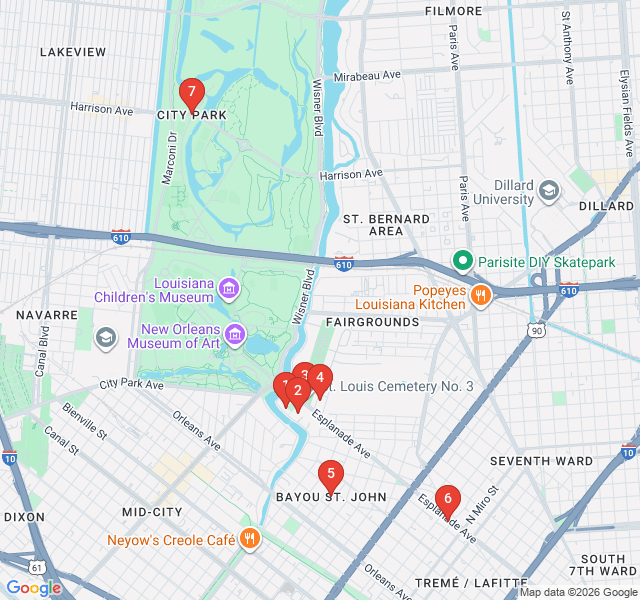
Numbers indicate the order of stops on the tour
Begin your self-guided adventure at the Pitot House, a stunning example of a late 18th-century 'country cottage.' Built around 1799, this house reflects the West Indies style brought to Louisiana by French settlers. It was named after James Pitot, the first democratically elected mayor of New Orleans, who lived here in the early 1800s. Notice the wide galleries and the use of 'briquette-entre-poteaux' (brick between posts) construction, designed to handle the humid climate and swampy terrain. This house was originally located closer to the bayou but was moved to its current spot to save it from demolition, serving as a testament to the city's preservation efforts.
As you continue, you will see the campus of Cabrini High School. This site holds deep spiritual and social significance for New Orleans. It was originally the Sacred Heart Orphan Asylum, founded by Mother Frances Xavier Cabrini, the first American citizen to be canonized as a saint. Mother Cabrini arrived in New Orleans in the late 1800s to serve the city’s large Italian immigrant population. The historic building you see today, with its grand facade, remains a centerpiece of the Esplanade Ridge, blending the city's Catholic educational heritage with the architectural elegance of the avenue.
Cross the street to explore St. Louis Cemetery No. 3. Opened in 1854, this cemetery is often considered the most beautiful of the city's 'Cities of the Dead' due to its wide aisles and elaborate marble tombs. Unlike the older cemeteries in the French Quarter, this one was planned with more space, allowing for grander family monuments. Look for the tombs of prominent Creole families and the Sisters of the Holy Family. The above-ground burial style here is both a practical response to the high water table and a cultural tradition inherited from Mediterranean Europe, creating a hauntingly beautiful landscape of stone and sculpture.
Tucked slightly back from the main road is the Luling Mansion, a hidden gem of the Gilded Age. Built in 1865 for Florence Luling, a wealthy cotton merchant, this 30-room Renaissance Revival palace was once surrounded by 30 acres of landscaped gardens and a private lake. It was designed by the famous architect James Gallier Jr. Though much of its original land was later sold off to become the New Orleans Fair Grounds, the mansion itself remains a powerful symbol of the immense wealth that flowed through New Orleans’ ports during the mid-19th century. Its scale and stone craftsmanship are rare for the neighborhood.
Take a moment to enjoy the breeze along Bayou St. John. Long before the French founded New Orleans, this natural waterway was a vital trade route for the Native American tribes of the region, who showed the French explorers how to use it as a back door to the city from Lake Pontchartrain. In the 19th century, it was a hub of activity for residents seeking recreation and cooling breezes. Today, it is a favorite local spot for kayaking and picnicking. The historic houses lining the bayou represent some of the oldest residential architecture in the city, predating many of the mansions on Esplanade.
The Degas House is a mandatory stop for art lovers. In 1872, the famous French Impressionist Edgar Degas traveled from Paris to New Orleans to visit his mother's family, the Mussons. During his stay, he painted several significant works here, including 'A Cotton Office in New Orleans.' This is the only home or studio of Degas that is open to the public anywhere in the world. The house itself was once a single large mansion but was later split into two separate residences. It stands as a bridge between the high art of 19th-century Europe and the complex social reality of the American South.
Your neighborhood stroll concludes at the entrance to City Park. Established in 1854, this is one of the oldest urban parks in the country and is roughly 50% larger than Central Park in New York. As you enter, look for the 'Dueling Oaks,' where gentlemen once settled matters of honor with swords or pistols. Today, the park is home to the New Orleans Museum of Art, the Botanical Garden, and the world's largest collection of mature live oaks. It is the perfect place to sit, reflect on your walk, and enjoy the moss-draped scenery that defines the spirit of the Deep South.
Download Zigway to experience "Esplanade Avenue: The Creole Millionaires' Row" with AI-powered audio narration. Walk at your own pace while stories unfold around you.
 Easy
EasyNew Orleans, United States
Explore the legendary restaurants and historic flavors of the New Orleans French Quarter on this delicious self-guided audio walk.
 Moderate
New Orleans, United States
Discover vibrant murals, iconic folk art, and industrial charm on this self-guided walking route through New Orleans' artistic Bywater district.
 Easy
EasyNew Orleans, United States
Discover the soul of New Orleans on this self-guided walk through the iconic jazz clubs and vibrant art markets of Frenchmen Street.
 Easy
EasyNew Orleans, United States
Explore the eerie history and supernatural legends of the French Quarter on this independent audio walk through New Orleans' most haunted corners.
 Moderate
Vienna, Austria
Discover the noir world of The Third Man and Cold War Vienna on this atmospheric self-guided audio walk through the historic Innere Stadt.
 Moderate
Gothenburg, Sweden
Discover Gothenburg’s maritime soul on this self-guided walk from the historic Central Station to the scenic riverfront at Stenpiren.
 Easy
EasyGothenburg, Sweden
Explore Gothenburg’s historic wooden houses, legendary giant cinnamon buns, and panoramic fortress views on this self-guided neighborhood stroll.
 Moderate
Vienna, Austria
Follow the footsteps of Mozart and Strauss through Vienna’s historic center on this self-guided walk through the city's rich musical history.
 Easy
EasyNew York City, United States
Explore the golden age of Manhattan architecture on this self-guided walk through Midtown's iconic Art Deco skyscrapers and historic landmarks.
 Easy
EasyNew York City, United States
Discover the literary legends, jazz haunts, and revolutionary history of Greenwich Village on this immersive self-guided walking route.
 Easy
EasyNew York City, United States
Explore Manhattan's transformation on this self-guided walk from the High Line to Hudson Yards.
 Easy
EasyNew York City, United States
Discover the world's finest cast-iron architecture and the evolution of fashion on this self-guided walking route through NYC's iconic SoHo district.
