Step into the past with a self-guided walk through the historic streets of Charleston, a city where the echoes of the American Civil War still resonate from every cobblestone corner. This walking route takes you through the heart of the 'Holy City,' focusing on the pivotal events and locations that shaped the mid-19th century. From the initial sparks of secession to the final days of the conflict, you will explore the urban landscape that witnessed the birth of a nation's greatest internal struggle. This neighborhood stroll offers a deep dive into the military and political history of the South, starting in the lush greenery of Washington Square and concluding at the bustling waterfront where the first shots were famously aimed toward Fort Sumter. Along the way, you will encounter grand civic architecture, solemn memorials, and hidden religious sites that survived the heavy bombardment of the Union siege. Discover the stories of the people who lived through these tumultuous times—from military strategists and wealthy merchants to the enslaved individuals who sought their freedom. This independent exploration allows you to absorb the atmosphere of Charleston at your own pace, providing context for the city's complex legacy. Whether you are a history buff or a first-time visitor, this walking tour Charleston experience provides an immersive look at the sites that defined a defining era in American history. Explore the Old Exchange, where the British once held prisoners and where revolutionary fervor paved the way for later rebellion, and see the Old Citadel, which transitioned from a military academy to a modern landmark. As you traverse the historic district, you will see how the Civil War's impact is etched into the very fabric of the city's buildings and monuments.
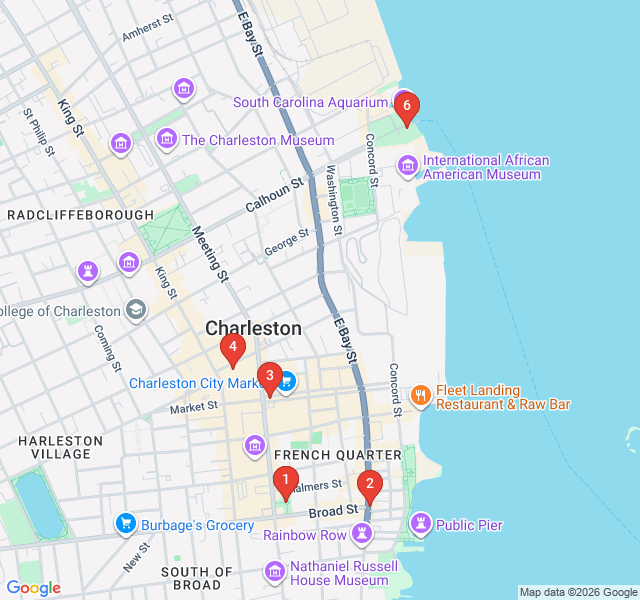
Numbers indicate the order of stops on the tour
Begin your self-guided adventure in Washington Square, a quiet park established in 1818. This square serves as a memorial garden for Charleston’s long history. Look for the obelisk dedicated to the Washington Light Infantry, which fought in both the Revolutionary and Civil Wars. You will also find a statue of Pierre Beauregard, the Confederate general who ordered the first shots fired on Fort Sumter. Adjacent to the park is the Fireproof Building, one of the most important architectural survivors of the era. Built in the 1820s, it was designed by Robert Mills, the same architect who designed the Washington Monument. Its sturdy construction protected vital records during the fires and bombardments that ravaged the city during the war years.
The Old Exchange is one of the most significant buildings in American history. Completed in 1771, it was the social and economic hub of the city. During the Civil War era, the area around the Exchange was frequently used for public auctions, including the sale of enslaved people, a somber reminder of the conflict's central causes. The building itself witnessed the reading of the Declaration of Independence and later became a site of great interest during the secession crisis. Its proximity to the harbor made it a target during the Union blockade. Today, it stands as a testament to Charleston’s resilience, having survived earthquakes, fires, and wartime shelling while maintaining its grand Palladian architecture.
Market Hall is a striking example of Greek Revival architecture, completed in 1841. This building served as the entrance to the city’s municipal market. During the Civil War, it became a recruitment center for Confederate soldiers. Since 1899, the upper floor has housed the Confederate Museum, operated by the United Daughters of the Confederacy. It contains a vast collection of artifacts, including uniforms, flags, and personal items from the soldiers who fought in the South. The building’s high-style design, featuring Doric columns and triglyphs decorated with bull and ram heads, reflects the wealth and ambition of Charleston on the eve of the conflict. It remains a focal point for understanding the local perspective on the war.
Saint Mary of the Annunciation is the mother church of Roman Catholicism in the Carolinas and Georgia. The current structure was completed in 1839 after a fire destroyed the previous building. During the Civil War, the church sat within the range of Union artillery located on Morris Island. While the building survived the 'Charleston Fire' of 1861, it suffered damage from the long-range shelling that targeted the city center. The church’s cemetery is a final resting place for many soldiers and citizens who lived through the war years. Its interior features beautiful murals and stained glass that offer a peaceful contrast to the turbulent military history of the surrounding blocks.
Now a luxury hotel, this impressive fortress-like building was originally the site of the Citadel Academy. Established in 1842, the military college was formed to provide a guard for the city's arsenal and to train young men for military service. Cadets from this academy were stationed at the battery on Morris Island and are credited with firing the first shots of the Civil War at the Union supply ship, Star of the West, in January 1861. The building served as the academy’s headquarters until the school moved to its current location in 1922. The central courtyard and thick walls are classic examples of 19th-century military architecture, designed to withstand siege and civil unrest.
Your walking route concludes at Liberty Square, the gateway to Fort Sumter. From here, you can look out across the harbor toward the man-made island where the first official battle of the Civil War took place on April 12, 1861. The fort was a symbol of federal authority that South Carolina could not tolerate after seceding from the Union. After a 34-hour bombardment, the Union garrison surrendered, marking the start of a four-year struggle. The waterfront area today is home to the Fort Sumter Visitor Education Center, which provides detailed exhibits on the causes of the war and the specific events leading up to the harbor conflict. It is the perfect place to reflect on the immense impact the war had on both Charleston and the United States.
Download Zigway to experience "Echoes of Secession: Civil War Sites of Charleston" with AI-powered audio narration. Walk at your own pace while stories unfold around you.
 Easy
EasyCharleston, United States
Explore the elegant streets of Harleston Village on this self-guided stroll through Charleston's most historic residential enclave.
 Easy
EasyCharleston, United States
Explore the neon lights and culinary gems of Upper King. Discover Charleston's modern nightlife and cultural evolution on this self-guided stroll.
 Easy
EasyCharleston, United States
Discover Charleston’s rich literary history on this self-guided walk past historic libraries, authors' homes, and iconic bookstores.
 Moderate
Charleston, United States
Discover the profound Gullah-Geechee influence and African American history of Charleston on this moving and educational self-guided walking route.
 Moderate
Warsaw, Poland
A powerful self-guided walk through Warsaw's WWII history, tracking the 1944 Uprising from ruined skyscrapers to solemn memorials.
 Moderate
Gdansk, Poland
Discover the origins of WWII in Gdansk on this self-guided walk through heroic last stands, massive museums, and strategic hilltop fortifications.
 Moderate
Warsaw, Poland
Explore the resilient spirit of Warsaw's Muranów district on this self-guided walk through the history and landmarks of the former Jewish Ghetto.
 Moderate
Helsinki, Finland
Explore the 'Gibraltar of the North' on this independent walking route through the historic bastions and hidden gardens of Suomenlinna Sea Fortress.
 Easy
EasyNew York City, United States
Explore the golden age of Manhattan architecture on this self-guided walk through Midtown's iconic Art Deco skyscrapers and historic landmarks.
 Easy
EasyNew York City, United States
Discover the literary legends, jazz haunts, and revolutionary history of Greenwich Village on this immersive self-guided walking route.
 Easy
EasyNew York City, United States
Explore Manhattan's transformation on this self-guided walk from the High Line to Hudson Yards.
 Easy
EasyNew York City, United States
Discover the world's finest cast-iron architecture and the evolution of fashion on this self-guided walking route through NYC's iconic SoHo district.
