Charleston is a city where every brick tells a story and every column speaks of a different era. This architectural eras walk invites you to explore the evolution of Southern design, from the early Georgian residences to the opulent Victorian mansions of the Gilded Age. As you begin your self-guided adventure through the historic district, you will notice how the city’s unique geography and climate influenced its 'Single House' style and grand piazzas. This walking route highlights the preservation efforts that have kept Charleston looking much as it did two centuries ago. Discover at your own pace the intricate ironwork, the famous 'flying' staircases, and the towering porticos that define the Holy City. Unlike a standard neighborhood stroll, this route focuses specifically on the technical and aesthetic shifts in American architecture between the late 18th and late 19th centuries. You will traverse the exclusive South of Broad neighborhood, where the concentration of historic wealth created a laboratory for competing architectural styles. Whether you are a fan of Neoclassical symmetry or the dramatic flares of the Greek Revival, this self-guided walking tour Charleston experience provides a deep dive into the structures that survived fires, earthquakes, and the Civil War. While a guided tour Charleston often focuses only on broad history, this architectural walk allows you to linger at the details of the Miles Brewton House or the Robert W. Roper House, appreciating the craftsmanship of a bygone era. By the time you reach the northern end of the route at the Manigault House, you will have a comprehensive understanding of how Charleston transitioned from a colonial outpost to a Victorian masterpiece. Prepare to see the city not just as a collection of pretty buildings, but as a chronological timeline of American ambition and artistry.
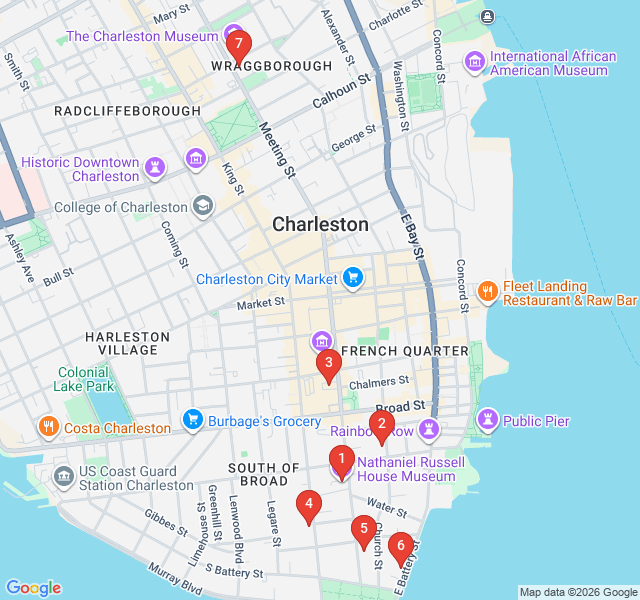
Numbers indicate the order of stops on the tour
Completed in 1808 for a wealthy merchant, the Nathaniel Russell House is a premier example of the Federal, or Adamesque, style. While the exterior is impressive with its red brick and white marble accents, the interior is where the architectural drama truly unfolds. It is home to a three-story cantilevered spiral staircase, often called a 'flying' staircase because it appears to float without visible support. As you stand before this house, note the delicate ironwork on the balconies, featuring Russell's initials. This house represents the peak of Charleston’s early 19th-century prosperity, showcasing a lightness and elegance that moved away from the heavier Colonial styles of the previous generation.
Built in 1772, this residence offers a contrast to the Russell House, showcasing the earlier Georgian style. It was the home of Thomas Heyward Jr., a signer of the Declaration of Independence. The building is famously named for George Washington, who stayed here during his week-long visit to Charleston in 1791. The architecture is characterized by its massive, symmetrical brickwork and formal garden layout. This stop highlights the transition from British colonial design to the independent American aesthetic. Pay attention to the 'double house' floor plan, which was a mark of status, allowing for four rooms per floor rather than the typical long, narrow 'single house' layout found elsewhere in the city.
Moving toward the civic heart of the city, Hibernian Hall stands as a monument to Charleston’s Irish heritage and the Greek Revival movement. Designed by Thomas U. Walter—the same architect who later designed the dome of the U.S. Capitol—and completed in 1840, it features a grand Ionic portico. The building has played a central role in Charleston's social and political life, most notably serving as the headquarters for the Northern Democrats during the contentious 1860 National Convention. Architecturally, it represents the shift toward the 'Classical' ideal, where buildings were designed to look like ancient temples, reflecting the young American republic's fascination with Greek democracy.
Considered one of the finest townhouses in the United States, the Miles Brewton House was built around 1769 in the High Palladian style. Its double-tiered portico is a masterclass in proportion and classical orders. One of the most striking features you can see from the street is the 'chevaux-de-frise,' the defensive iron spikes atop the walls, designed to protect the property during periods of social unrest. The house has a storied history of occupation; it served as British headquarters during the Revolutionary War and Union headquarters during the Civil War. Its survival through these conflicts makes it a rare, intact example of pre-Revolutionary luxury and architectural ambition.
Formerly known as the Calhoun Mansion, this 24,000-square-foot residence represents the Gilded Age's arrival in Charleston. Built in 1876 for George Williams, it is a Victorian-era marvel with 30 rooms and 23 fireplaces. While much of Charleston’s architecture is celebrated for its restraint, the Williams Mansion is all about excess. Its Italianate style features ornate cornices, expansive windows, and a 75-foot domed ceiling. This house was built during the Reconstruction era, signaling a return of capital to the city after the devastation of the Civil War. It stands as a testament to the eclectic tastes of the late 19th century, blending various historic styles into a singular, grand statement of wealth.
Standing prominently at the Battery, the Robert W. Roper House is impossible to miss. Built in 1838, it is a superlative example of the Greek Revival style on a monumental scale. The house is famous for its massive Ionic columns that support a two-story piazza, designed specifically to catch the harbor breezes. Look at the scale of the windows and the height of the ceilings, which were practical adaptations for the humid Southern climate before the advent of modern cooling. This house has become one of the most photographed buildings in America, symbolizing the 'Old South' aesthetic that many associate with Charleston’s historic waterfront and the grandeur of the antebellum period.
To conclude the walk, we travel slightly north to the Joseph Manigault House, an 1803 masterpiece of Federal architecture. Designed by Gabriel Manigault for his brother, this 'urban townhouse' is known for its delicate proportions and the use of geometric shapes, such as the semi-circular bow on the garden facade. It reflects the Huguenot influence on Charleston’s elite, emphasizing refined taste over sheer size. The gatehouse, or 'pauper's lodge,' is a unique feature of the property. This stop brings the architectural journey full circle, returning to the early Republic’s obsession with grace and symmetry, providing a quiet, elegant end to your exploration of the city's built history.
Download Zigway to experience "Columns and Courtyards: Architectural Eras Walk" with AI-powered audio narration. Walk at your own pace while stories unfold around you.
 Easy
EasyCharleston, United States
Explore the elegant streets of Harleston Village on this self-guided stroll through Charleston's most historic residential enclave.
 Easy
EasyCharleston, United States
Explore the neon lights and culinary gems of Upper King. Discover Charleston's modern nightlife and cultural evolution on this self-guided stroll.
 Easy
EasyCharleston, United States
Discover Charleston’s rich literary history on this self-guided walk past historic libraries, authors' homes, and iconic bookstores.
 Moderate
Charleston, United States
Discover the profound Gullah-Geechee influence and African American history of Charleston on this moving and educational self-guided walking route.
 Easy
EasyGothenburg, Sweden
Explore Gothenburg’s historic wooden houses, legendary giant cinnamon buns, and panoramic fortress views on this self-guided neighborhood stroll.
 Easy
EasyNairobi, Kenya
Discover Nairobi's iconic skyline on this self-guided architecture walk through the CBD’s most famous modernist and Brutalist landmarks.
 Moderate
Vienna, Austria
Discover the noir world of The Third Man and Cold War Vienna on this atmospheric self-guided audio walk through the historic Innere Stadt.
 Easy
EasyKrakow, Poland
Explore the historic heart of Kazimierz on this self-guided walk through synagogues, ancient cemeteries, and vibrant squares.
 Easy
EasyNew York City, United States
Explore the golden age of Manhattan architecture on this self-guided walk through Midtown's iconic Art Deco skyscrapers and historic landmarks.
 Easy
EasyNew York City, United States
Discover the literary legends, jazz haunts, and revolutionary history of Greenwich Village on this immersive self-guided walking route.
 Easy
EasyNew York City, United States
Explore Manhattan's transformation on this self-guided walk from the High Line to Hudson Yards.
 Easy
EasyNew York City, United States
Discover the world's finest cast-iron architecture and the evolution of fashion on this self-guided walking route through NYC's iconic SoHo district.
