Stepping into Vienna’s third district, Landstraße, feels like walking through a living gallery of European history and imperial ambition. This self-guided walk invites you to explore the Belvedere complex, a UNESCO World Heritage site that serves as one of the world’s most stunning examples of Baroque architecture. Originally commissioned by Prince Eugene of Savoy, a brilliant military commander, the two palaces and the connecting tiered gardens were designed to showcase power, wealth, and a refined aesthetic. Today, the area is just as famous for the treasures housed within its walls—most notably the world’s largest collection of paintings by Gustav Klimt, including the iconic 'The Kiss'. This walking route begins at the powerful Hochstrahlbrunnen fountain and the somber Soviet War Memorial, providing a historical bridge between the imperial era and the mid-20th century. As you move toward the Lower Belvedere, you’ll transition from the bustling city into the serene, structured beauty of the Baroque age. The heart of the experience lies in the Belvedere-Schlossgarten, a meticulously designed landscape that uses symmetry, statues, and water features to create a sense of infinite perspective. Climbing through the gardens toward the Upper Belvedere offers one of the most famous views of Vienna’s skyline. While many travelers visit for the art, this neighborhood stroll allows you to appreciate the architectural harmony and the botanical diversity of the neighboring University of Vienna Botanical Garden. Whether you are an art aficionado or a history enthusiast, this walking route Vienna provides a flexible way to experience the city's Golden Age at your own pace. Discover the stories of the Habsburgs and the genius of architect Johann Lukas von Hildebrandt without the constraints of a rigid schedule. This travel experience is perfect for those who want to blend a leisurely park visit with world-class cultural heritage.
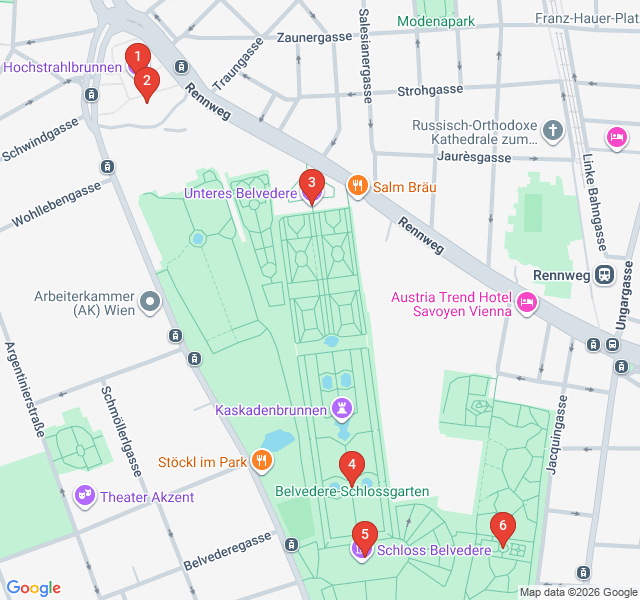
Numbers indicate the order of stops on the tour
Start your journey at the Hochstrahlbrunnen, a magnificent fountain built in 1873 to celebrate the completion of Vienna's first mountain spring water pipeline. At the time, bringing fresh water from the Alps to the city was a feat of engineering that drastically improved public health. The fountain’s design is rich with symbolism: the 365 small fountains at the edge represent the days of the year, while the seven jets in the middle represent the days of the week. Look for the 12 larger jets that signify the months. In the evening, the fountain is often illuminated in vibrant colors, but even by day, it serves as a refreshing gateway to the diplomatic quarter and the Belvedere palaces beyond.
Just behind the fountain stands a semi-circular colonnade and a towering bronze statue of a Soviet soldier. This is the Heldendenkmal der Roten Armee, erected in 1945 to commemorate the 17,000 Soviet soldiers who died during the Battle of Vienna at the end of World War II. It serves as a stark reminder of the city's complex 20th-century history. Despite the changing political tides over the decades, the monument remains a permanent fixture of the city's landscape, protected by the Austrian State Treaty. The soldier holds a shield and a flag, standing atop a high pedestal that dominates the square, marking the transition from the modern city to the imperial grounds.
As you enter the Belvedere grounds, you first encounter the Lower Belvedere. This was the residential palace of Prince Eugene of Savoy. While the Upper Belvedere was built for prestige and entertaining, this building was more personal and intimate. Architecture fans will notice the work of Johann Lukas von Hildebrandt, who used rich stucco work and frescoes to create a luxurious domestic space. Today, the Lower Belvedere and the adjacent Orangery host world-class temporary art exhibitions. Don't miss the Hall of Grotesques and the Marble Gallery, which still retain their original 18th-century splendor, reflecting the Prince’s immense wealth and sophisticated taste in art and design.
Walking between the two palaces, you are now in the Schlossgarten, the oldest part of the complex. This is a classic French-style Baroque garden designed by Dominique Girard, a student of the landscape architect who worked on Versailles. The garden is laid out on three levels, connected by grand staircases and flanked by sphinxes—mythical creatures symbolizing strength and wisdom. The design is based on the concept of 'nature subdued by art,' with perfectly manicured hedges and symmetrical flower beds. As you walk uphill, the view of the Upper Belvedere framed by the gardens becomes increasingly dramatic, offering one of the most iconic photo opportunities in all of Vienna.
You have reached the crowning jewel of the estate: the Upper Belvedere. Completed in 1723, this palace was designed to serve as a grand reception hall and a gallery for the Prince’s vast art collection. Its silhouette, with its distinctive rooflines and ornate white facade, is a masterpiece of the high Baroque. While the exterior is breathtaking, the interior is legendary for housing the Austrian Gallery, including the largest collection of works by Gustav Klimt. This is where you can find 'The Kiss' and 'Judith'. The palace also offers a magnificent view over the garden toward the city center, a perspective often referred to as the 'Canaletto view' after the famous painter who captured it.
To finish your walk, step into the peaceful University of Vienna Botanical Garden, located right next to the Upper Belvedere. Founded in 1754 by Empress Maria Theresa on the advice of her personal physician, it was originally designed as a medicinal herb garden. Today, it spans eight hectares and houses over 11,500 plant species from around the world. It offers a wonderful, less-structured contrast to the formal Baroque gardens you just walked through. It’s a favorite spot for locals to escape the city noise. Wander through the arboretum or explore the tropical greenhouses to conclude your independent exploration of Vienna's green and golden heritage.
Download Zigway to experience "Baroque Gardens and Golden Art: The Belvedere Circuit" with AI-powered audio narration. Walk at your own pace while stories unfold around you.
 Easy
EasyVienna, Austria
Explore Vienna’s vibrant open-air gallery along the Danube Canal on this self-guided street art and nightlife stroll through Leopoldstadt.
 Moderate
Vienna, Austria
Follow the footsteps of Mozart and Strauss through Vienna’s historic center on this self-guided walk through the city's rich musical history.
 Moderate
Vienna, Austria
Discover the noir world of The Third Man and Cold War Vienna on this atmospheric self-guided audio walk through the historic Innere Stadt.
 Easy
EasyVienna, Austria
Discover the literary haunts and architectural gems of Vienna's legendary coffee culture on this self-guided stroll through the historic city center.
 Easy
EasyGdansk, Poland
Discover the opulent Royal Way of Gdansk at your own pace. Explore Hanseatic history, gilded architecture, and the iconic Neptune's Fountain.
 Easy
EasyGothenburg, Sweden
Explore Gothenburg's elegant academic district, featuring grand 19th-century stone architecture and the iconic cultural hub of Götaplatsen.
 Easy
EasyNairobi, Kenya
Discover Nairobi's iconic skyline on this self-guided architecture walk through the CBD’s most famous modernist and Brutalist landmarks.
 Easy
EasyGdansk, Poland
Discover the 'Baltic Gold' on this self-guided walk through Gdansk's historic mills, massive cathedrals, and the magical Mariacka Street.
 Easy
EasySalzburg, Austria
Discover the 'Rome of the North' on this self-guided walk through the Baroque squares and monumental legacy of Salzburg’s Prince-Archbishops.
 Easy
EasySalzburg, Austria
Discover Salzburg's oldest medieval alley, the birthplace of the 'Silent Night' author, and breathtaking views on this quiet self-guided walk.
 Easy
EasySalzburg, Austria
Walk through the iconic filming locations of The Sound of Music and discover the real history of the von Trapp family in Salzburg.
 Challenging
Salzburg, Austria
Scale the heights of Salzburg on this self-guided walk to the Hohensalzburg Fortress, exploring medieval walls and ancient monastic grounds.
