Cholon, the historic Chinatown of Ho Chi Minh City, is a sensory explosion where ancient traditions thrive amidst the hum of a modern metropolis. This self-guided walk invites you to explore District 5, an area defined by its Cantonese, Teochew, and Fujianese heritage. Unlike the sleek skyscrapers of District 1, Cholon preserves a gritty, authentic charm, where the air is thick with the scent of medicinal herbs and sandalwood incense. As you navigate these streets independently, you will discover that this neighborhood is much more than a commercial hub; it is a spiritual sanctuary where centuries-old assembly halls and pagodas stand as pillars of the community. This neighborhood stroll takes you through the architectural evolution of the city. You will witness the grand French-influenced design of Binh Tay Market, the surprising Chinese-Gothic fusion of St. Francis Xavier Church, and the intricate porcelain artistry of Thien Hau Pagoda. This walking route is designed for those who want to peel back the layers of local history at their own pace. Along the way, you will encounter the legacy of Quach Dam, the merchant king of Cholon, and reflect on the dramatic moments of the 20th century that unfolded within these very walls. Whether you are a photography enthusiast looking for the perfect shot of sunlight filtering through incense coils or a history buff eager to understand the ethnic diversity of Vietnam, this audio walk provides the context you need. Exploring Cholon on a walking tour Ho Chi Minh City style allows you to pause whenever a hidden alleyway or a steaming bowl of noodles catches your eye. This is an invitation to witness the living history of the Hoa people, whose traditions remain the heartbeat of District 5. By choosing a self-guided adventure, you can truly immerse yourself in the vibrant local life, from the frantic energy of the wholesale markets to the profound silence of the inner temple courtyards. A walking tour Ho Chi Minh City experience in Cholon is incomplete without visiting the assembly halls that served as both community centers and places of worship, showcasing the most exquisite woodcarvings and ceramic reliefs in the country.
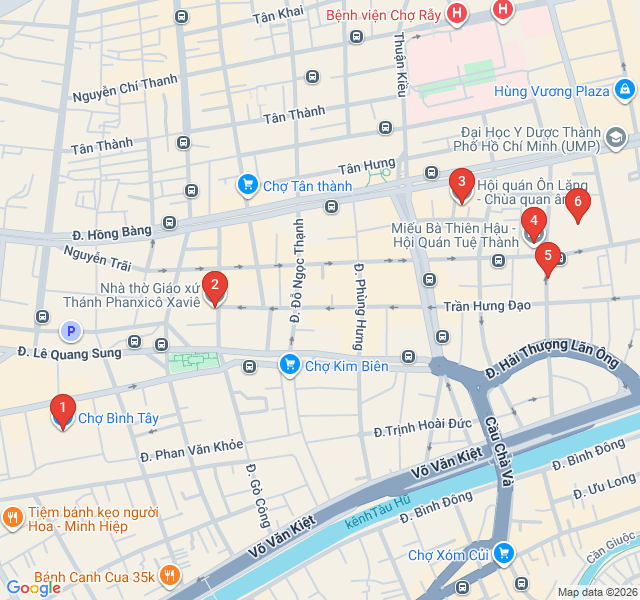
Numbers indicate the order of stops on the tour
Begin your self-guided adventure at Binh Tay Market, the beating heart of Cholon. Built in the late 1920s, this market was funded by a wealthy Cantonese merchant named Quach Dam, whose statue once stood in the central courtyard. Notice the unique architectural blend: the ochre walls and tiled roofs reflect French colonial influence, while the dragon motifs and central tower are distinctly Chinese. This is a wholesale market, so the energy here is frantic and authentic. As you walk through the aisles, you will see everything from dried seafood to colorful textiles. It is a testament to the commercial spirit of the Hoa people who transformed this swampy land into a thriving trade hub.
Known locally as Cha Tam, this church is a fascinating cultural anomaly. Built in 1900, it serves the local Catholic Chinese community. Look closely at the entrance, where you will see Chinese characters and traditional red lanterns alongside Western Gothic arches. Inside, the fusion continues with a primary altar decorated in typical Chinese style. Beyond its architecture, this site holds significant modern history. It was here in 1963 that South Vietnamese President Ngo Dinh Diem and his brother Nhu sought refuge during a military coup, shortly before their capture. It is a quiet place of reflection that bridges the many worlds of Cholon.
This assembly hall, also known as the On Lang Pagoda, was established by the Fujianese community in the mid-19th century. Dedicated to Quan Am, the Goddess of Mercy, it is a masterpiece of ornate woodwork and colorful ceramic reliefs. As you enter, look up at the intricate roofline decorated with dragons and phoenixes. The interior is often filled with the heavy scent of incense and the sound of rhythmic chanting. Take a moment to observe the detailed carvings on the wooden pillars, which depict scenes from Chinese folklore. This space illustrates how assembly halls functioned as both religious sanctuaries and community support networks for immigrants.
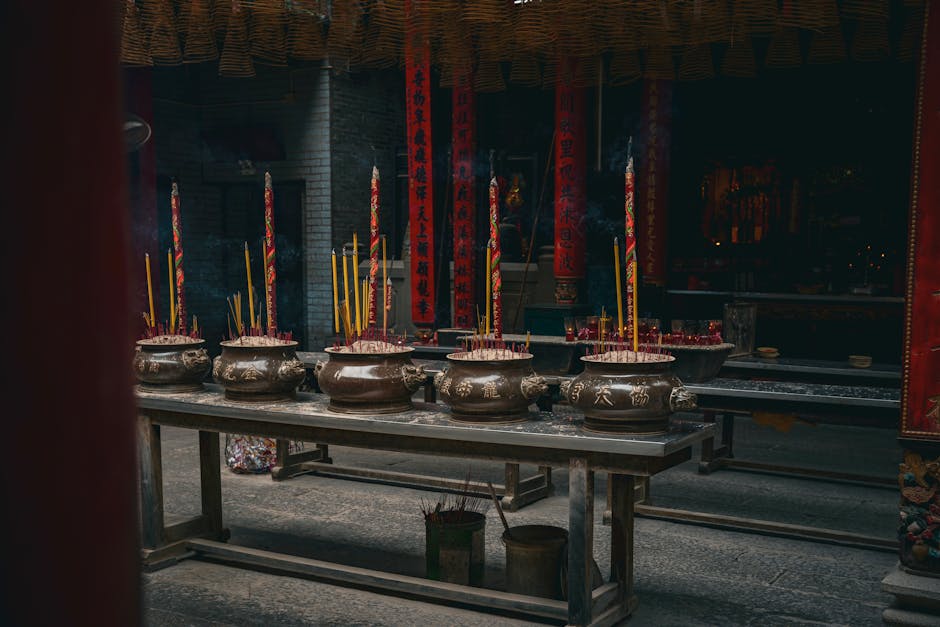
Dedicated to Mazu, the Goddess of the Sea, Thien Hau is one of the oldest and most beautiful temples in Ho Chi Minh City. Established in 1760 by Cantonese immigrants, it was built to thank the goddess for their safe passage across the South China Sea. The courtyard is famous for its massive hanging incense coils, which can burn for weeks at a time. Do not miss the exquisite porcelain dioramas that line the roof and walls; they depict scenes from 19th-century Chinese city life and mythology with incredible detail. The play of light through the open roof makes this a favorite spot for photographers and seekers of peace.
A short walk away lies the Tam Son Hoi Quan, a smaller but deeply significant temple built by the Fukien congregation in the 19th century. While it was originally dedicated to the Goddess of the Sea, it has become a popular site for those praying for fertility and the well-being of children. The temple is vibrant with red and gold decor, and the atmosphere is notably more intimate than the larger pagodas. Look for the statues of the 'Twelve Midwives' who are believed to protect infants. It is a wonderful example of how personal and communal traditions intertwine in the daily lives of District 5 residents.
Concluding your neighborhood stroll is the Nghia An Assembly Hall, a stunning Teochew temple dedicated to General Guan Yu, a symbol of loyalty and bravery. The architecture here is grand, featuring a large courtyard and impressive woodcarvings gilded in gold. The Teochew style is distinct from the Cantonese style seen earlier, characterized by different roof shapes and decorative motifs. Look for the massive wooden door guards and the large incense burner in the center. Inside, the statues are draped in rich silks, and the craftsmanship of the altars is among the finest in the city. It is a powerful finale to your exploration of Cholon's spiritual heritage.
Download Zigway to experience "Cholon's Ancient Temples and Traditions" with AI-powered audio narration. Walk at your own pace while stories unfold around you.
 Moderate
Ho Chi Minh City, Vietnam
Explore the history of the Vietnam War at your own pace through iconic landmarks and hidden clandestine sites in Districts 1 and 3.
 Moderate
Ho Chi Minh City, Vietnam
Explore Saigon’s coffee evolution from 1930s clay-pot brews to modern specialty roasters on this self-guided walk through District 1 and 3.
 Easy
EasyHo Chi Minh City, Vietnam
Discover the vibrant spirituality and stunning architecture of District 3, from serene pagodas to the iconic Pink Church.
 Moderate
Ho Chi Minh City, Vietnam
Explore the bold lines and tropical soul of Southern Modernism on this self-guided architecture walk through Saigon's District 3.
 Easy
EasyKrakow, Poland
Explore the prestigious Jagiellonian University district, featuring Neo-Gothic architecture, Baroque churches, and Krakow's hidden scholarly gems.
 Easy
EasyKrakow, Poland
Explore the historic heart of Kazimierz on this self-guided walk through synagogues, ancient cemeteries, and vibrant squares.
 Easy
EasySalzburg, Austria
Discover the 'Rome of the North' on this self-guided walk through the Baroque squares and monumental legacy of Salzburg’s Prince-Archbishops.
 Moderate
Gdansk, Poland
Discover the origins of WWII in Gdansk on this self-guided walk through heroic last stands, massive museums, and strategic hilltop fortifications.
 Moderate
Hanoi, Vietnam
Discover Hanoi's resilient spirit on this self-guided audio walk through wartime bunkers, historic prisons, and military landmarks.
 Easy
EasyHanoi, Vietnam
Discover Hanoi's spiritual heart and scenic vistas on an independent stroll featuring ancient pagodas, colonial architecture, and sunset lake views.
 Easy
EasyHanoi, Vietnam
Explore Hanoi's diverse spiritual heritage on this self-guided walk through historic pagodas, a Neo-Gothic cathedral, and lakeside temples.
 Easy
EasyHanoi, Vietnam
Discover Hanoi's vibrant soul through railway-side murals, historic tracks, and the record-breaking Ceramic Road on this self-guided walk.
