Oslo has undergone one of the most radical urban transformations in Europe, turning a gritty industrial harbor into a shimmering glass-and-marble cultural hub. This self-guided walk invites you to explore Bjørvika, the heart of the 'Fjord City' project, where world-class architecture meets the cold, clear waters of the Oslofjord. As you follow this neighborhood stroll, you will witness how the city has reclaimed its shoreline, replacing highways and container ports with public plazas and iconic museums. This route is a dream for photography enthusiasts and fans of contemporary design, offering a perspective on a city that is looking firmly toward the future. This walking route Oslo enthusiasts often recommend begins at the striking Deichman Bjørvika library, a structure that redefines what a public space can be. From there, the path leads you across the sloping white marble roof of the Oslo Opera House, an architectural feat that looks like an iceberg rising from the sea. You will then encounter the towering presence of the Munch Museum, a vertical gallery that houses the world's largest collection of Edvard Munch's work. The journey continues through the Barcode Project, a series of narrow, high-rise buildings that have redefined the city skyline. Each building was designed by a different firm, creating a diverse visual rhythm. As you cross the Akrobaten pedestrian bridge, you'll find the perfect vantage point to capture the geometry of the new city. The walk concludes at Sørenga, a residential pier where urban life meets the water, complete with a seawater pool and stunning views back toward the city's historic core. This self-guided adventure allows you to appreciate the intricate details of Norwegian architecture at your own pace, away from the constraints of a traditional guided tour Oslo visitors might otherwise find restrictive. Whether you are interested in the sustainable materials used in construction or simply want to find the best angles for your photos, the Fjordfront route provides a comprehensive look at the new Oslo.
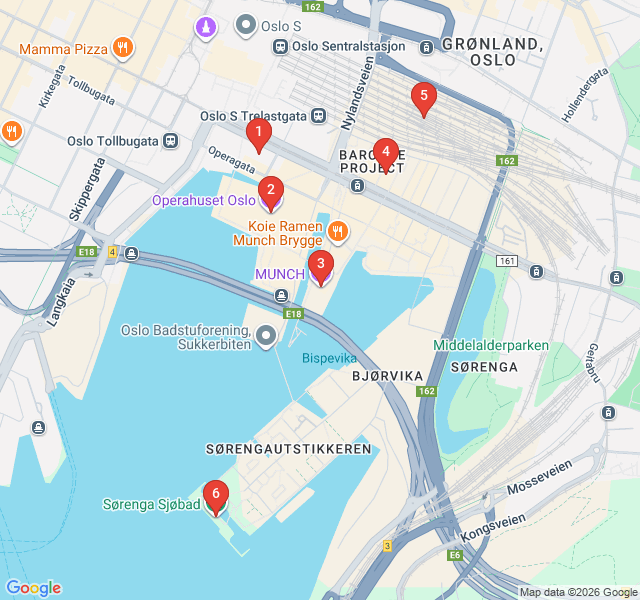
Numbers indicate the order of stops on the tour
Welcome to the start of your self-guided walk. Deichman Bjørvika is not just a library; it is Oslo's modern 'living room.' Opened in 2020, this building was designed by Lund Hagem and Oslo Works. Look up at the top floor—it cantilevers out 20 meters over the plaza, providing shade and a unique silhouette. The interior is organized around three light shafts that cut through the building, ensuring every floor is bathed in natural light. It houses over 450,000 books, but also a cinema, workshops, and recording studios. The design reflects a commitment to open access and sustainability, serving as a beacon of modern Norwegian civic pride.
Just a short walk away is the building that started the waterfront revolution: the Oslo Opera House. Designed by the world-renowned firm Snøhetta and completed in 2008, it is constructed of Italian Carrara marble and white granite. The genius of the design lies in its accessibility; the roof slopes down to the water, inviting you to walk all the way to the top. This 'carpet' of marble creates a massive public plaza that offers some of the best views of the fjord. Inside, the main auditorium is shaped like a horseshoe, inspired by traditional theaters but wrapped in warm, sustainably sourced oak.
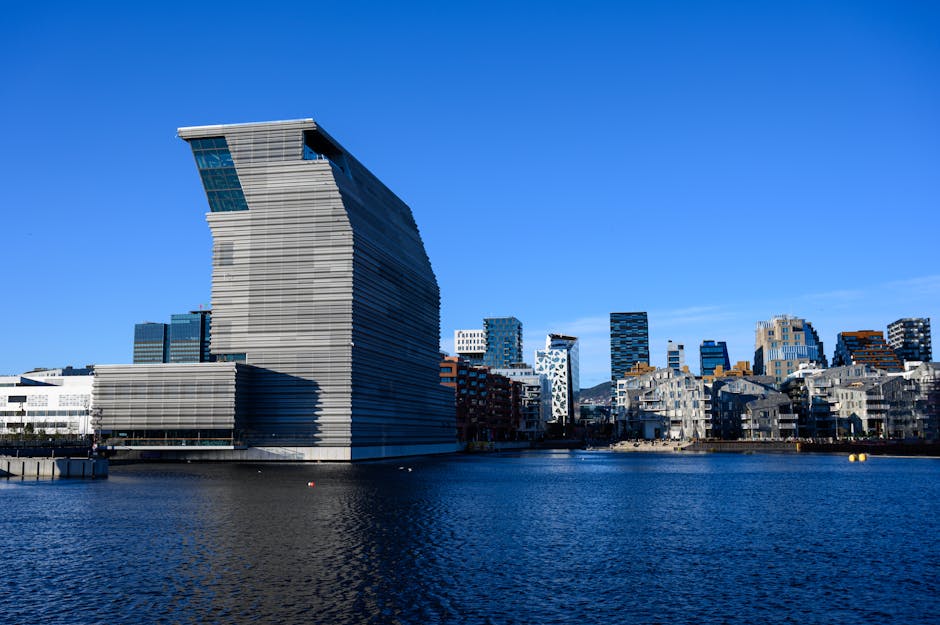
Standing tall next to the Opera is the Munch Museum, designed by Spanish architect Juan Herreros. This 13-story tower is wrapped in a translucent, perforated aluminum skin that reflects the changing light of the Oslo sky. The most distinctive feature is the 'kink' or leaning top section, which houses an observation deck. Inside, the museum is built on a vertical concept, with galleries stacked to maximize space on a compact footprint. It was a controversial design when first proposed, but it has quickly become a landmark of the Fjordfront, housing the legacy of Norway's most famous artist.
Turn your gaze inland to see the Barcode Project. This row of 12 multi-purpose high-rise buildings resembles a barcode from a distance. Each building is narrow with varying heights and architectural styles, designed by different firms to ensure visual diversity. The concept was to maintain 'porosity'—ensuring that light and air can still reach the historic city center behind the development. Notice the intricate facades, from the jagged 'staircase' of the DnB building to the geometric patterns of the PwC tower. This area is the financial heart of the new Oslo, blending workspace with luxury apartments.
To get the best view of the Barcode, step onto the Akrobaten (The Acrobat) Bridge. This 206-meter-long steel and glass pedestrian bridge spans the tracks of Oslo Central Station. Its name comes from the dynamic, geometric steel structures that support it, resembling an acrobat in mid-air. It connects the Bjørvika neighborhood with Grønland. From here, you can see the contrast between the sleek modernism of the Fjordfront and the traditional brick buildings of the older city. It is a favorite spot for photographers, especially at night when the bridge and the Barcode buildings are illuminated.
Your final stop is Sørenga, a former container terminal transformed into a vibrant residential neighborhood. The highlight here is the Sjøbad, or seawater pool. This floating park offers a beach, a diving board, and lanes for lap swimming directly in the fjord. Even in winter, you might see brave locals taking a 'cold plunge' before heading to a nearby sauna. Looking back toward the city, you have an uninterrupted view of the Opera House and Munch Museum. It is the perfect place to sit, relax, and reflect on the incredible architectural journey you've just completed.
Download Zigway to experience "The Fjordfront: Architecture of the New Oslo" with AI-powered audio narration. Walk at your own pace while stories unfold around you.
 Easy
EasyOslo, Norway
Explore Oslo's 'Thief Island' on this self-guided walk through cutting-edge architecture, world-class galleries, and stunning fjord-side sculptures.
 Easy
EasyOslo, Norway
Discover Oslo's most charming 18th-century wooden houses and medieval history on this peaceful self-guided stroll through hidden hillside lanes.
 Moderate
Oslo, Norway
Discover Oslo's 1,000-year history on this self-guided walk from the medieval Akershus Fortress to the ancient ruins of the Old Town.
 Moderate
Oslo, Norway
Step into Harry Hole's shoes on this self-guided walk through the gritty streets and iconic haunts of Oslo’s most famous fictional detective.
 Easy
EasyGdansk, Poland
Discover the 'Baltic Gold' on this self-guided walk through Gdansk's historic mills, massive cathedrals, and the magical Mariacka Street.
 Easy
EasyGdansk, Poland
Discover the opulent Royal Way of Gdansk at your own pace. Explore Hanseatic history, gilded architecture, and the iconic Neptune's Fountain.
 Easy
EasyWarsaw, Poland
Explore the miracle of Warsaw's reconstructed Old Town on this self-guided walk through royal squares, medieval walls, and heroic monuments.
 Easy
EasyGothenburg, Sweden
Explore Gothenburg's elegant academic district, featuring grand 19th-century stone architecture and the iconic cultural hub of Götaplatsen.
 Easy
EasyBergen, Norway
Explore Bergen's vibrant craft beer scene and historic pubs on this self-guided audio walk through the atmospheric Sentrum district.
 Easy
EasyBergen, Norway
Discover Bergen's rich literary heritage on this self-guided walk through the city's historic theaters, libraries, and monuments of great writers.
 Easy
EasyBergen, Norway
Explore Bergen's charming Nordnes peninsula at your own pace, featuring narrow wooden alleys, historic fortresses, and stunning fjord views.
 Moderate
Bergen, Norway
Explore Bergen’s steepest alleys and hidden wooden neighborhoods on this self-guided photography walk through the historic Fjellsiden district.
