Oslo's Frogner neighborhood holds a grand open-air gallery dedicated to the raw complexity of the human experience. This self-guided walking route through the Vigeland installation explores the life's work of Gustav Vigeland, a sculptor who struck a unique deal with the city of Oslo: he would gift them his entire creative output in exchange for a studio and an eventual museum. The result is the world's largest sculpture park created by a single artist, featuring over 200 works in bronze, granite, and wrought iron. As you follow this neighborhood stroll, you will encounter the full spectrum of human life, from the innocence of childhood and the passion of youth to the reflections of old age and the finality of death. This is not just a collection of statues; it is a narrative of existence carved into stone. This walking tour Oslo residents and visitors alike cherish provides a deep dive into the artist's psyche without the constraints of a rigid schedule. You will start at the artist's former studio, now a museum, before entering the lush greenery of Frogner Park. Highlights include the iconic 'Angry Boy,' whose bronze hand glows from the touch of millions, and the soaring Monolith, a pillar of 121 human figures striving for the divine. The route concludes at the Wheel of Life, a symbolic representation of eternity. This exploration allows for personal reflection at your own pace, making it a perfect way to experience one of Norway's most visited cultural sites. Whether you are an art enthusiast or simply looking for a peaceful walk, the Vigeland installation offers a profound look at what it means to be human in a setting of unparalleled Scandinavian beauty.
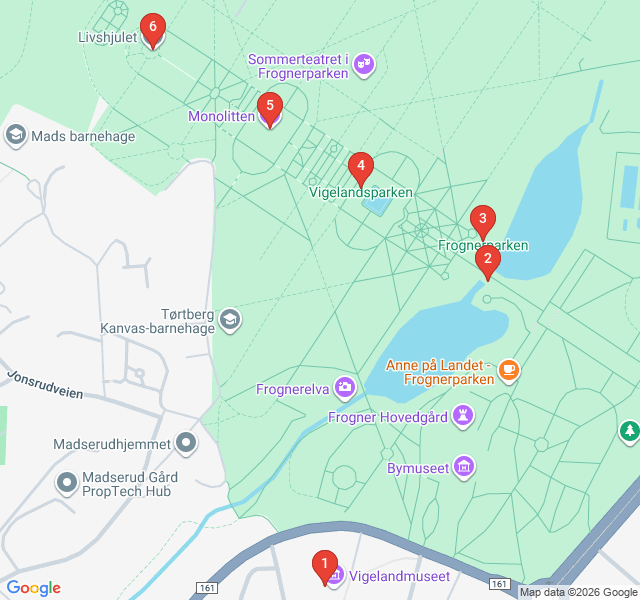
Numbers indicate the order of stops on the tour
Begin your self-guided adventure at the Vigeland Museum, located just south of the park. This red brick building was once Gustav Vigeland’s home and studio. In 1921, the artist made a remarkable deal with the city of Oslo: they would build him this space, and in return, he would donate all his future works to the public. Today, the museum houses the original plaster casts of the sculptures you will see in the park, as well as his woodcuts and drawings. It offers a quiet, intimate look at the man behind the monumental granite. Notice the architectural style, which bridges the gap between Neoclassicism and Modernism, setting the stage for the artistic journey ahead.
As you move onto the bridge within the park, look for 'Sinnataggen,' or 'The Angry Boy.' This is perhaps the most famous inhabitant of the park. This small bronze figure, captured in the middle of a toddler's tantrum, has become an unofficial symbol of Oslo. Despite his fury, he is clearly well-loved; you’ll notice his left hand is shiny and gold. This is the result of decades of visitors holding his hand for luck or a photo. Vigeland had a unique talent for capturing the raw, unpolished emotions of childhood, and this sculpture is the pinnacle of that ability, showing that even a moment of anger can be immortalized as art.
While the sculptures are the main attraction, the surrounding Frogner Park provides the essential canvas. This is Oslo’s largest public park and a favorite local hangout. Historically, this area was part of the Frogner Manor estate. Today, it serves as a democratic space where art and recreation coexist. As you walk between the sculpture installations, take a moment to observe the locals jogging, picnicking, or playing in the massive rose gardens, which contain over 14,000 plants. The park’s layout was largely designed by Vigeland himself, ensuring that the landscape directs your gaze toward his masterpieces while providing a sense of openness and tranquility.
You are now in the heart of the central axis of the Vigeland installation. This area includes the Bridge, the Fountain, and the Monolith Plateau. The Bridge itself is 100 meters long and lined with 58 bronze sculptures. These figures represent people of different ages and genders, exploring the relationships between parents and children, as well as men and women. Further along, you see the Fountain, the oldest part of the park's plan. It is surrounded by 20 bronze trees where human figures are intertwined with branches, representing the idea that from death comes new life. The sheer scale of this bronze work is a testament to Vigeland's obsession with the continuity of existence.
Standing at the highest point of the park is the Monolith. This 17-meter-tall column was carved from a single piece of solid granite. It took three stonecarvers fourteen years to complete, working from Vigeland’s plaster model. The column features 121 human figures struggling and climbing upward. Interpretations vary: some see it as a depiction of the resurrection, others as a representation of the human desire to reach for the divine or simply the struggle for survival. Surrounding the Monolith are 36 granite groups representing the cycle of life, from birth to old age. The elevated position offers a panoramic view back across the park toward the city.
The final stop on this neighborhood stroll is the Wheel of Life, located at the western end of the park's main axis. Cast in bronze in 1933-34, this sculpture is a wreath of seven human figures—four adults and three children—intertwined in a circle. It serves as a visual summary of the entire park's theme: the journey of a human life from the cradle to the grave and back again. There is no beginning and no end to the circle, suggesting an eternal harmony. It is a peaceful place to conclude your walk, looking back over the path you’ve taken through the park and reflecting on the universal stories Vigeland told through his art.
Download Zigway to experience "Vigeland's Masterpiece: The Human Cycle in Stone" with AI-powered audio narration. Walk at your own pace while stories unfold around you.
 Easy
EasyOslo, Norway
Discover Oslo's stunning modern waterfront on this self-guided walk through the innovative Bjørvika district and its iconic architecture.
 Easy
EasyOslo, Norway
Explore Oslo's 'Thief Island' on this self-guided walk through cutting-edge architecture, world-class galleries, and stunning fjord-side sculptures.
 Easy
EasyOslo, Norway
Discover Oslo's most charming 18th-century wooden houses and medieval history on this peaceful self-guided stroll through hidden hillside lanes.
 Moderate
Oslo, Norway
Discover Oslo's 1,000-year history on this self-guided walk from the medieval Akershus Fortress to the ancient ruins of the Old Town.
 Easy
EasyNairobi, Kenya
Discover Nairobi's iconic skyline on this self-guided architecture walk through the CBD’s most famous modernist and Brutalist landmarks.
 Easy
EasyNairobi, Kenya
Explore Nairobi's architectural evolution from colonial-era landmarks to iconic Brutalist skyscrapers on this historic self-guided walking route.
 Easy
EasyKrakow, Poland
Uncover Krakow's legendary past on this self-guided walk from literary monuments to the fire-breathing Wawel Dragon.
 Easy
EasyInnsbruck, Austria
Uncover the myths and legends of Innsbruck on this self-guided walk through the historic Altstadt and beyond.
 Easy
EasyBergen, Norway
Explore Bergen's vibrant craft beer scene and historic pubs on this self-guided audio walk through the atmospheric Sentrum district.
 Easy
EasyBergen, Norway
Discover Bergen's rich literary heritage on this self-guided walk through the city's historic theaters, libraries, and monuments of great writers.
 Easy
EasyBergen, Norway
Explore Bergen's charming Nordnes peninsula at your own pace, featuring narrow wooden alleys, historic fortresses, and stunning fjord views.
 Moderate
Bergen, Norway
Explore Bergen’s steepest alleys and hidden wooden neighborhoods on this self-guided photography walk through the historic Fjellsiden district.
