Frankfurt is often defined by its gleaming skyline and financial heart, but a shift toward the east reveals a completely different character. The Ostend district is where the city’s industrial past meets a bold, creative future. This self-guided walk invites you to explore a neighborhood that has transformed from a gritty harbor zone into a hub for avant-garde architecture and underground culture. You will begin at the towering presence of the European Central Bank, a site that perfectly encapsulates the area's evolution by merging a historic 1920s fruit and vegetable market with a futuristic glass skyscraper. As you move away from the glass and steel, the route takes you along the banks of the Main, where the atmosphere shifts toward the raw and the reclaimed. This neighborhood stroll highlights the contrast between the high-stakes world of global finance and the grassroots energy of local artists. You will encounter repurposed railway bridges, urban sports parks, and creative collectives housed in massive concrete arches. While many visitors stick to the reconstructed Old Town, this walking tour Frankfurt route offers a more authentic look at the city’s modern identity. The Ostend is a place where industrial heritage is not just preserved but actively utilized for new purposes. From the active cranes of the Osthafen to the hidden, ivy-clad corners of the Schwedlersee, you will see how Frankfurt’s 'East End' has become its most dynamic quarter. This journey is as much about the visual experience—skyline views and vibrant murals—as it is about understanding the urban planning that reshaped this district. Whether you are a fan of modern design or simply looking for an off-the-beaten-path adventure, this self-guided adventure provides a comprehensive look at Frankfurt’s most exciting transformation. **Note:** This area is known for its ever-changing character. Street art, pop-up venues, and temporary exhibitions may differ from what's described. That's part of the adventure - you might discover something entirely new!
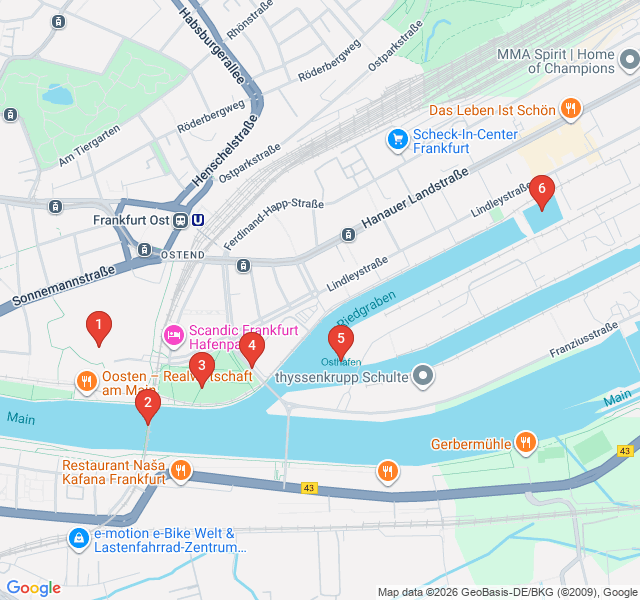
Numbers indicate the order of stops on the tour
The journey begins at the European Central Bank, a landmark that defines the Frankfurt skyline. This site is a masterclass in architectural fusion. The architects, Coop Himmelb(l)au, integrated the historic Grossmarkthalle—a massive brick market hall built in 1928—with a modern, deconstructivist twin tower. For decades, this was the city’s primary hub for the fruit and vegetable trade. Today, it serves as the financial nerve center for the Eurozone. Notice how the glass towers appear to twist as they rise, reflecting the sky and the river. This building signaled the beginning of the Ostend’s massive revitalization, turning a former industrial fringe into a symbol of global power. While the interior is highly secure, the exterior provides a fascinating study in how old and new can coexist.
Step onto the Deutschherrnbrücke, a railway bridge that offers one of the most iconic views of Frankfurt. Built in the early 20th century, this steel structure carries trains across the Main, connecting the south side of the city to the Ostend. As you walk the pedestrian path, look back toward the city center. You’ll see the 'Mainhattan' skyline framed by the bridge’s industrial iron arches. It is a favorite spot for photographers, especially at sunset when the light hits the glass towers. The bridge serves as a physical link between the city’s historic core and its industrial roots, and it’s a perfect place to feel the rhythmic pulse of the city as trains rumble overhead.
Descend from the bridge into Hafenpark, a sprawling urban space that celebrates concrete and movement. This isn't your typical green park; it’s a 'movement landscape' designed for skaters, climbers, and athletes. The design mirrors the industrial aesthetic of the surrounding harbor, using raw materials and bold geometric shapes. On any given day, the park is alive with energy, reflecting the youthful, international spirit of the modern Ostend. It represents a shift in urban planning, where formerly derelict industrial land is reclaimed for public recreation. Take a moment to watch the skaters or simply enjoy the open space that provides a rare, unobstructed view of the ECB tower and the riverfront.
Located directly under the arches of the Honsellbrücke, the Kunstverein Familie Montez is the creative heart of the district. This independent art association moved into this vaulted concrete space, turning a dark underpass into a vibrant gallery and cultural hub. The art here is as eclectic as the neighborhood itself, often featuring local artists and experimental installations. Please note that the murals and exhibitions here change frequently, as this is a living canvas for the city’s street art scene. The contrast between the heavy industrial bridge above and the delicate, often provocative art within is a hallmark of the Ostend’s 'Industrial Chic' vibe. It’s an essential stop for anyone wanting to see Frankfurt’s alternative side.
Walking further east, you enter the Osthafen, or East Harbor. Unlike many European harbor districts that have been fully gentrified into luxury apartments, the Osthafen remains a working port. You will see massive cranes, stacks of shipping containers, and industrial warehouses. This area provides a raw, unpolished look at the logistics that keep Frankfurt running. The architecture here is functional and rugged, characterized by brick, steel, and weathered concrete. It is a reminder that despite the nearby bank towers, Frankfurt remains a city of trade and industry. The scale of the machinery and the expansive views of the water basins offer a unique, cinematic perspective on the city’s maritime heritage.
The walk concludes at Schwedlersee, a hidden gem tucked away in the industrial landscape. Originally a basin for the harbor, it was eventually separated and became a private swimming club in the early 20th century. Today, it feels like a secret garden surrounded by industry. Tall trees and ivy-covered walls shield this small lake from the noise of the city. While the water is usually reserved for club members, the surrounding area and nearby bistro offer a peaceful, nostalgic atmosphere. It is the perfect place to reflect on the Ostend’s evolution—from a busy industrial port to a place where nature and creativity are finding ways to thrive in the gaps of the urban fabric.
Download Zigway to experience "Ostend Evolution: Street Art and Industrial Chic" with AI-powered audio narration. Walk at your own pace while stories unfold around you.
 Easy
EasyFrankfurt, Germany
Walk the path of emperors through Frankfurt's Altstadt on this self-guided history stroll from the Cathedral to the Römerberg.
 Easy
EasyFrankfurt, Germany
Explore Frankfurt’s world-class Museum Embankment at your own pace, from the iconic Städel Museum to the scenic banks of the Main River.
 Moderate
Frankfurt, Germany
Discover the profound legacy of Jewish Frankfurt, from medieval ghetto ruins to the childhood home of Anne Frank, on this self-guided walking route.
 Moderate
Frankfurt, Germany
Step back in time to explore Frankfurt’s best-kept secret: a medieval old town featuring ancient churches, Baroque palaces, and a historic castle.
 Easy
EasyKrakow, Poland
Discover Krakow’s creative soul in Zabłocie, exploring industrial heritage, contemporary art museums, and avant-garde architecture at your own pace.
 Moderate
Gdansk, Poland
Discover the bohemian soul of Gdańsk. Explore the literary landmarks of Günter Grass, Prussian villas, and the trendy cafes of historic Wrzeszcz.
 Moderate
Gdansk, Poland
Discover the raw beauty of Gdansk’s Lower Town. Explore industrial ruins, hidden sluices, and riverside bastions on this self-guided walk.
 Moderate
Gdansk, Poland
Discover Zaspa, a massive open-air gallery where grey housing blocks are transformed by over 60 monumental murals. Explore at your own pace.
 Easy
EasyBerlin, Germany
Explore the sites of Nazi power and the memorials that honor its victims on this self-guided walk through Berlin's historic Wilhelmstraße district.
 Moderate
Berlin, Germany
Explore Berlin’s 'Green Heart' on a self-guided walk through royal history, Cold War memorials, and serene lakeside gardens.
 Moderate
Berlin, Germany
Discover the legacy of the Berlin Wall on this self-guided walk from historic ghost stations to the vibrant street art and cafes of Mauerpark.
 Easy
EasyBerlin, Germany
Discover the soul of 1920s Berlin on a self-guided walk through Charlottenburg’s iconic literary cafes, historic theaters, and artistic landmarks.
