While many travelers flock to Verona for the tragic tale of Romeo and Juliet, the city holds a much more formidable secret within its massive stone embrace. For centuries, Verona was one of Europe's most fortified cities, serving as a linchpin in the 'Quadrilateral' defense system of the Austrian Empire. This self-guided walk invites you to step away from the crowded piazzas and explore the 'Austrian Fortress,' a monumental circuit of walls, bastions, and gates that redefined the city's skyline in the 19th century. On this neighborhood stroll, you will discover how the visionary architect Michele Sanmicheli laid the Renaissance foundations that the Austrian military later transformed into a sprawling urban fortress. This walking route is not just a lesson in military history; it is a journey through the evolution of European architecture. You will encounter the neoclassical elegance of Porta Nuova and the rugged, functional beauty of Porta Palio, which many consider a masterpiece of the Mannerist style. As you follow the path of the Adige River and climb toward the heights of the city, the scale of the defensive works becomes clear. The route takes you to the San Bernardino Bastion, where the transition from medieval walls to modern artillery defenses is most visible. A highlight of this exploration is the ascent to Castel San Pietro. While once a site of stern military barracks, it now offers the most iconic panoramic view of the city. This self-guided adventure concludes at Porta Vescovo, the eastern gate that witnessed the final years of Austrian rule before Verona joined the Kingdom of Italy. Perfect for history buffs and those seeking a more challenging trek, this walking tour Verona provides a unique perspective on how conflict and conquest shaped the 'City of Love.' By following this audio walk, you can explore independently and uncover the layers of history that many visitors overlook.
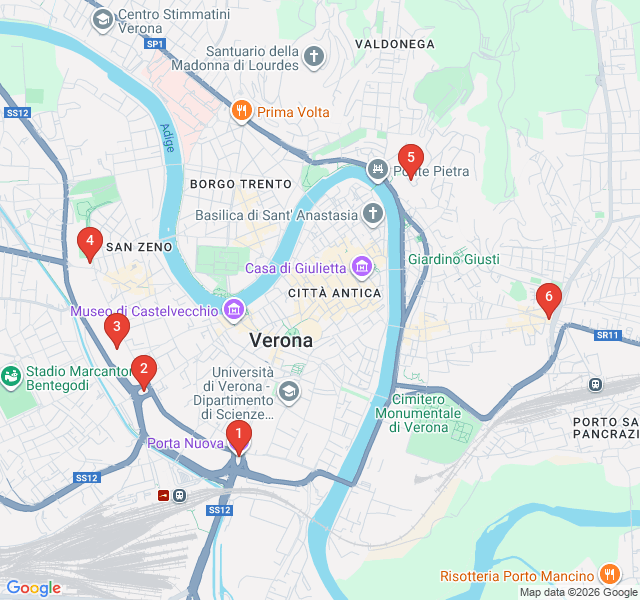
Numbers indicate the order of stops on the tour
Welcome to the monumental entrance to Verona. Porta Nuova was originally designed between 1532 and 1540 by the renowned Veronese architect Michele Sanmicheli. Look closely at the central arch; its classical inspiration was meant to signal Verona's importance within the Venetian Republic. However, what you see today is a hybrid. When the Austrians took control of Verona in the 19th century, they realized the gate was too narrow for modern military needs. They extensively remodeled it, adding the side arches and reinforcing the structure to withstand artillery. It stands as a perfect introduction to our theme: the blending of Italian Renaissance aesthetics with stern Austrian military pragmatism.
Continuing along the ring road, we reach Porta Palio, widely considered Sanmicheli's architectural masterpiece. Unlike the more functional gates you might see elsewhere, Porta Palio is a triumph of the Mannerist style. Notice the use of the Doric order and the textured, rusticated stone that gives it a look of both elegance and indestructible strength. It was named after the 'Palio del Drappo Verde,' an ancient horse race that used to pass through here. While the Austrians maintained it, they were so impressed by its design that they largely left its outward appearance intact, focusing their defensive upgrades on the surrounding earthen ramparts.
Step into the green space surrounding the San Bernardino Bastion. This is where the 'fortress' aspect of Verona becomes tangible. A bastion is a projecting part of a fortification built at an angle to the line of a wall, allowing defensive fire in several directions. The Austrians transformed these Renaissance bastions into sophisticated 'detached forts.' Today, these areas serve as a public park, but if you look at the thickness of the walls and the positioning of the embankments, you can imagine the sheer firepower once stationed here. It reflects the 19th-century shift toward 'active defense,' where the walls were not just barriers but platforms for long-range cannons.
Porta San Zeno is perhaps the most picturesque of the city gates. Completed in 1542, it served as the gateway for travelers coming from the north and the lake district. Architecturally, it differs from Porta Nuova and Porta Palio by utilizing brick alongside stone, creating a warmer, more decorative appearance. The Austrians integrated this gate into their defensive line, but its proximity to the Basilica of San Zeno meant it retained a more civic and religious importance. Look for the Venetian Lion of Saint Mark, a symbol of the city's previous rulers, which was often removed or defaced during various occupations but remains here as a testament to Verona's long history.
We now ascend to the highest point of our walking route. Castel San Pietro is not a medieval castle in the traditional sense, but rather a massive Austrian barracks built on a site that has been fortified since Roman times. After Napoleon's troops destroyed the previous fortifications, the Austrians, under Field Marshal Radetzky, built this imposing structure between 1852 and 1858. It was designed to house a large garrison that could keep watch over the city and the river. While the building itself is currently not open for interior tours, the terrace offers the definitive view of Verona. From here, you can see how the Adige River forms a natural moat around the historic center.
Our journey concludes at Porta Vescovo, the 'Bishop's Gate.' This gate marked the eastern entrance to the city and was of vital strategic importance for the Austrian military, as it sat near the railway line and the road to Vicenza. The Austrians completely rebuilt the exterior facade in a neo-Romanesque style, making it look more like a medieval fortress than a Renaissance gate. This was a deliberate choice to project power and permanence. This gate saw some of the most intense military activity during the Italian Wars of Independence. Today, it stands as a silent sentinel, marking the end of the defensive circuit that once made Verona an impregnable imperial stronghold.
Download Zigway to experience "The Austrian Fortress: Walls and Gates" with AI-powered audio narration. Walk at your own pace while stories unfold around you.
 Moderate
Verona, Italy
Explore Verona’s most magnificent cathedrals and basilicas on this self-guided walk through the city's artistic and spiritual heart.
 Easy
EasyVerona, Italy
Explore the romantic streets of Verona on this self-guided walk through the history and legends that inspired Shakespeare’s Romeo and Juliet.
 Easy
EasyVerona, Italy
Discover the flavors of Verona on this self-guided walk through historic wine cellars, vibrant markets, and the city's most iconic culinary landmarks.
 Easy
EasyVerona, Italy
Savor Verona's vibrant aperitivo culture on this self-guided stroll through historic squares and charming wine bars. Discover the city's heartbeat.
 Easy
EasyGothenburg, Sweden
Explore Gothenburg’s historic wooden houses, legendary giant cinnamon buns, and panoramic fortress views on this self-guided neighborhood stroll.
 Easy
EasyNairobi, Kenya
Discover Nairobi's iconic skyline on this self-guided architecture walk through the CBD’s most famous modernist and Brutalist landmarks.
 Moderate
Vienna, Austria
Discover the noir world of The Third Man and Cold War Vienna on this atmospheric self-guided audio walk through the historic Innere Stadt.
 Moderate
Nairobi, Kenya
Discover the pulse of Nairobi's contemporary art scene on this self-guided walk through the galleries and creative spaces of Kilimani.
 Easy
EasyRome, Italy
Explore Rome’s industrial heart on this self-guided walk featuring massive murals, the 'Iron Colosseum,' and unique industrial archaeology.
 Easy
EasyRome, Italy
Explore Rome’s whimsical Fairytale District. A self-guided walk through Art Nouveau palaces, mythical fountains, and the magical Coppedè architecture.
 Moderate
Rome, Italy
Uncover Rome's hidden history on this self-guided walk through ancient gladiator pits, subterranean temples, and buried Roman houses.
 Challenging
Rome, Italy
Walk the 'Queen of Roads.' Explore ancient catacombs, imperial villas, and historic basalt stones on this scenic self-guided Roman adventure.
