Milan is often celebrated as Italy’s capital of fashion and finance, but beneath its sleek, modern exterior lies the profound legacy of the Renaissance. This self-guided walk invites you to step back into the late 15th century, a transformative era when Leonardo da Vinci called this city home for nearly twenty years. By following this walking route through the elegant Magenta neighborhood and the historic center, you will uncover the artistic and scientific footprint left by the ultimate Renaissance man. The journey begins in the heart of the city, where Leonardo’s presence is commemorated in stone, before leading you toward the halls of power and the quiet cloisters where he produced his most famous works. As you explore independently, you will encounter the Pinacoteca Ambrosiana, a treasure trove of intellectual history that houses the world’s largest collection of Leonardo’s drawings and notes. The path then winds toward the 'Sistine Chapel of Milan,' a hidden gem of frescoed beauty that showcases the influence Leonardo had on his contemporaries. No exploration of this era is complete without visiting the Sforzesco Castle, the massive fortress where Leonardo served as a court engineer, architect, and artist for the Sforza dukes. The final leg of this neighborhood stroll takes you into the Magenta district, home to the UNESCO-listed Basilica di Santa Maria delle Grazie. While the area is famous for housing 'The Last Supper,' the surrounding streets and gardens, such as the hidden vineyard at Casa Atellani, offer a more intimate look at Leonardo’s personal life in Milan. This walking tour Milan provides the flexibility to linger at a museum or enjoy an espresso in a historic plaza, allowing the stories of the Italian Renaissance to unfold at your own pace. Whether you are an art aficionado or a curious traveler, this route reveals how Leonardo’s genius helped shape the skyline and the soul of Milan.
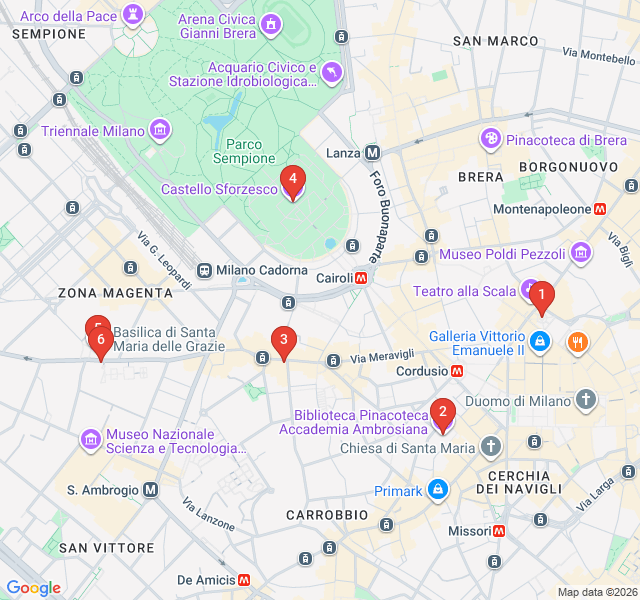
Numbers indicate the order of stops on the tour
Standing in the center of Piazza della Scala, you are greeted by the stern yet contemplative gaze of Leonardo da Vinci. This marble monument, unveiled in 1872, honors the master’s nearly two-decade residence in Milan. Leonardo is depicted at the top, surrounded by four of his most prominent pupils: Giovanni Antonio Boltraffio, Marco d'Oggiono, Cesare da Sesto, and Andrea Salaino. Notice the bas-reliefs on the pedestal, which illustrate Leonardo’s diverse talents as a painter, sculptor, engineer, and architect. This square serves as a bridge between Milan’s musical history, represented by the La Scala opera house, and its intellectual past. Take a moment to appreciate the symmetry of the square before we head toward the library that guards his most precious thoughts.
The Pinacoteca Ambrosiana is more than just an art gallery; it is a monument to human knowledge. Founded in 1618 by Cardinal Federico Borromeo, it is one of the oldest public libraries in the world. Its greatest treasure is the Codex Atlanticus, a twelve-volume set of drawings and writings by Leonardo da Vinci. Within these pages, you can see his sketches for flying machines, hydraulic pumps, and weapons of war, alongside his iconic mirror-writing. The gallery also houses Leonardo’s 'Portrait of a Musician,' his only known male portrait. The hushed, scholarly atmosphere here reflects the Renaissance ideal of the 'universal man.' As you walk through the halls, consider how Leonardo’s curiosity bridged the gap between art and science.
Often called the 'Sistine Chapel of Milan,' this church is a breathtaking explosion of Renaissance color. While Leonardo didn't paint these walls himself, the influence of his style—known as Leonardismo—is evident in every brushstroke. The frescoes were largely executed by Bernardino Luini, who worked closely with Leonardo's artistic legacy. The church is uniquely divided by a central wall, originally intended to separate the public from the cloistered nuns of the Monastero Maggiore. As you wander between the two halves, look for the vivid depictions of biblical scenes and the portraits of the Bentivoglio family. The preservation of these 16th-century paintings is remarkable, offering a window into the spiritual and artistic devotion of Renaissance Milan.
This massive red-brick fortress was the seat of the Sforza Dukes, the powerful family that brought Leonardo to Milan. Originally built as a defensive structure, it was transformed into a magnificent Renaissance court. Leonardo worked here for years, not just as an artist, but as a military engineer designing fortifications and a master of ceremonies for courtly festivals. His most direct contribution is the 'Sala delle Asse,' a room decorated with a complex canopy of interwoven mulberry trees, symbolizing the Duke’s wisdom. Even from the courtyards, you can feel the scale of ambition that defined the Sforza era. The castle today serves as a cultural hub, housing several museums that continue to celebrate Milan’s artistic heritage.
This UNESCO World Heritage site is a masterpiece of Renaissance architecture, blending the Gothic style of the nave with the magnificent dome added by Donato Bramante. It was intended to be the mausoleum for the Sforza family. While most visitors flock to the adjacent refectory to see 'The Last Supper,' the basilica itself is a testament to the era’s architectural innovation. Leonardo spent countless days here, working on his mural just a few steps away. The interplay of light and geometry in the tribune reflects the Renaissance obsession with harmony and proportion. Take a quiet moment in the cloisters, known as the 'Small Cloister of the Frogs,' to enjoy the same peaceful atmosphere Leonardo might have experienced.
Directly across from Santa Maria delle Grazie lies Casa Atellani, a beautifully restored XV-century palace. This was the home of the Atellani family, courtiers to Duke Ludovico Sforza. In 1498, the Duke gifted Leonardo a vineyard located in the gardens of this house as payment for his work on 'The Last Supper.' It was a rare and cherished possession that Leonardo mentioned in his will. Though the original vines were lost to time, modern DNA testing and replanting efforts have brought Leonardo’s Vineyard back to life. Walking through these gardens offers a rare, personal glimpse into the life of the master, showing that even a genius like Leonardo appreciated the simple pleasure of a quiet garden and a glass of wine.
Download Zigway to experience "Leonardo’s Legacy: Renaissance Wonders in Milan" with AI-powered audio narration. Walk at your own pace while stories unfold around you.
 Moderate
Milan, Italy
Uncover the hidden capital of the Western Roman Empire on this self-guided walk through Milan's ancient ruins and historic Cinque Vie district.
 Moderate
Milan, Italy
Uncover Milan's dark past on this self-guided walk through plague hospitals, execution grounds, and bone-lined chapels.
 Moderate
Milan, Italy
Explore Milan's historic waterways and ancient basilicas on this self-guided stroll through the vibrant and historic Navigli district.
 Moderate
Milan, Italy
Explore Milan’s creative heart on this self-guided walk through Isola’s vibrant murals, modern architecture, and hidden industrial history.
 Moderate
Warsaw, Poland
A powerful self-guided walk through Warsaw's WWII history, tracking the 1944 Uprising from ruined skyscrapers to solemn memorials.
 Moderate
Gdansk, Poland
Discover the origins of WWII in Gdansk on this self-guided walk through heroic last stands, massive museums, and strategic hilltop fortifications.
 Moderate
Warsaw, Poland
Explore the resilient spirit of Warsaw's Muranów district on this self-guided walk through the history and landmarks of the former Jewish Ghetto.
 Moderate
Vienna, Austria
Follow the footsteps of Mozart and Strauss through Vienna’s historic center on this self-guided walk through the city's rich musical history.
 Easy
EasyRome, Italy
Explore Rome’s industrial heart on this self-guided walk featuring massive murals, the 'Iron Colosseum,' and unique industrial archaeology.
 Easy
EasyRome, Italy
Explore Rome’s whimsical Fairytale District. A self-guided walk through Art Nouveau palaces, mythical fountains, and the magical Coppedè architecture.
 Moderate
Rome, Italy
Uncover Rome's hidden history on this self-guided walk through ancient gladiator pits, subterranean temples, and buried Roman houses.
 Challenging
Rome, Italy
Walk the 'Queen of Roads.' Explore ancient catacombs, imperial villas, and historic basalt stones on this scenic self-guided Roman adventure.
